We have 68 plots at our allotment site, Bowbrook Allotment Community, and after just three seasons of being open we have a waiting list of about 50. Phase two was on the cards from the word go but with budget constraints we didn’t really think it would ever come to fruition. The plan was to open up the field next to us and create about 50 extra plots.
Meetings with town council representatives and reports in the local newspaper over the last year or so indicated that this might still happen. Then recently the allotment management committee were asked if a few members could meet with representatives from the town and the county councils to look at plans. It seemed that things would be moving ahead in the autumn of 2012.
Budget constraints had effected the plans as the draft map for the new extension showed just 25 plots covering half the field. Still we couldn’t look a gift horse in the mouth! Ideas were exchanged and the proposals will go in for planning permission and hopefully work will be done by the autumn.
So we can halve our waiting list. The plots will be so tightly packed that little space will be available to develop our community gardens but we should gain the pond, a spring and a few yards of stream and a triangle of land beneath a group of mature trees. We shall endeavour to make these exciting places!!
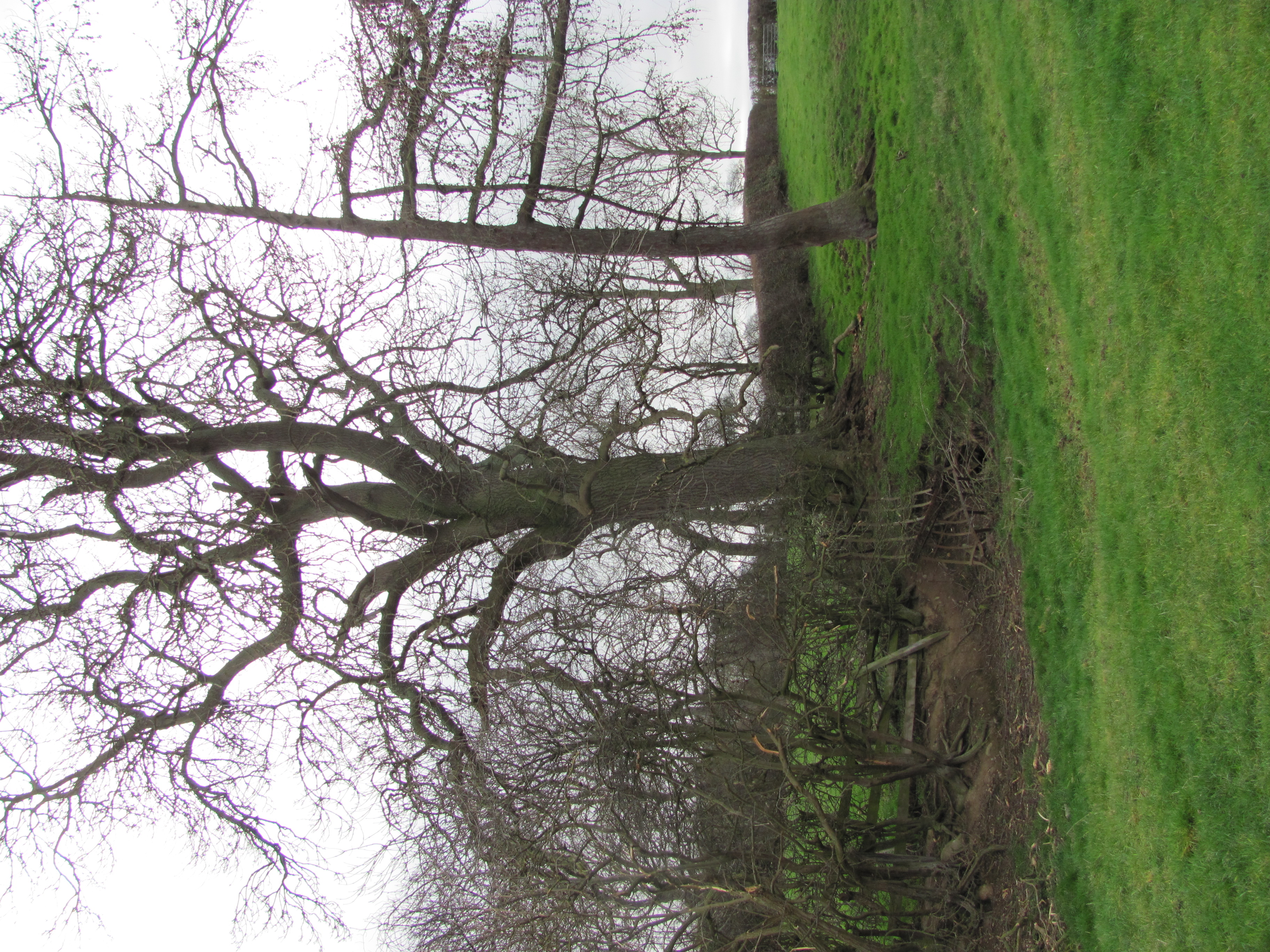
The strip of pastureland that will become our new allotments.The poor neglected pond that will become part of our site.The old Ash tree that will overlook the new allotments.The spring emerging from its old collapsed brickwork. The water table is so low it is currently dry.The mature trees in the corner of land to be developed as part of our community gardens.
So, opportunities are coming our way. The council will tidy out the pond, removing old fences, and other rubbish and hopefully the barbed wire surrounding it. A fence will be built around it with gated access, all conforming with the latest health and safety requirements. The old Ash tree will be attended to by tree surgeons to make it safe and ensure its future health. The 25 plots will be prepared for cultivation.
And then it will be up to new plot holders to cultivate them and the committee to develop the green spaces. the area around the spring could become a bog garden and the area under the mature trees could become a mini-arboretum. We shall see!
This is the third of the garden wandering posts already. Why is this year going so quickly? Could it be that we have had so many days when the weather has been amenable to gardening? So what is happening here in our garden? The bulbs are at last flowering well after such a slow start but in contrast the birds are responding quickly to warmer periods of weather. Robins are nesting in the box on my fishing tackle shed, House Sparrows are using three boxes around the garden, Great Tits are using the box on the summer-house and Blue Tits have started building in the box opposite the front door. They are so busy! Blackbirds are collecting moss from the lawns and dried grass stems from the borders so are nesting somewhere close by. The early morning bird song gets louder and more birds join in the chorus each day.
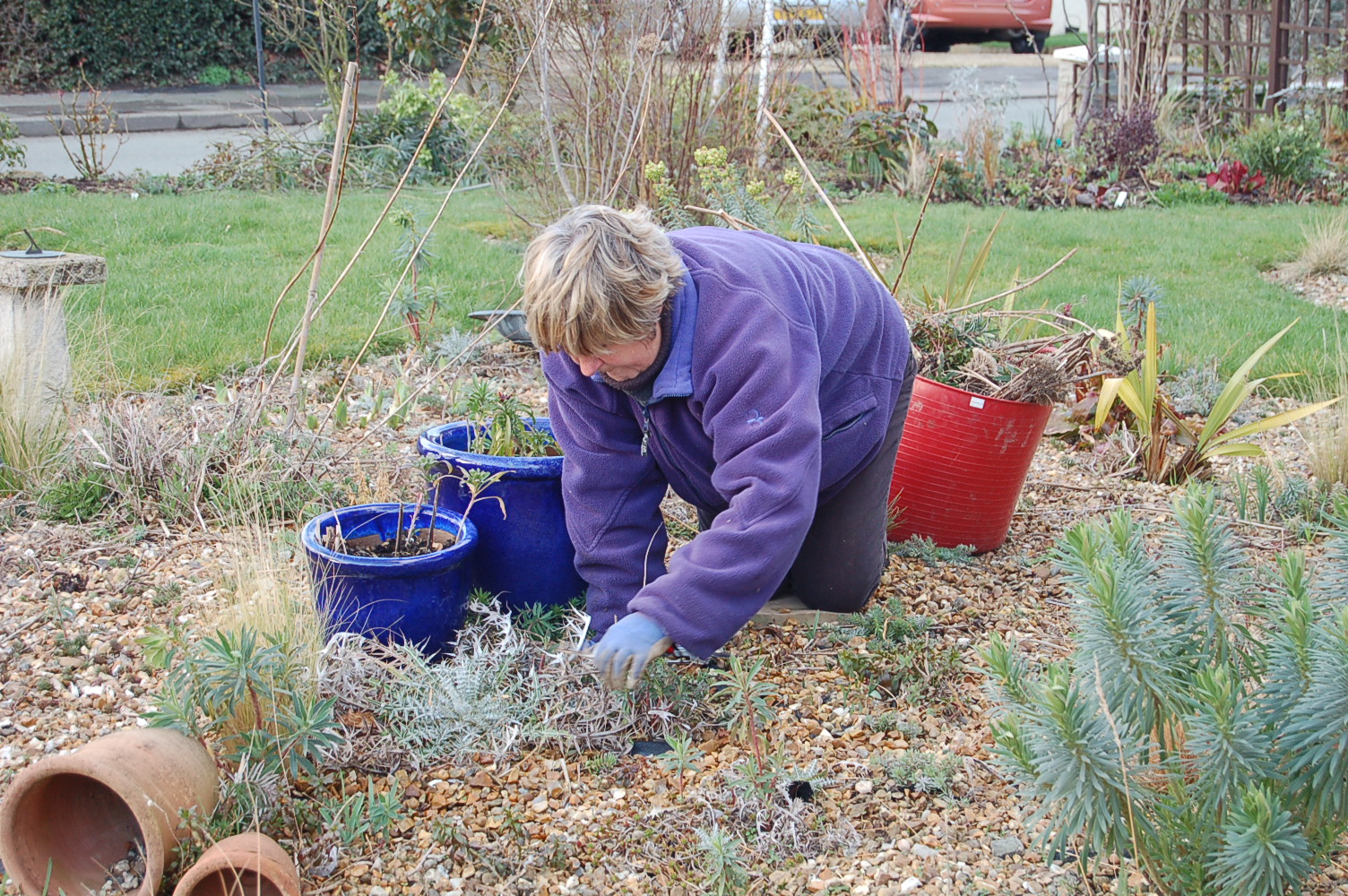
We have spent most sunny days continuing to clear borders, cutting down and adding new mulch. Clearing the “Beth Chatto Garden” is a hands and knees job. Jude the “Undergardener” pulls up weed seedlings by hand. Very tedious but made more enjoyable by the constant song of Blackbirds, Song Thrushes and Robins. Calls of Buzzards high above us provide a good excuse to stop occasionally.
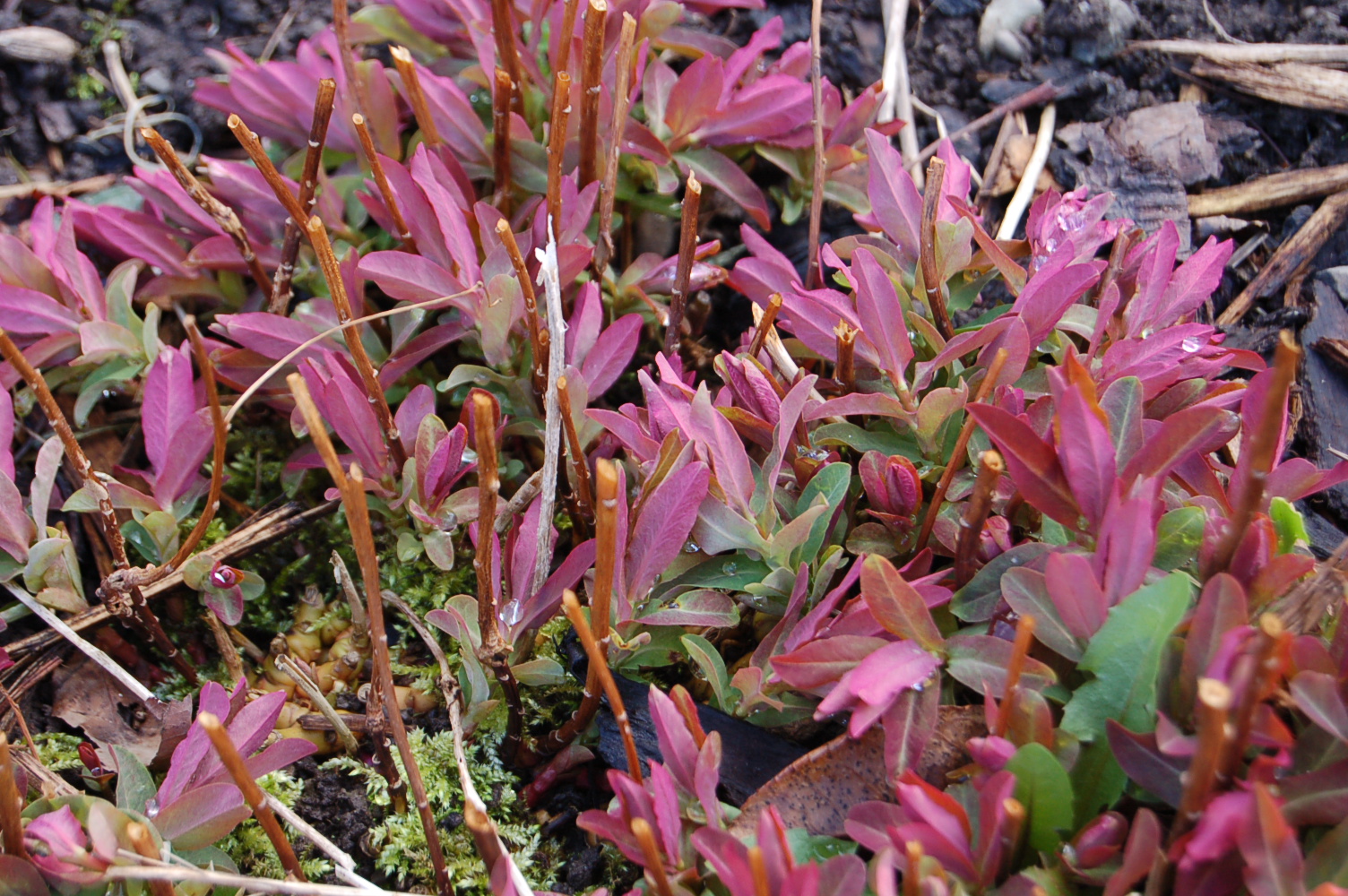
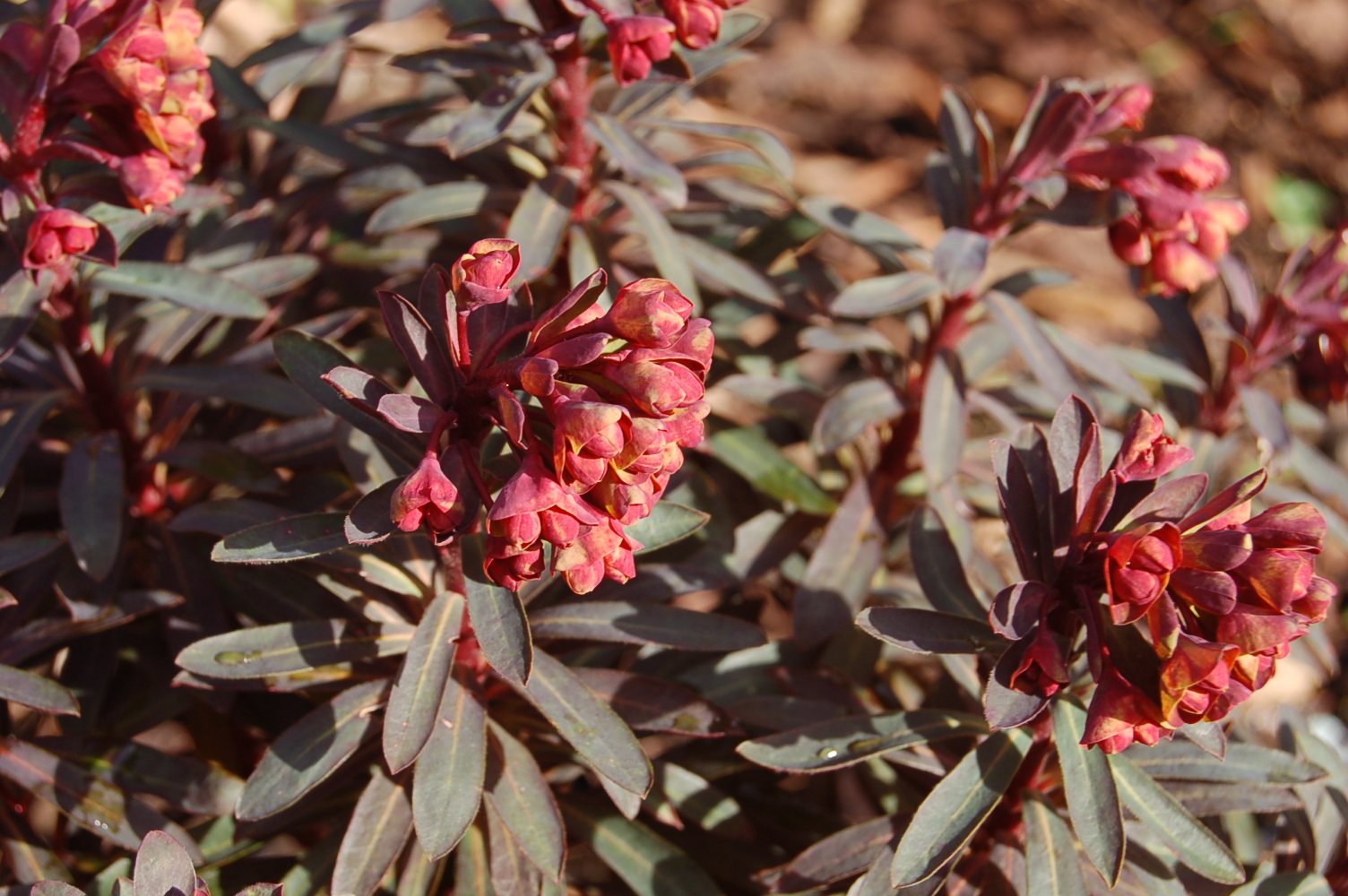
In the front garden Euphorbias are bursting into growth and some have already sent up their flower stalks curling over like shepherds’ crooks. New growth on the later ones is showing bright colours as they emerge from the bark mulch.
The flowering quince at the end of the drive is covered in bright red blooms scattered amongst its thorny angular network of stems – it will flower for months giving a warm welcome to visitors.
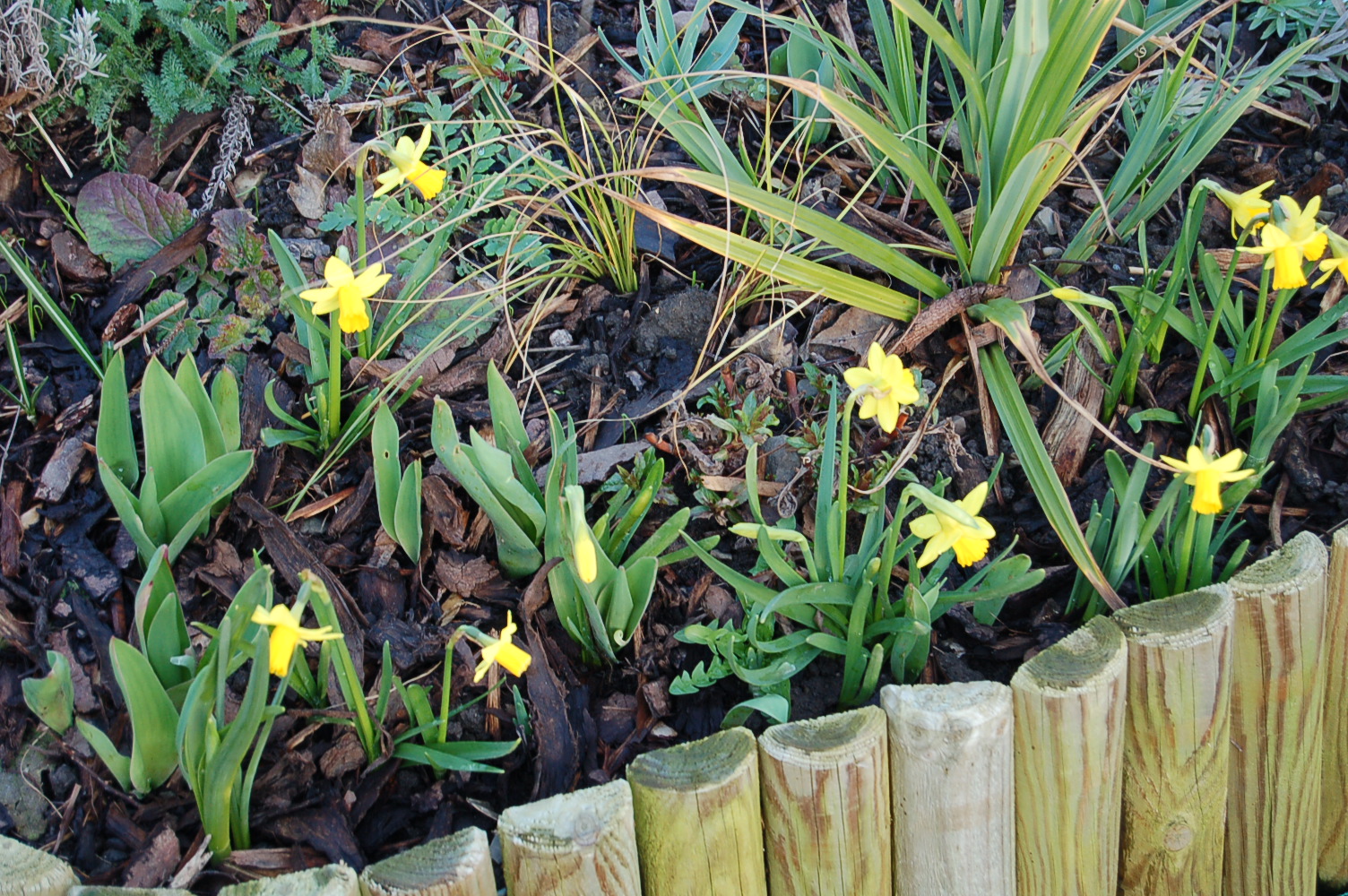
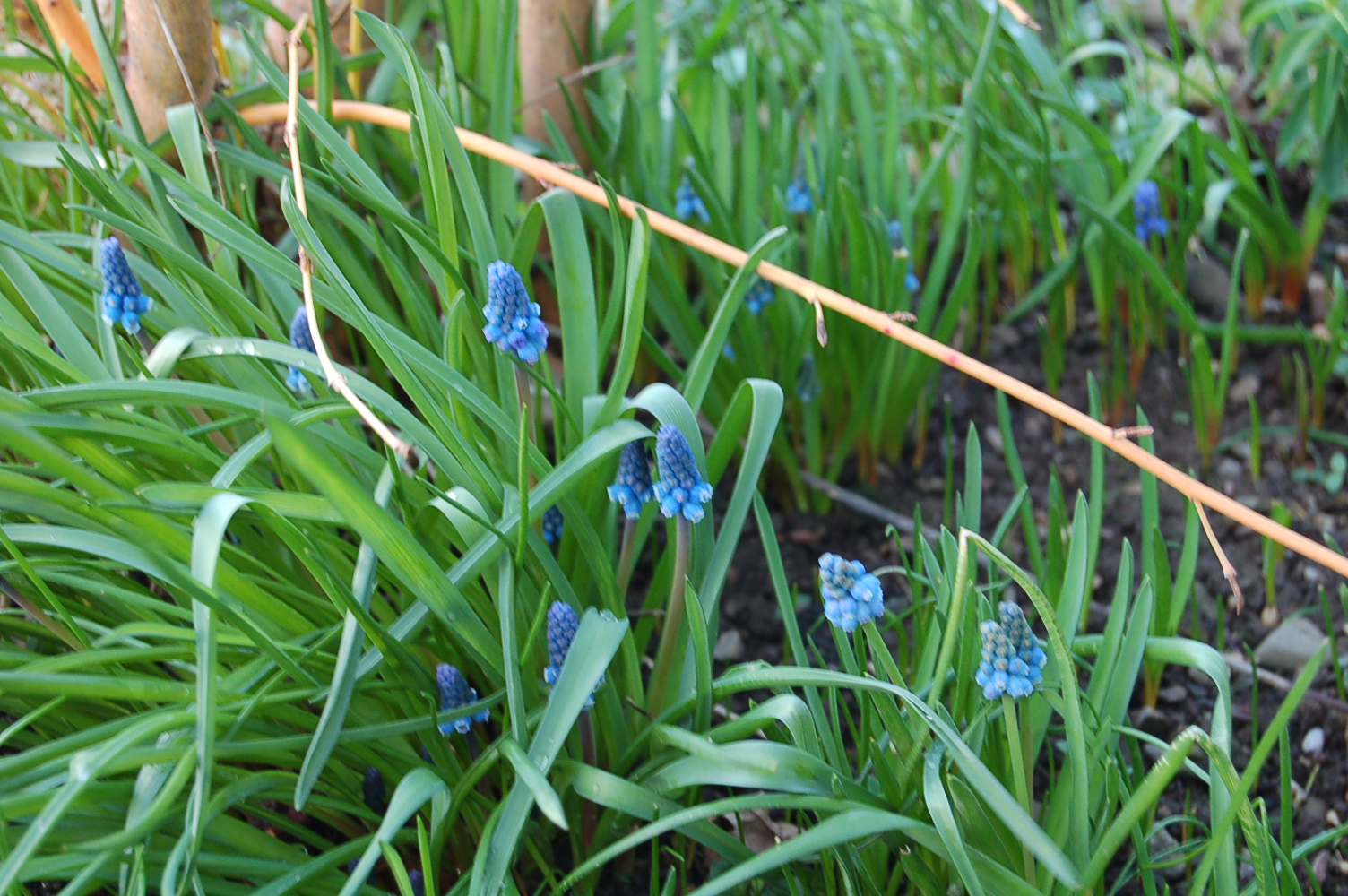
At last our first daffodils are fully in flower! We have waited so long. Muscari are also now bursting into bloom adding their own shade of blue all around the garden.
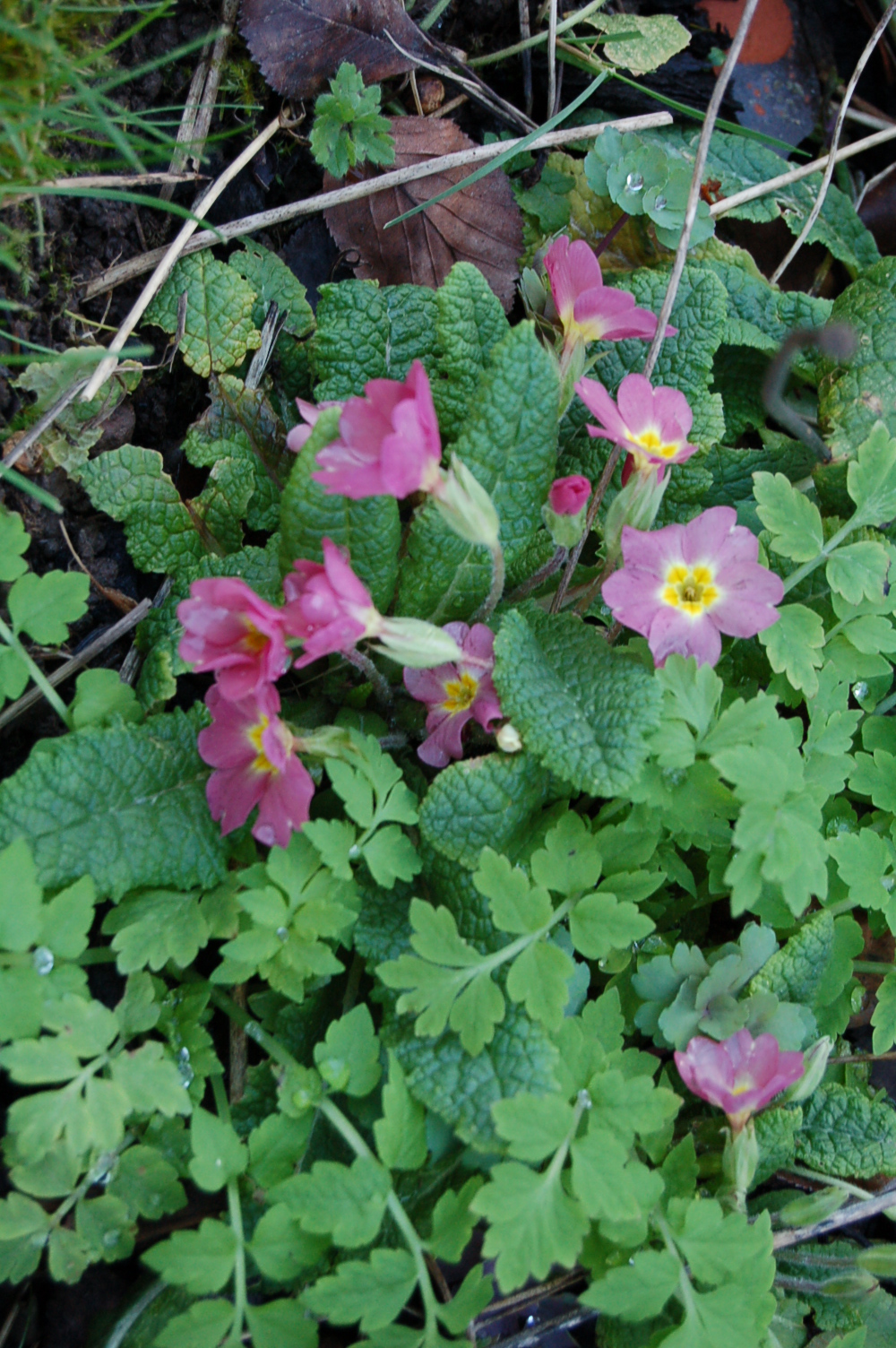
The Primroses we grew from seed a few years ago now give us big clumps of flower in their own special shade of yellow. They are self seeding and spreading around the garden, with an occasional plant producing flowers of an extraordinary shade of greyish pinky. Not sure I like them!
One of the delights of this time of year are the Pulmonarias with their flowers coloured pink and blue on the same plant and their beautifully marked hairy leaves.
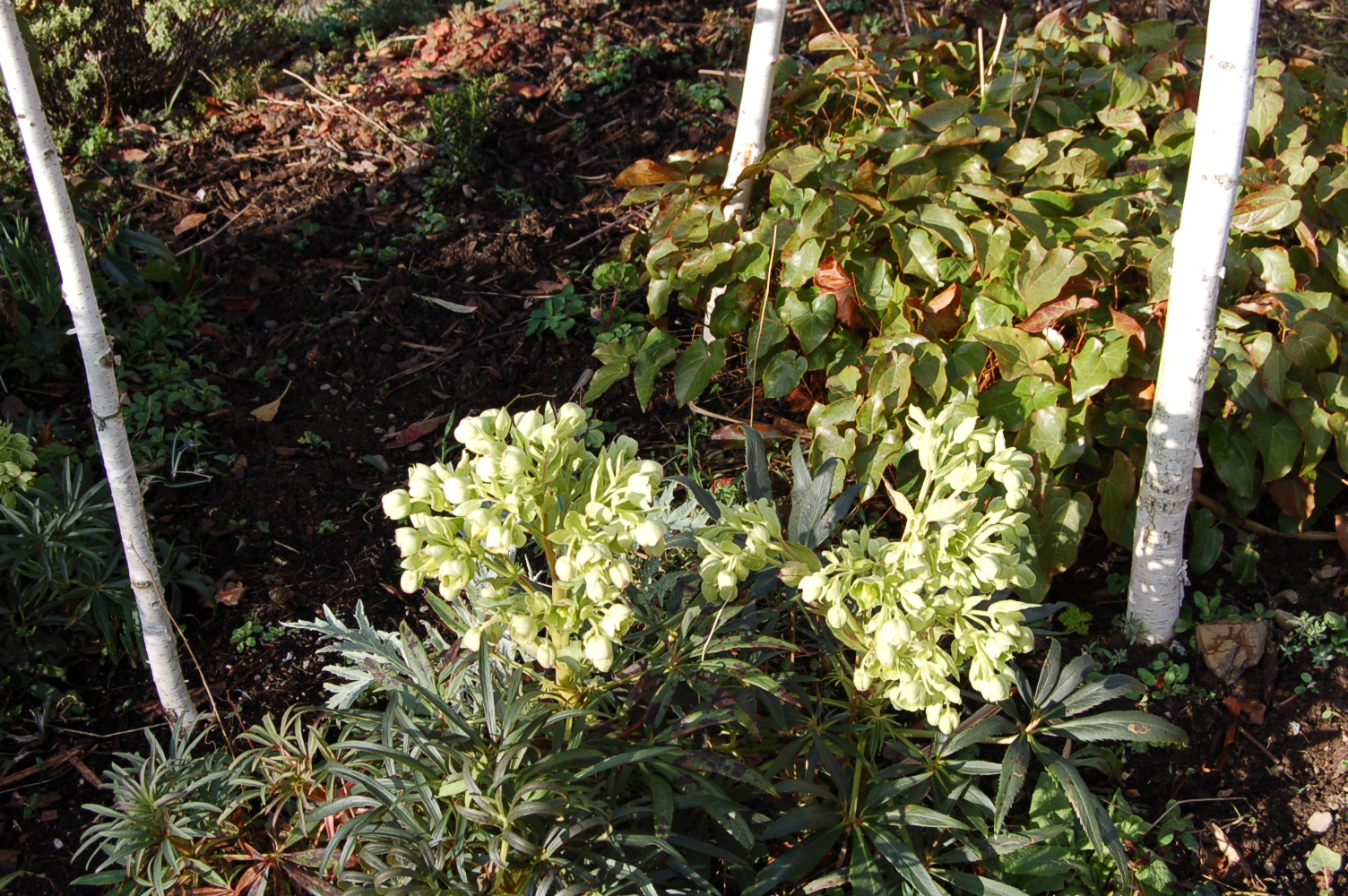
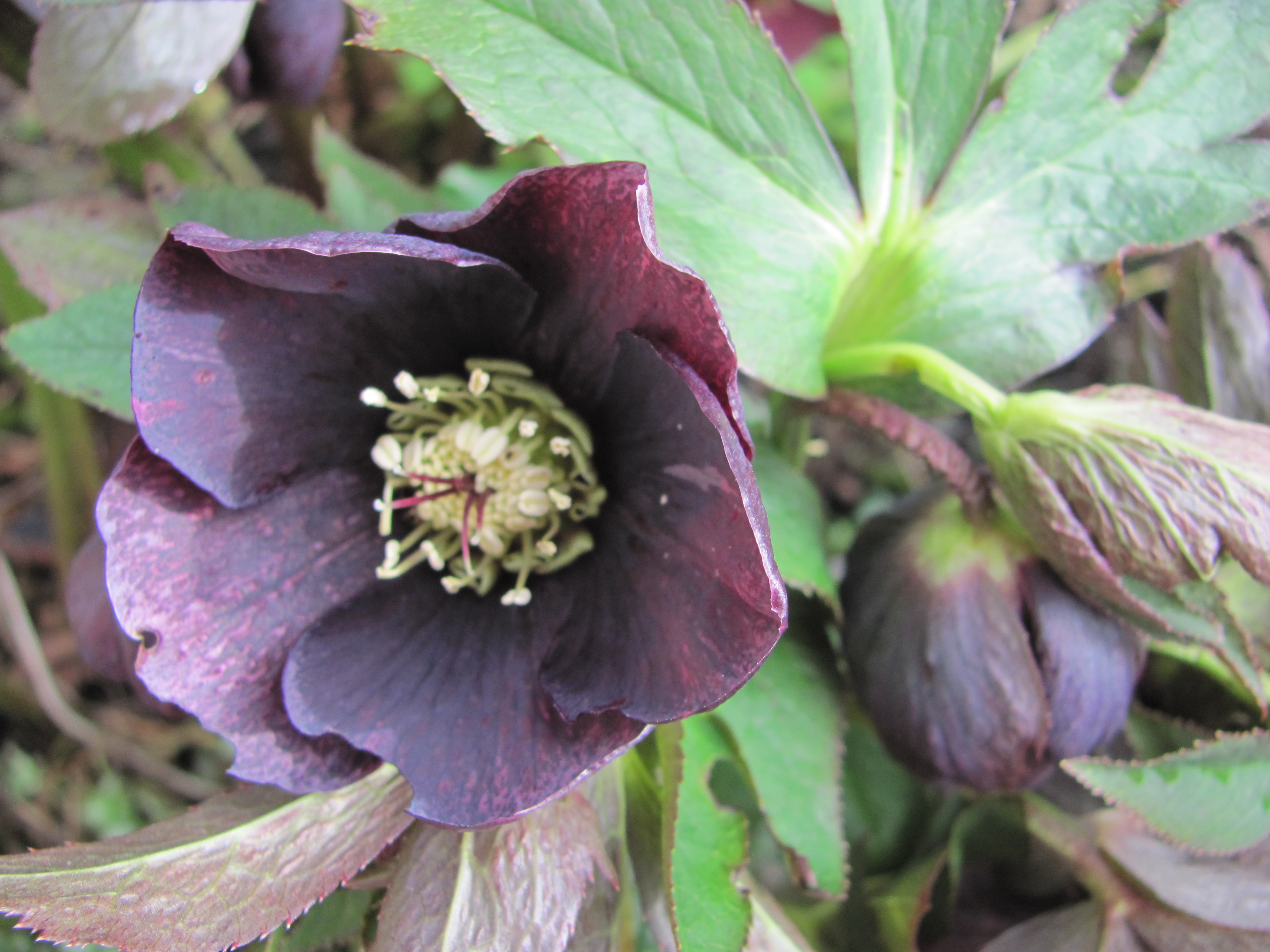
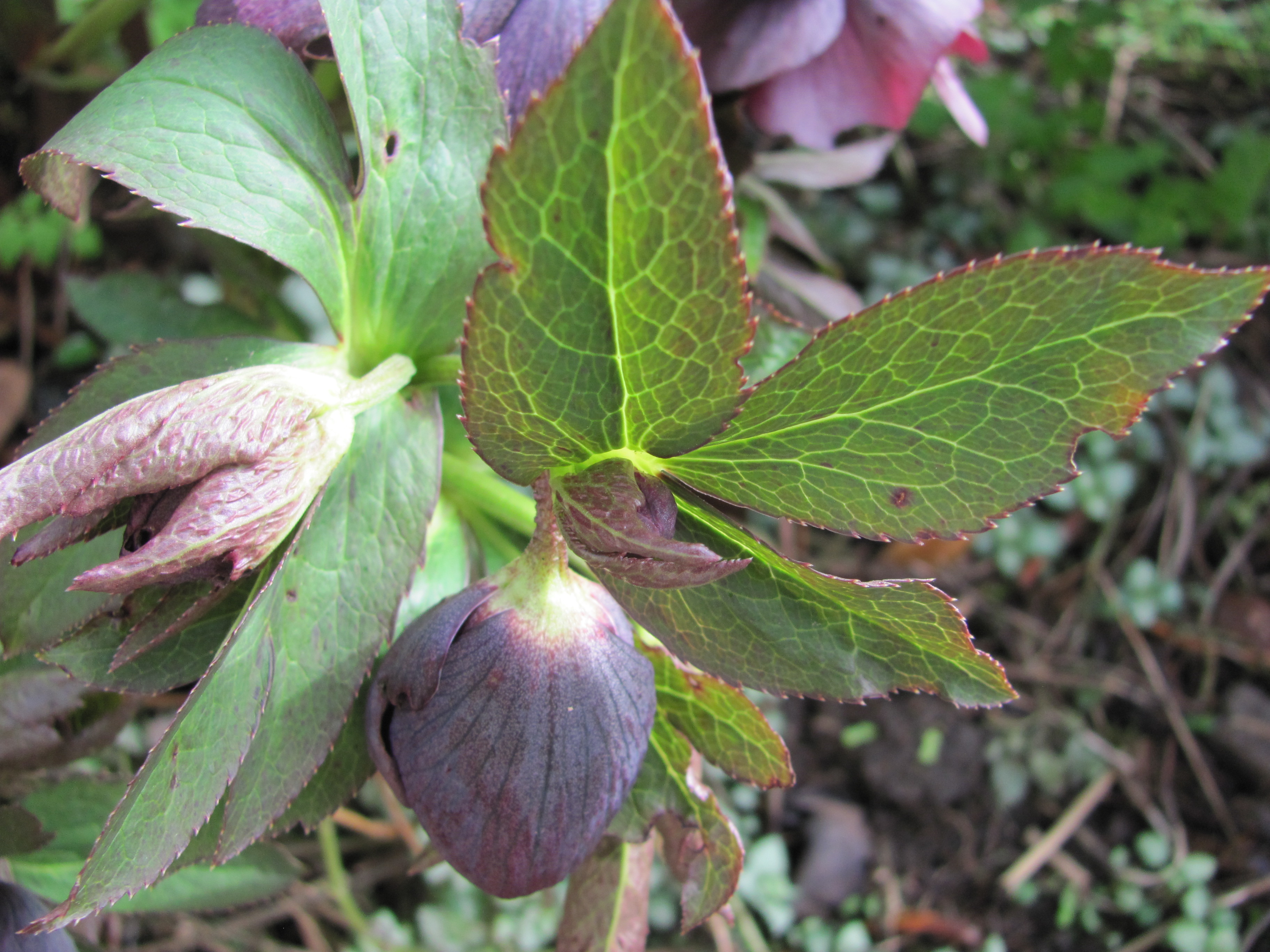
Helleborus have featured in both the January and February garden wanderings and they are still going strong. Two of the last ones to come into flower are this red hybrid and the magnificent near black variety. It looks good in bud and full flower and has the added attraction of interesting foliage. The clump of mixed Hellebores in the “Chicken Garden” give us plenty to look at on coffee breaks when the March sun bursts through and its warmth feels so good on our backs.
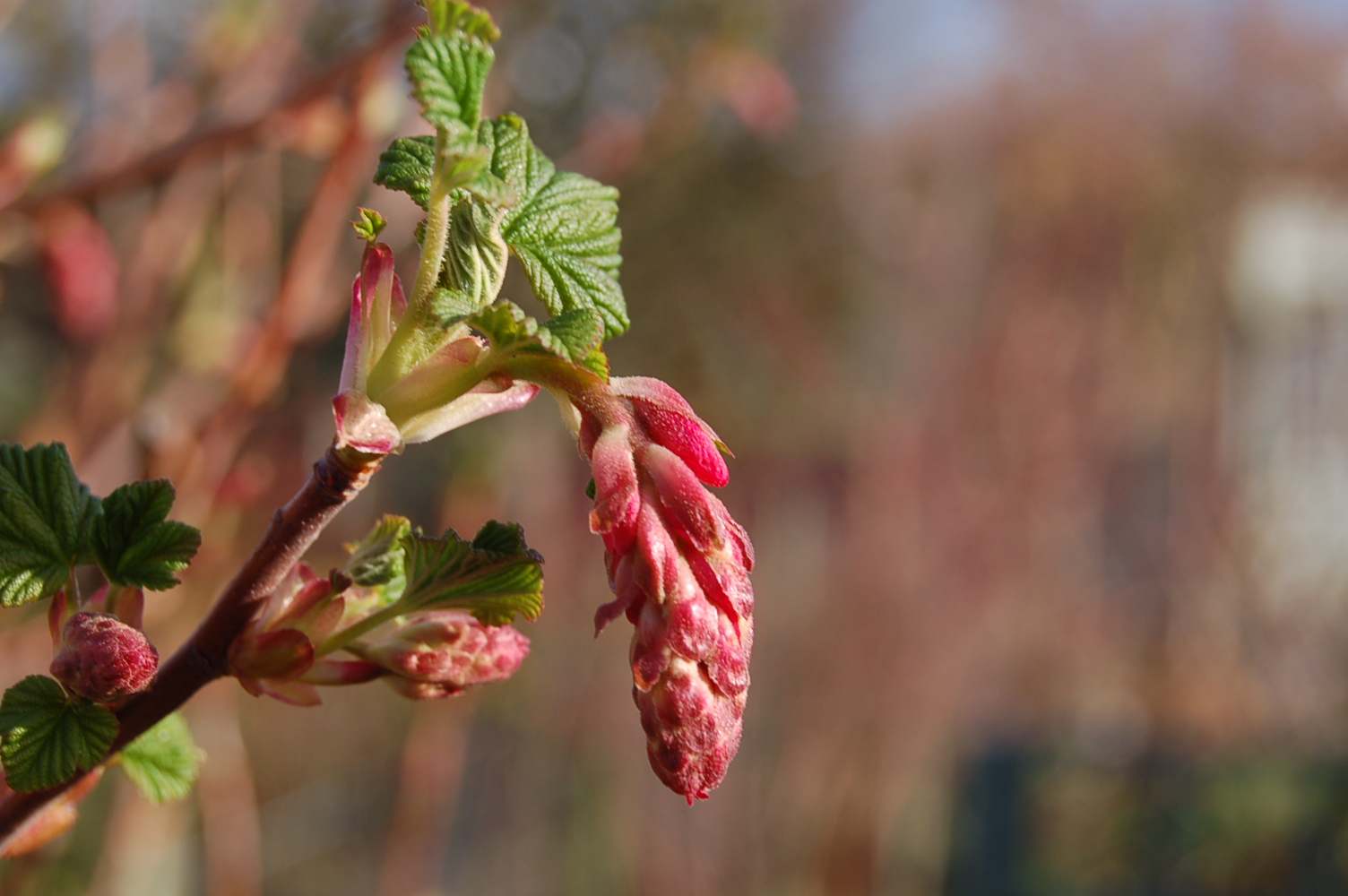
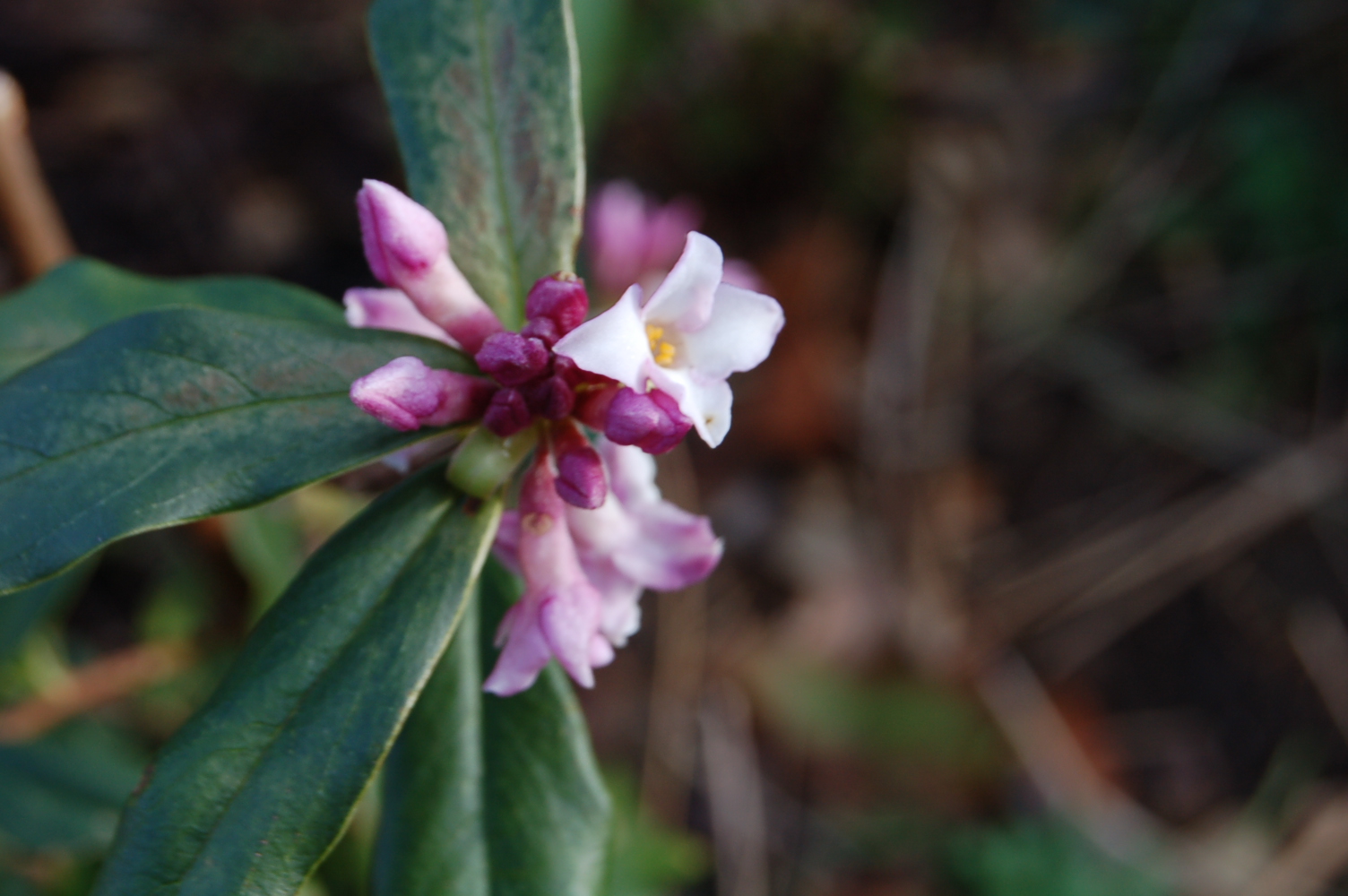
The bees appreciate the early flowering bulbs especially purple crocuses but soon they will be flocking to feed on the Flowering Currant, the exceptionally large flowered variety Ribes sanguineum King Edward VII, which is on the point of bud burst. The buds on the Daphne bhulua “Jacqueline Postill” have opened to reveal highly scented flowers in several shades of pink.
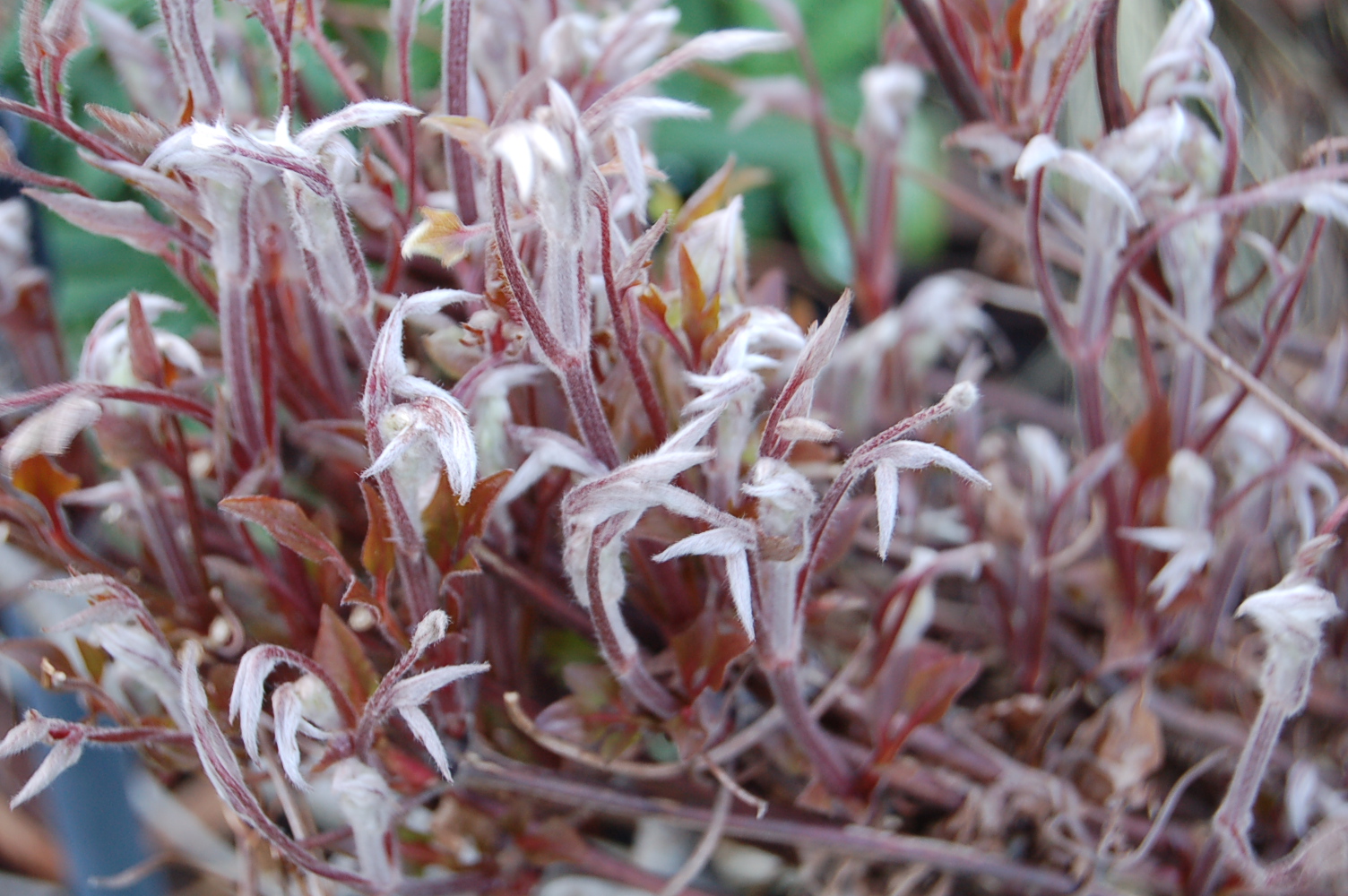
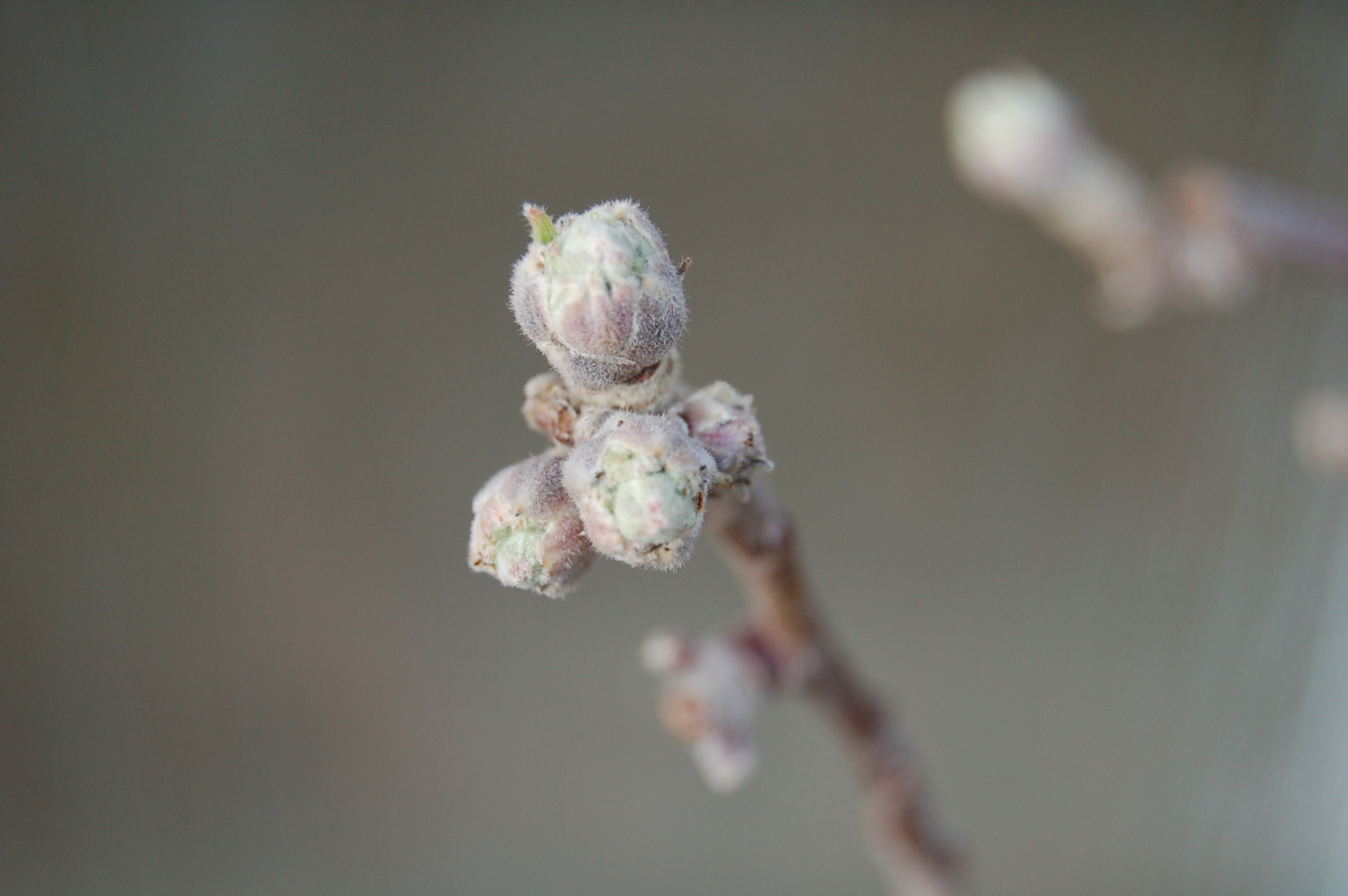
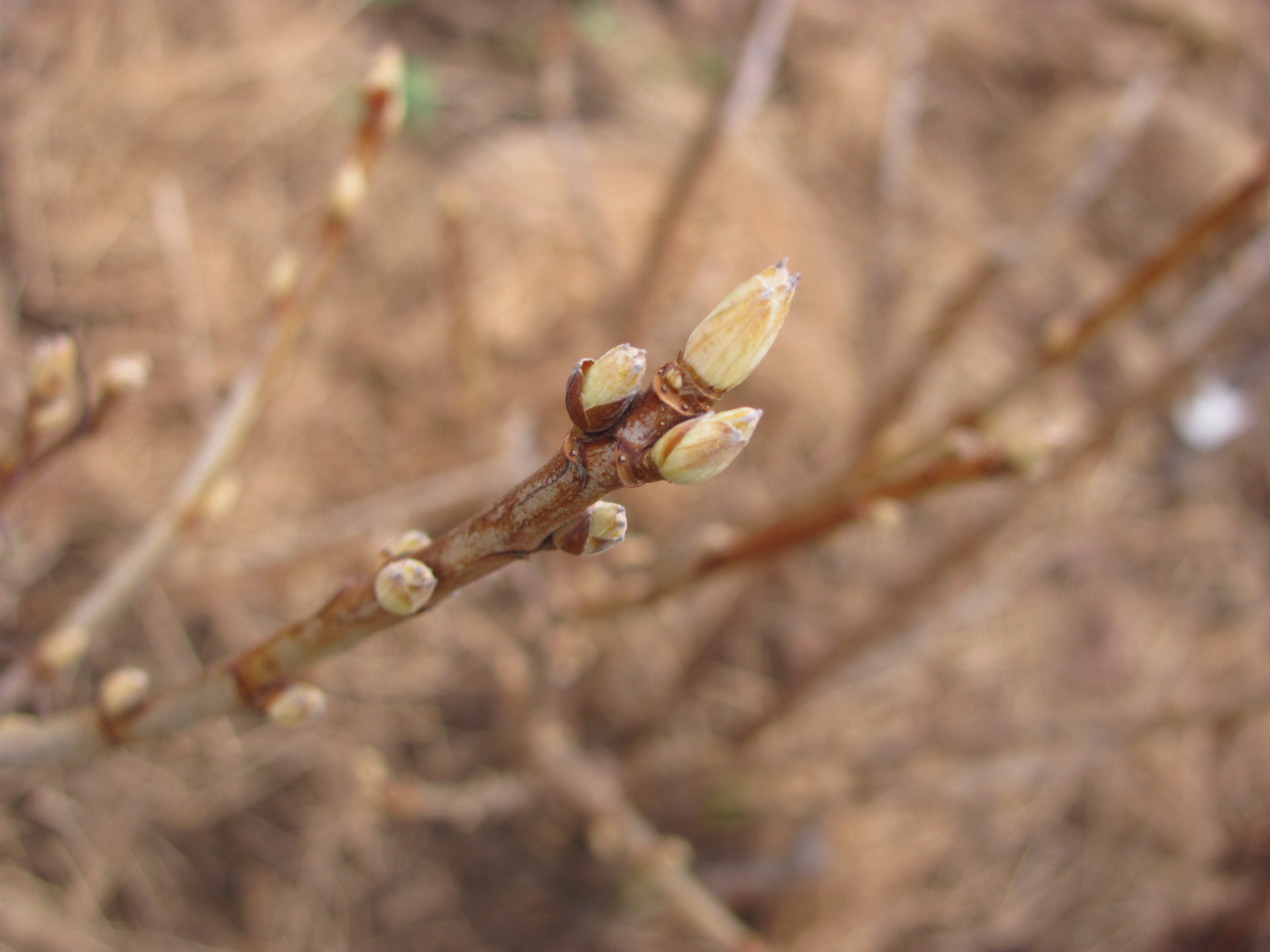
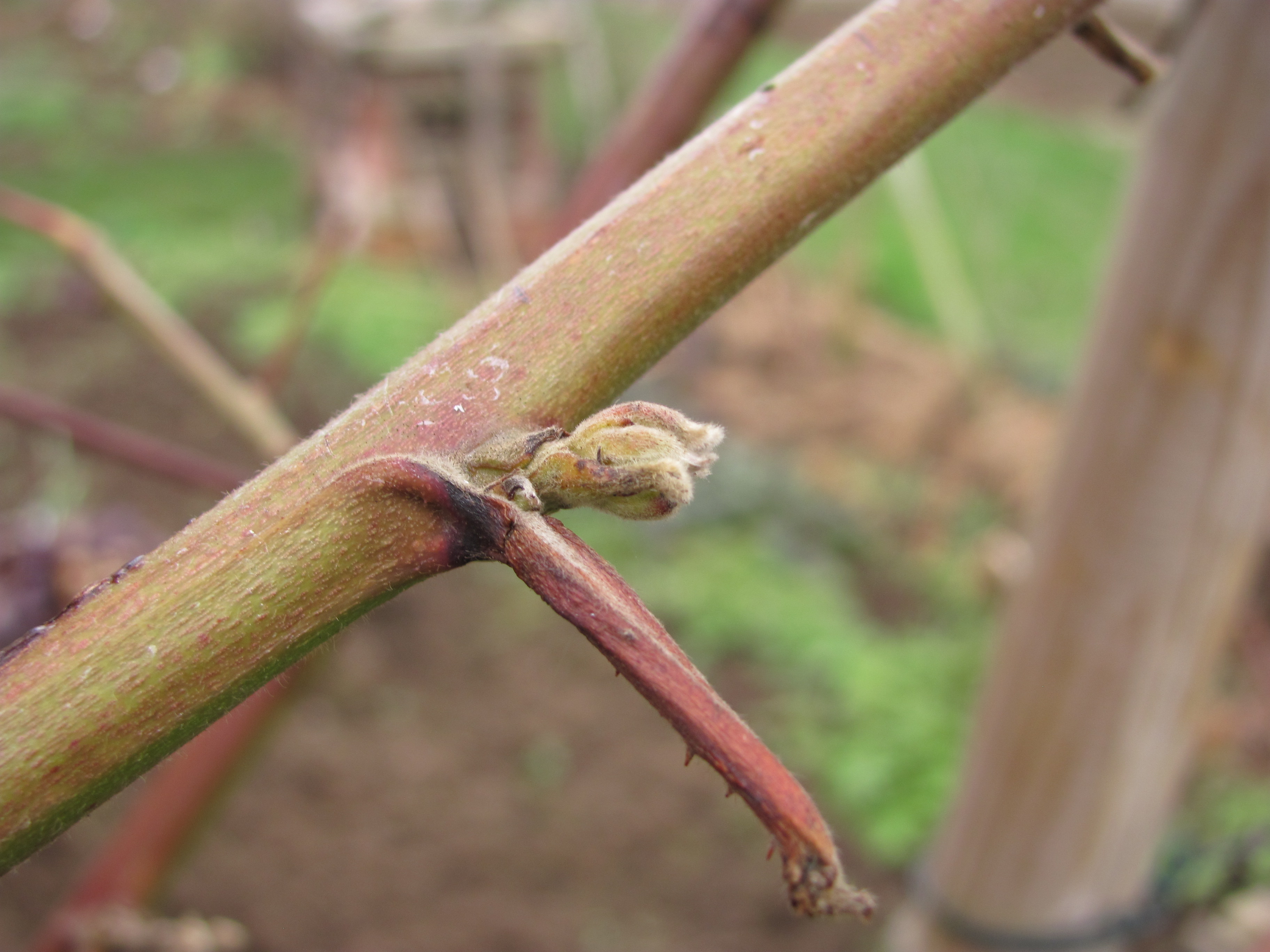
March in the garden is full of promises with buds developing and preparations underway for the productive garden. The photos show buds of Clematis, both climbing and herbaceous, and Apples and Pears.
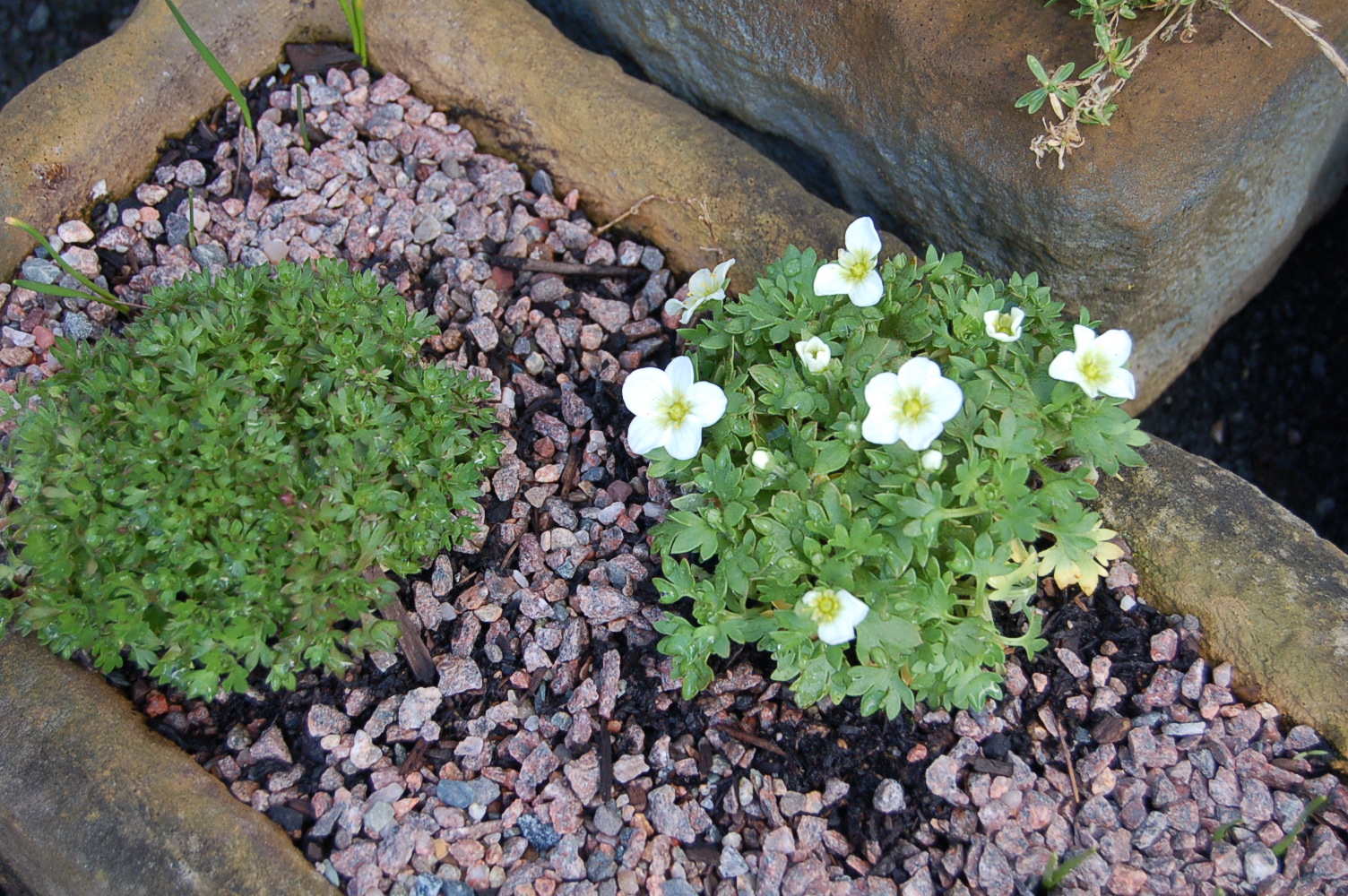
The Sempervivum in the alpine troughs and on the slate scree bed are all budding up nicely but one pure white-flowered one is out and glowing in the March sunlight. They are such precious little jewels of plants.
Our two newest areas of the garden, the Chicken Garden and the Secret Garden, are turning glaucous green with Allium leaves. One area is like a lawn of Allium. They seem to enjoy our soil too much and are spreading and self seeding madly!
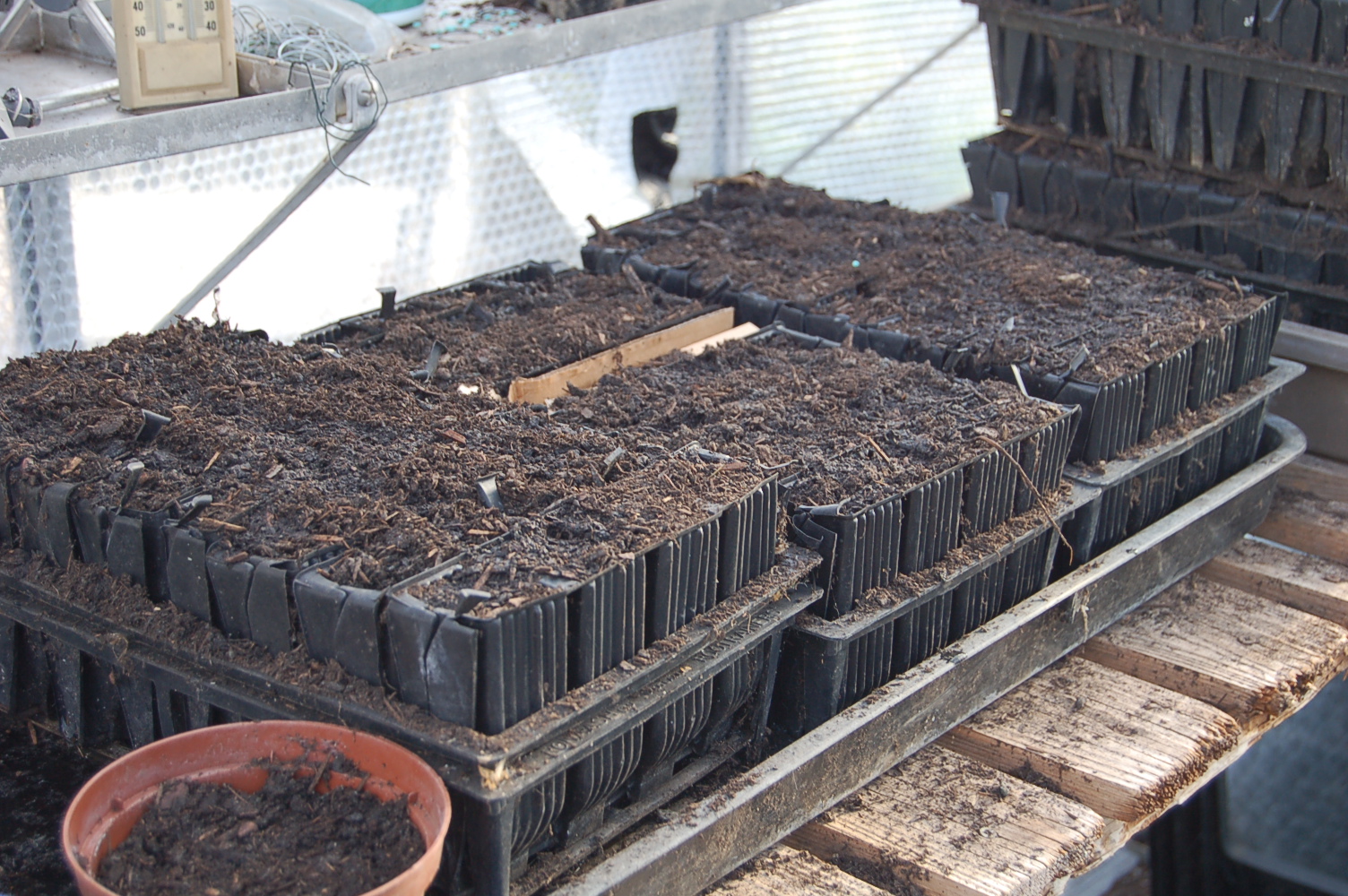
The productive side of our gardening mostly happens on our allotment but we have a big greenhouse in the back garden where we start off many of the veggie plants. Some seedlings have germinated in the propagator and lots cells and 5 inch pots are full of compost ready for us to sow peas, broad beans and sweet peas.
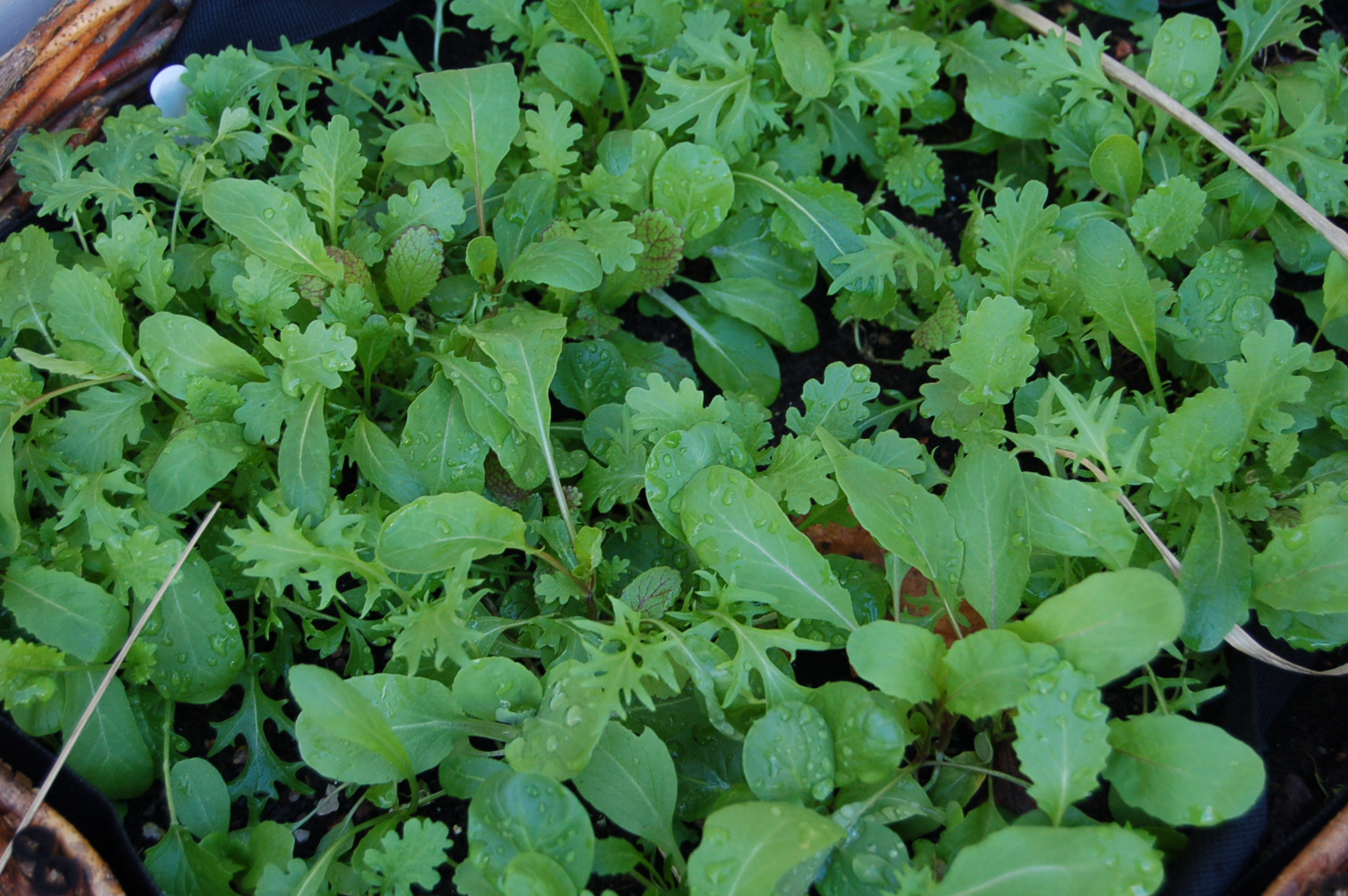
In our raised wicker beds just outside the back door the cut-and-come-again salad leaves are almost ready for the first cutting – and of course the first eating. So many different textures, colours and tastes! Delicious! Much is still to happen in March and on into April.
Our Comfrey patch is showing strong growth. This is one of the most important areas of the garden for in this 2ft by 10ft bed we grow a comfrey variety called Bocking 14, which we can cut 4 or 5 times a year. The leaves can be put in the bottom of potato trenches before we plant the potatoes to feed them and prevent the disease “Scab”. We also put them as a mulch under fruit trees and bushes as a feed and as a weed suppressant, and use them to make a liquid feed mixed with nettles.
So much is still to happen in the March garden. It is a busy and exciting month. So much to look forward to.
As part of the development of the shared community spaces at Bowbrook Allotment Community we have created “Gardens of the Four Seasons”. We did this with the support of “The Peoples Postcode Trust” who awarded us a generous grant for the purchase of plants. In early 2011 we began work on the Winter Garden and now we are beginning to see some results of our labours. The work was carried out by allotment holders who attend regular working parties (look out for future blog about our working parties) and the gardens are maintained by members. Much work is also done outside working parties by individuals or small groups.
I designed the garden and presented the plan to the management committee and informed other members by e-mail, asking for comments, further suggestions and ideas. The basic idea was to create a garden full of trees, shrubs, grasses, bulbs and perennials that looked good in the winter, for their stem colour, bark colour and texture, their flowers, their scents. Movement and sound was also considered so we included many grasses and some trees with rustling stems.
It is now a year since we began the groundwork. The preparation was completed by the end of February 2011 and the main framework of planting by the end of March.
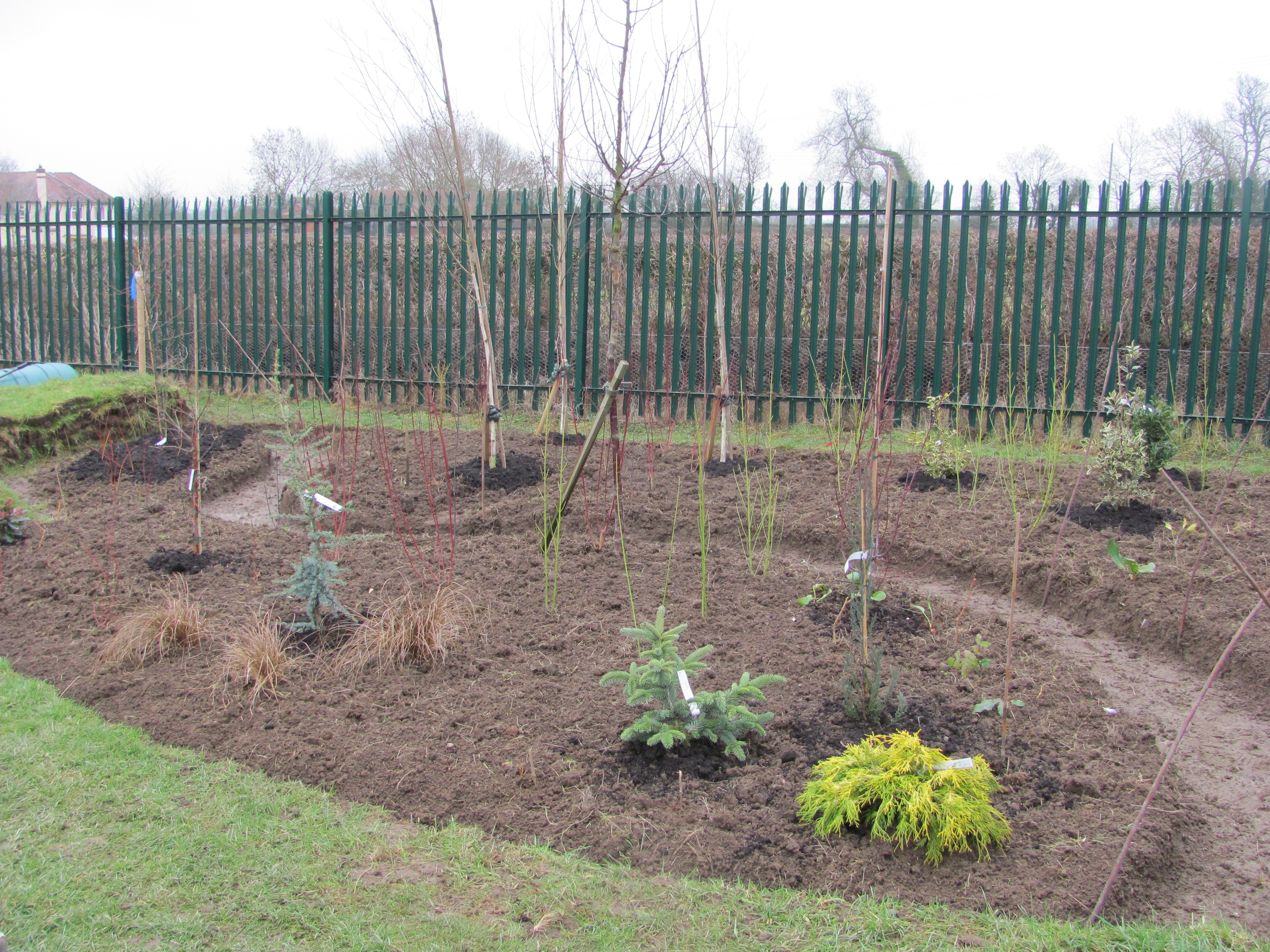
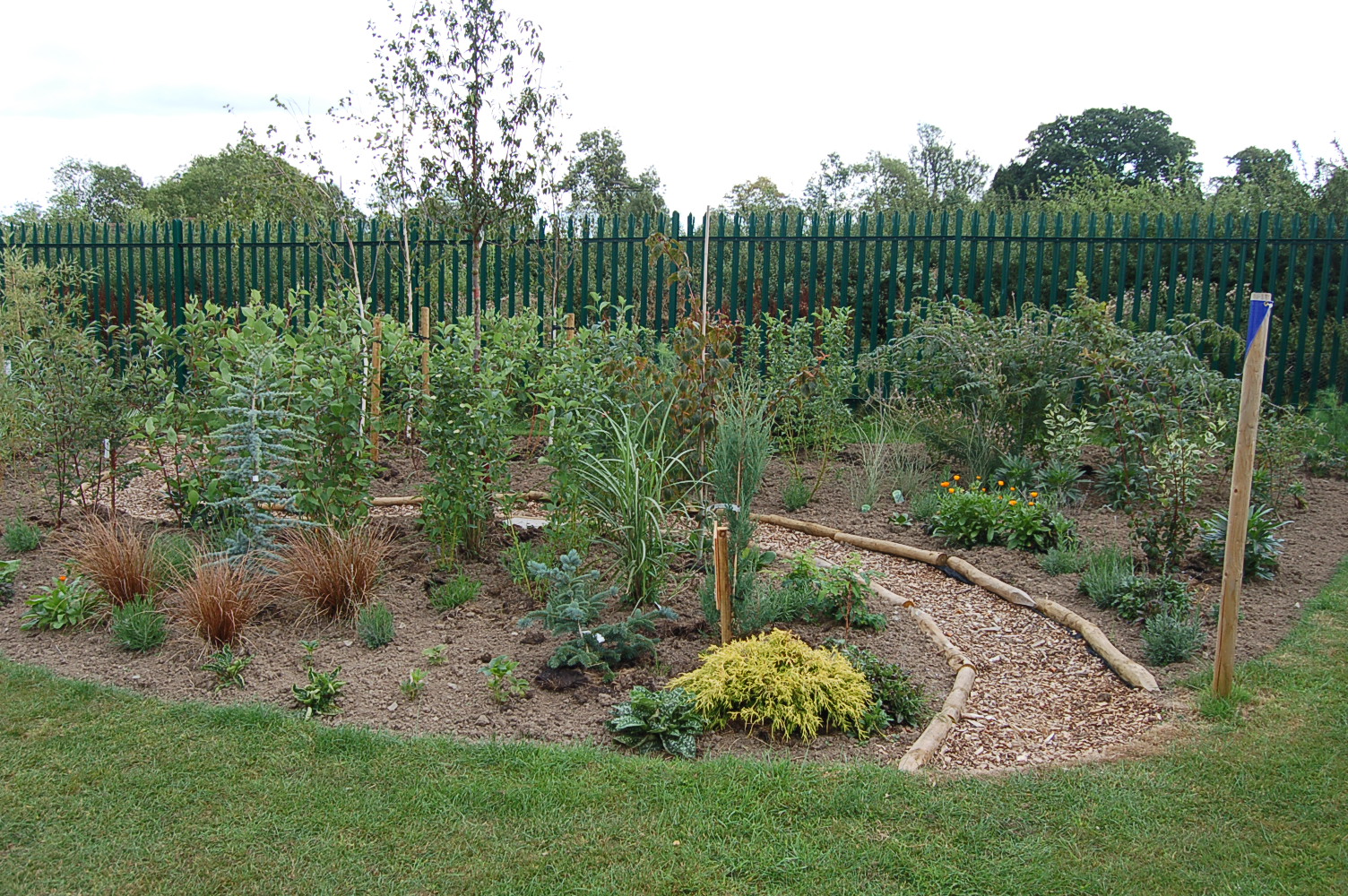
The first step was to rotovate the land, almost triangular in shape, in the corner of the site furthest from the huts, about 10 x 20 metres. We then added manure and rotovated once more. We dug out a path shaped as a serpentine curve, which cut the border in two, edged it with logs and gave it a deep layer of bark. It proved soft and comfortable to walk on. A thick layer of compost was added to the planting areas and raked level and we were prepared for planting.
Our Winter Garden is situated in a corner of the site. A water-butt is ready to be placed conveniently for watering in dry periods. In front is one of our wildlife banks.
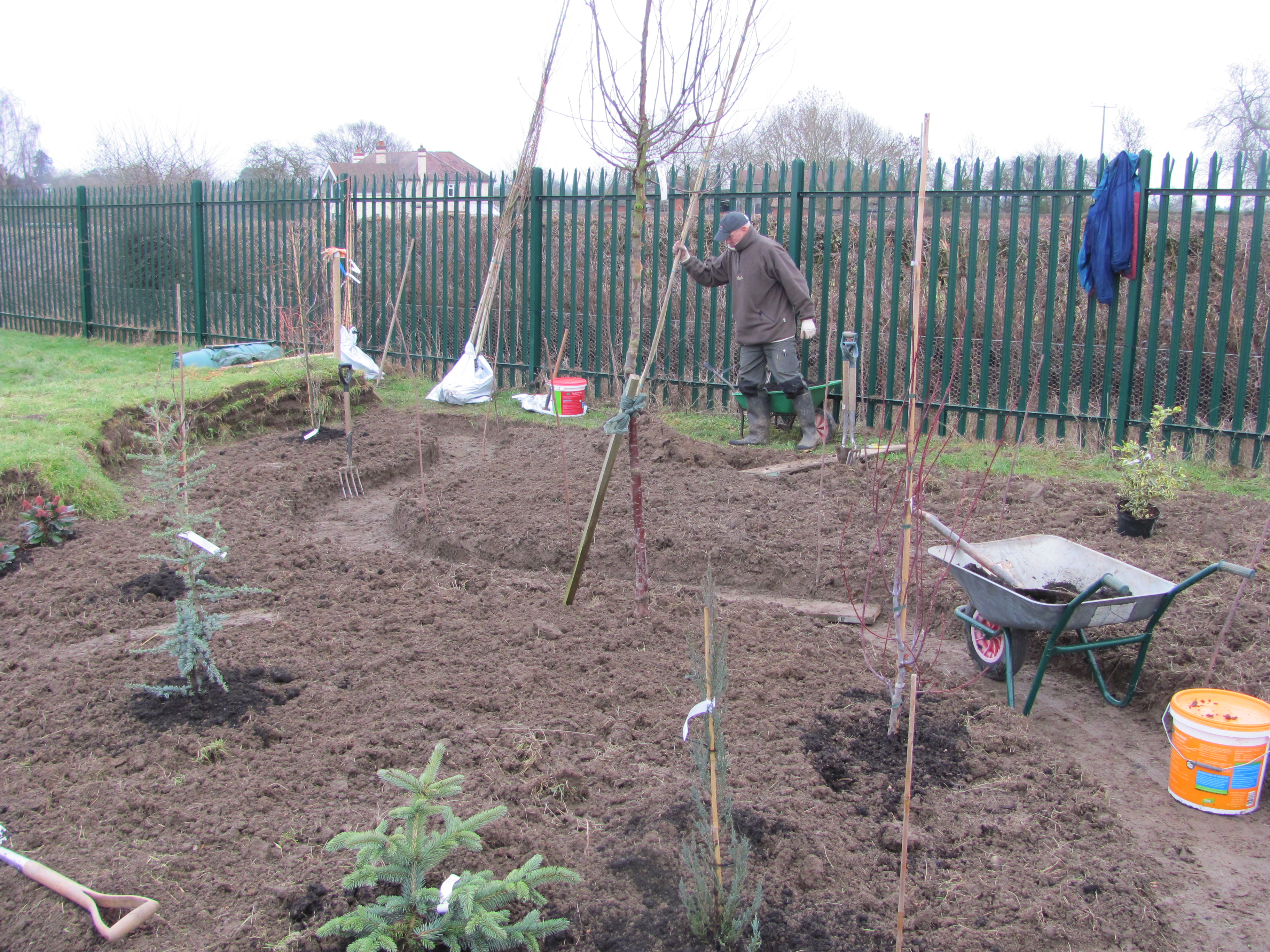
Trees and shrubs were delivered by The Dingle Nursery from Welshpool, who had proved so helpful in helping us to select the best when we visited them to place our order. Unloading the truck and unpacking the plants was an exciting time, full of anticipation. Transporting them across the site took longer than expected involving three plot-holders with wheelbarrows. Some of the trees were just too long to stay put. After an hour of laughter and regular rescuing of dropped goods, we finally began planting. It was to take a few days.
Trees in place.
Bulbs and herbaceous plants arrived by post and were added to our structural planting of trees and shrubs. a selection of grasses was added later. We now had trees with coloured bark, shrubs with coloured stems and a winter flowering time, perennials such as Hellebores and Pulmonaria and grasses to give movement and beautiful seed heads.
Plot holder Pete busy planting.
In pride of place are our three silver-barked Birches, Betula utilis “Jacquemontii” planted as 3 metre tall specimens, along with similarly sized Prunus serrula with its shining gingery-bronze bark. Smaller specimens of Acer davidii (a snake bark maple), Acer griseum appreciated for its peeling red bark and a selection of variegated Hollies completed the structural planting.
Key plants in place.
For bark colour we planted dozens of Cornus, Salix and Rubus tibeticanus to give an airy network of colour all winter and early spring. We interplanted these with patches of Lavender to give some summer interest, to attract butterflies, bees and hoverflies and to provide gentle bluish foliage colour all year. For winter flowering interest and scent we planted Cornus mas and Viburnum bodnantense “Dawn”.
In order to maintain all year interest with greatest emphasis of interest we added evergreens. As well as the Hollies we included Viburnum tinus and several conifers chosen for the variety of foliage colour, texture and habit of growth – Picea pungens Procumbens, Pinus sylvestris, Chamaecyparis “Boulevard” and to top it off John, our committee’s chairman donated a lovely specimen of Cedrus atlantica glauca. As a contrast we also planted a Larix decidua a conifer that is deciduous.
When we planted the trees and shrubs, following the allotment site’s organic policy, we gave them a sprinkling of bonemeal in the planting holes and top-dressed with blood fish and bone fertiliser before mulching with manure. We plan to give the bed regular mulching of compost and manure to give a slow-release nutrient regime.
Working parties and individual volunteers worked throughout the year to keep weeds at bay.
Volunteers at work tidying and weeding.
By late summer the garden was showing lots of healthy growth and we could see much promise for the future.
Full of promise.
In the autumn we gave the garden a mulch of chipped bark to protect it from the ravages of winter and to slowly break down releasing nutrients and improving humus levels ans soil texture.
This week three of us weeded the bed over, tidied, pruned and loosened up the soil. It was amazing to look at progress and realise how the garden had developed in less than a year. Bulbs were flowering, the trees and shrubs have made good growth and in particular the willows and dogwoods are showing strongly coloured stems.
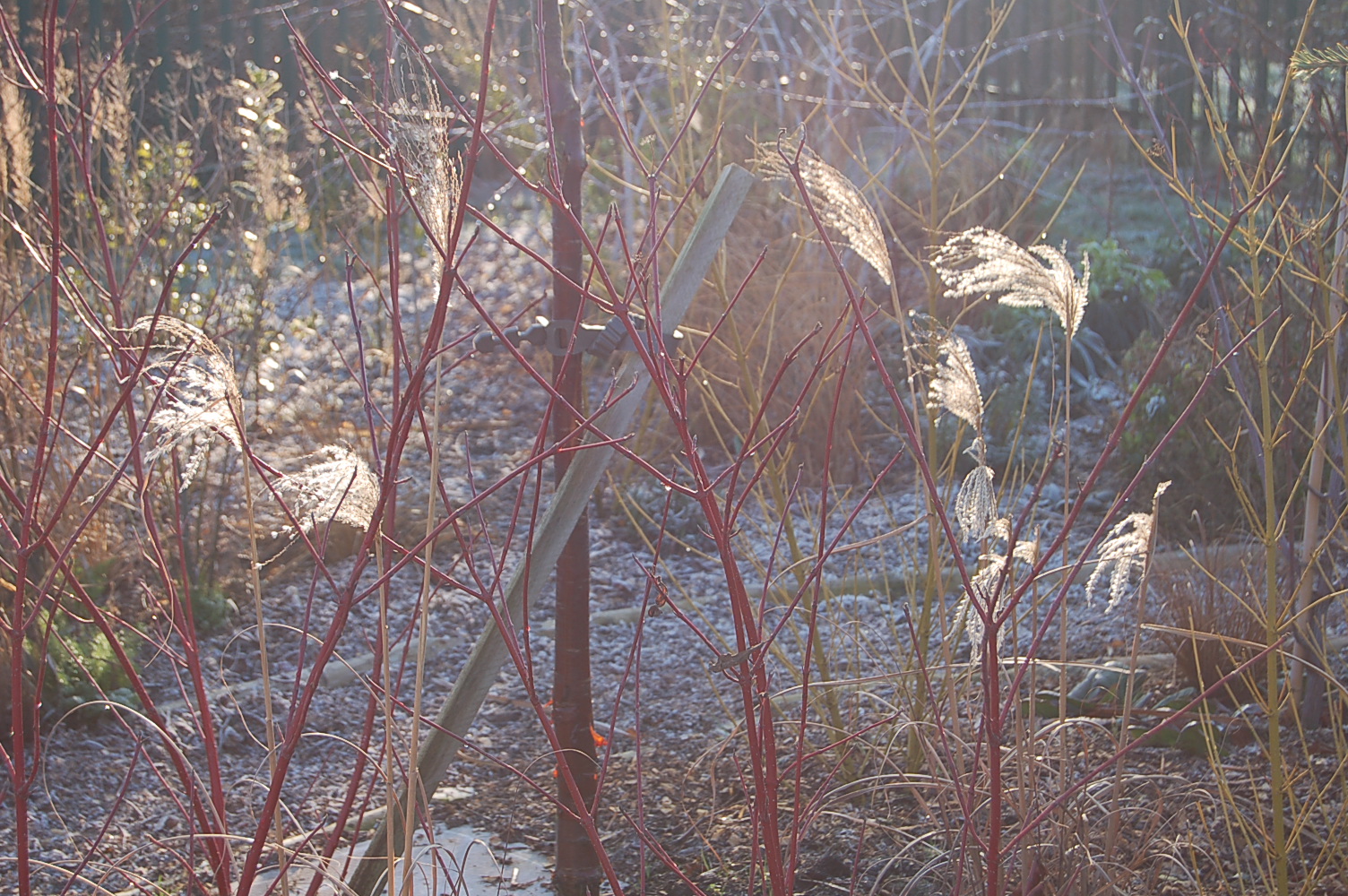
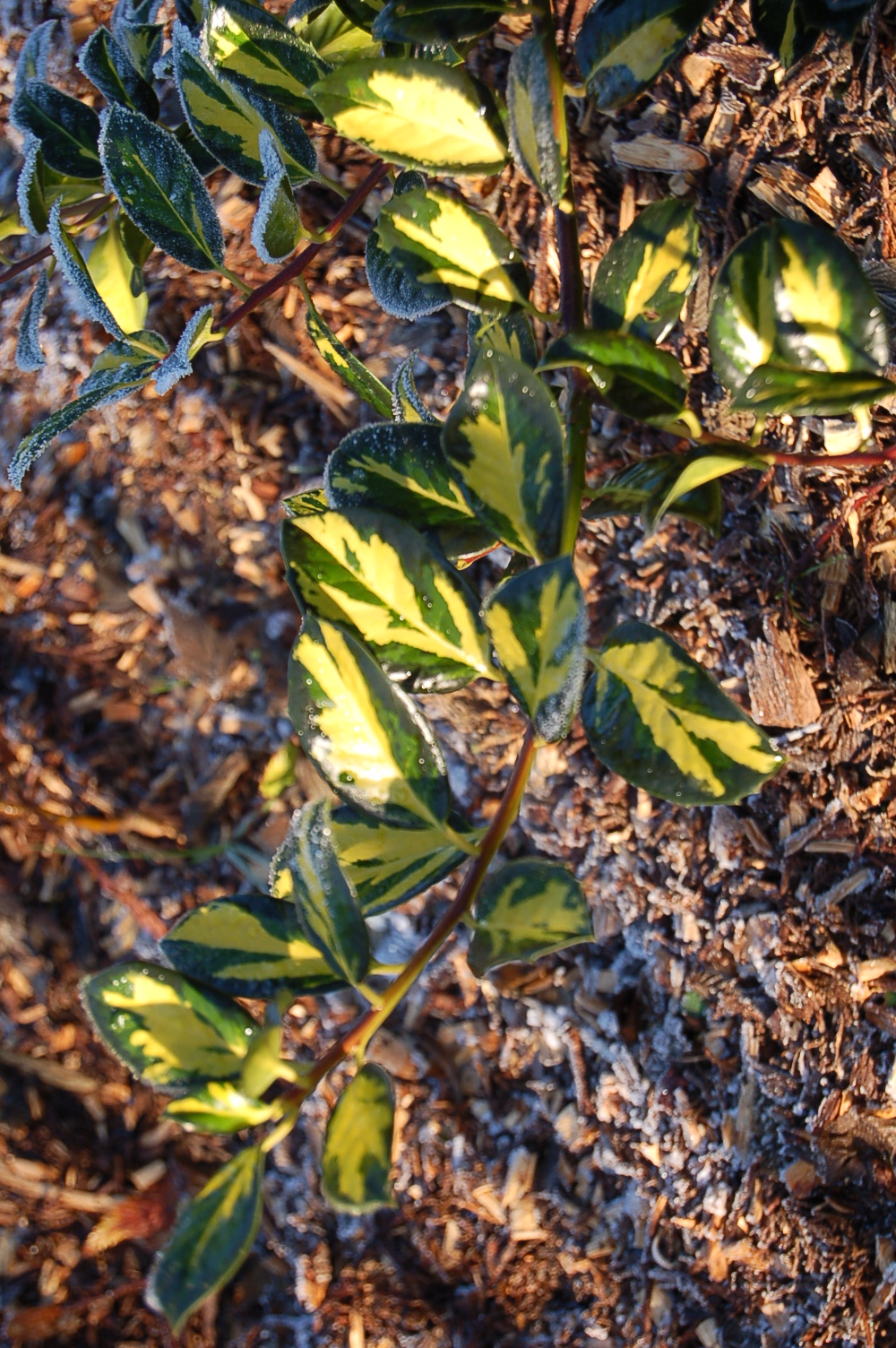
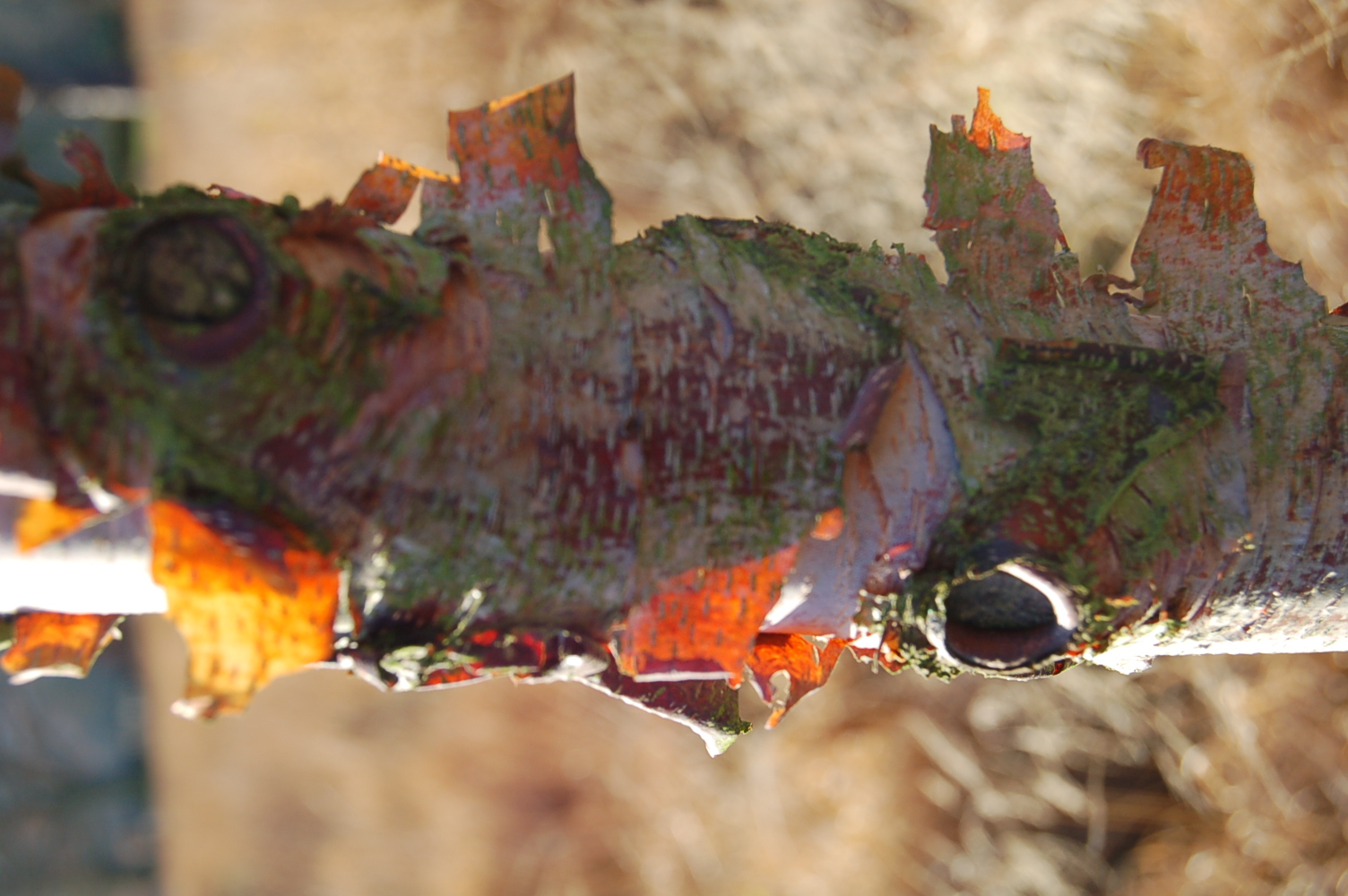
Winter sunlight through Miscanthus and Cornus.Stripes of fence shadows fall across a variegated holly.Blood red dogwood stems.Peeling bark like brittle toffee.Green flowered hellebore with striped shadows.Premature bud burst on Viburnum.Striped snake bark maple.
With so much to see after such a short time, we can but wonder at what our Winter Garden will bring us in the future. It was great fun creating it and judging from comments from plot holders it is already bringing much joy!
My blog reporting on “A January Wander around the Allotments” was all about the cold, as my wander then was on a bright, sunny but cold day with the thermometer registering minus five. Today my wander was a real treat, with temperatures of plus seven, it felt so mild. The sky however was grey and produced the occasional bout of drizzle. The bird life definitely appreciated the improvement, with so many to see and hear.
My walk over to our plot was halted by the whoosh of wings and the sight of a Kestrel in full hunting mode, its grey and rufus back curling low through the plots in search of its favourite prey, Field Voles. In a matter of a few minutes it had covered half the site, stopping occasionally to peer from a post or shed roof. The birdsong didn’t diminish with its presence but later when a Sparrow Hawk appeared, in threatening mode over the plots, silence reigned.
As I went to open up the shed I noticed how the recent freezing weather had shattered the little orange glazed dish I keep shells in on our coffee table, exposing the white china below its glaze.
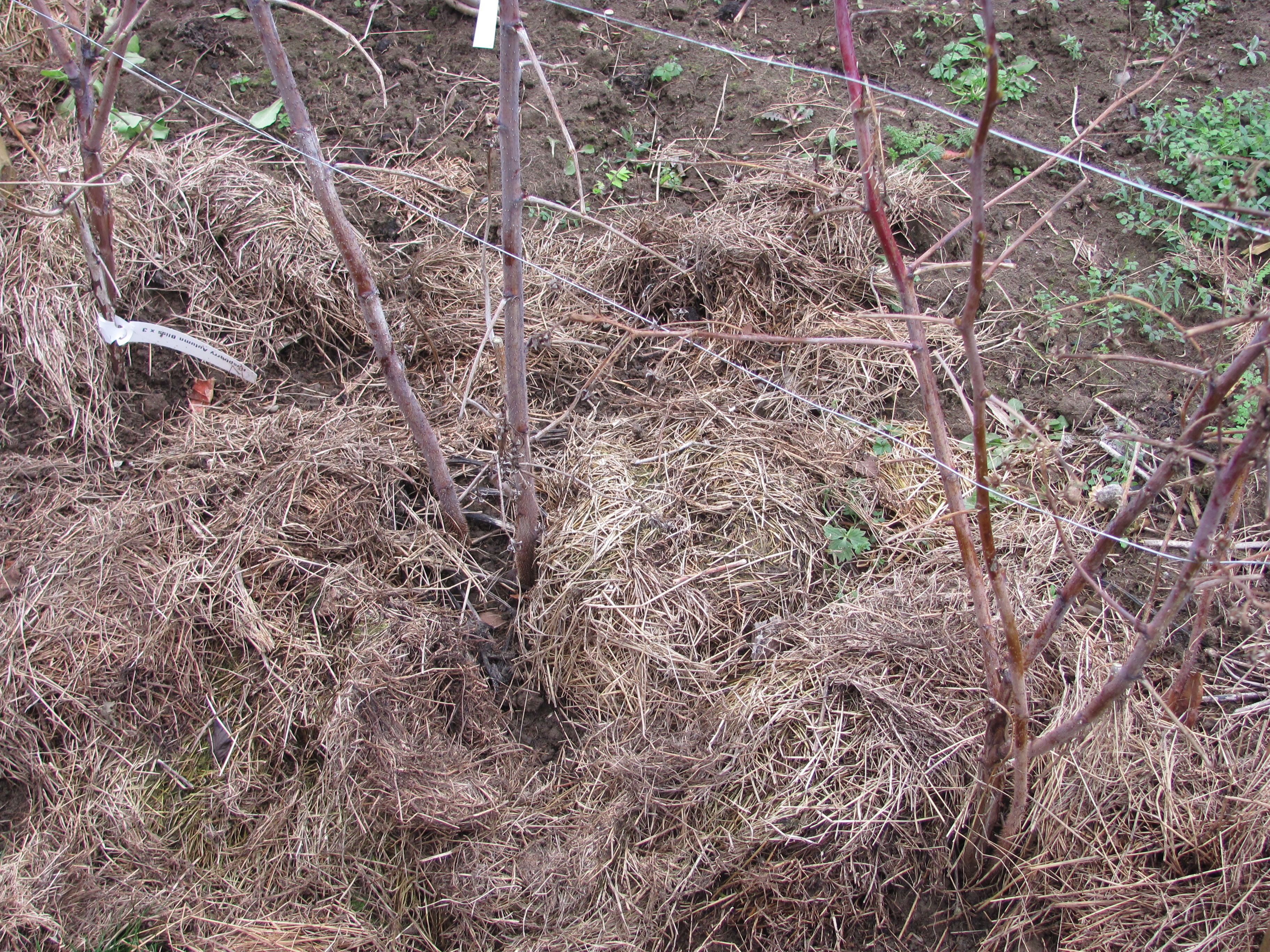
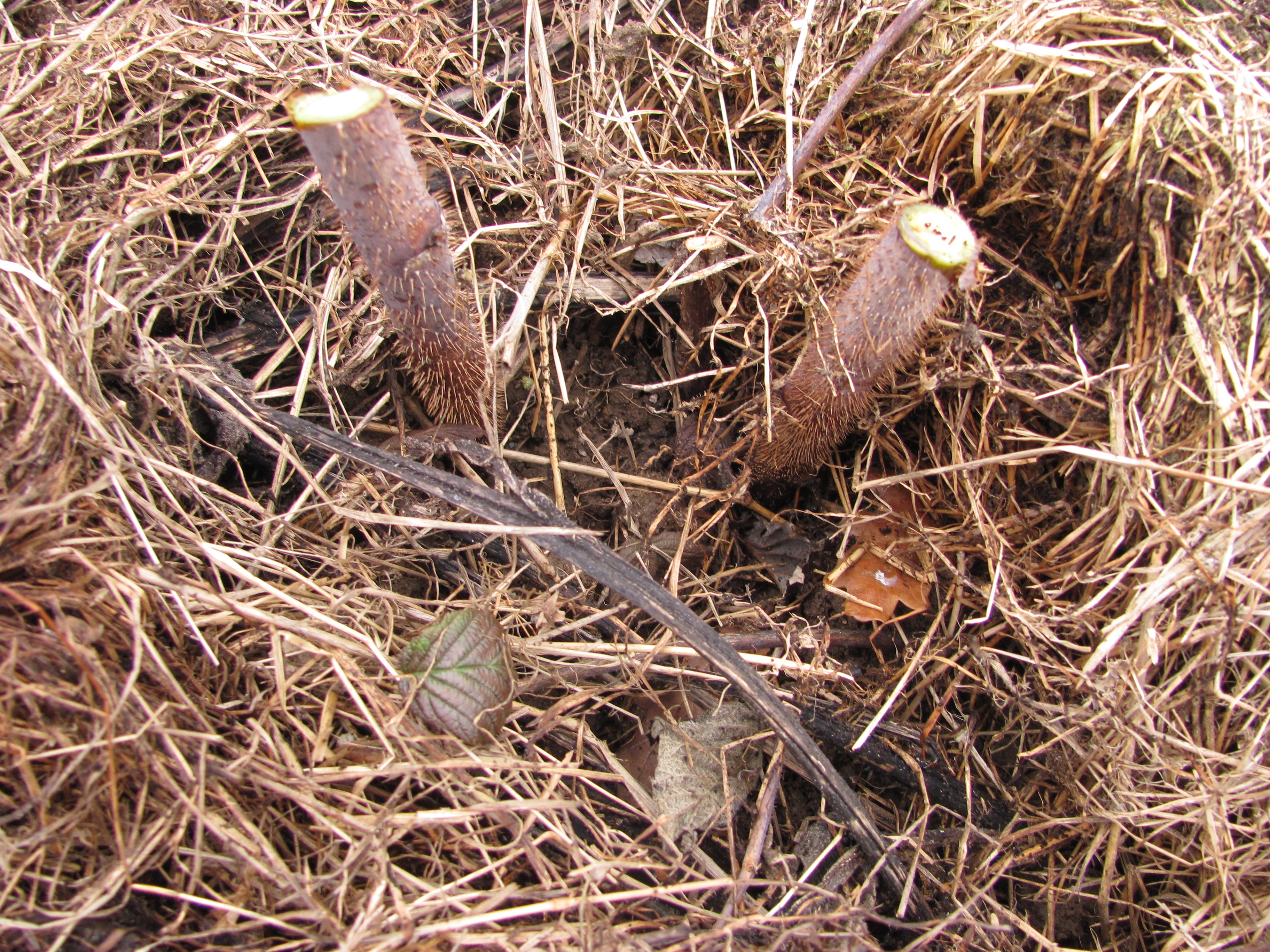
The feeders on our plot needed topping up before I set to work. My first task was to prune the Autumn fruiting raspberries, so pulled back their hay mulch and cut each stem down to just a few inches above the ground. Then their warm mulch blanket was replaced ready for the next cold spell.
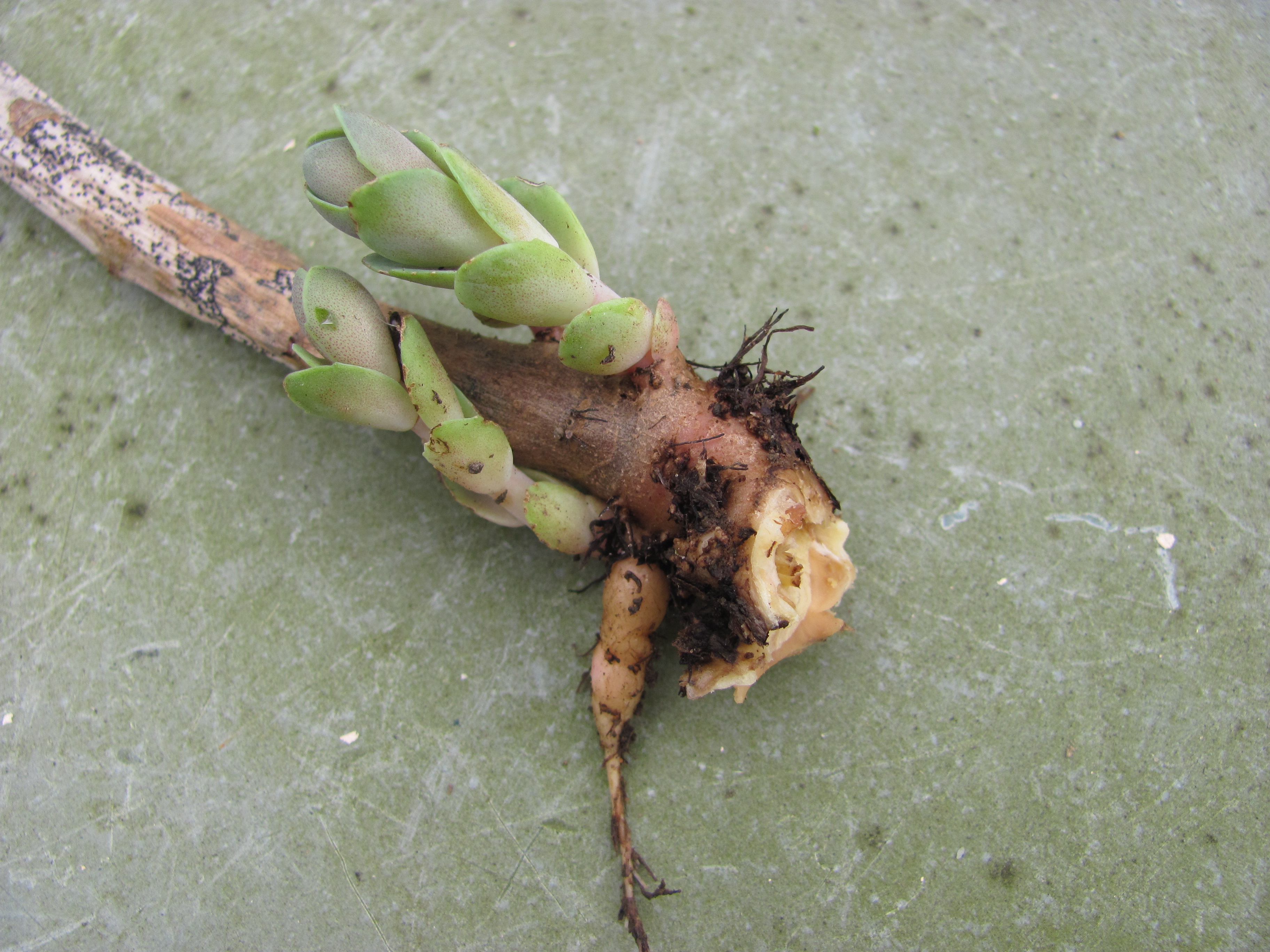
After tidying the edge of the plot where Calendulas had died down messily, I cut down perennials in the “Bug Border” alongside our central path, Sedum spectabile “Autumn Joy”, Linaria and several different Marjoram, all grown for the butterflies and hoverflies. As I pruned down the Sedum a few “slips” came away which I popped into my trug to be potted up at home.
A coffee break was called for to rest an aching back. A chance to do some bird spotting and listening out for their calls and songs. It was noticeable how some had moved on from calls to songs with the changing light of February. The Great Tit was giving a good performance repeatedly calling out “Teacher Teacher” just as it says in the books, but I often think it sounds more like the squeak of a tyre foot pump in need of lubrication. Its smaller cousin the Blue Tit sang gently from all around the site.
The peace was shattered as soon as the Rooks from the rookery on the northern boundary lifted as one and poured overhead, a cacophony of “cawing” and “rarking”. They are busy now restructuring last year’s nests. When one returned to the tree tops with twig in beak all its neighbours objected vocally craning their necks threatening and warning others to keep their distance. They live together in huge nesting groups but argue all the time! Their little corvid cousins, the Jackdaw, are quieter and more social. They pass overhead without any argument.
Signs of things to come! New growth is appearing at the base of perennials and the Globe Artichoke plants. Disappointingly the green manures have grown very little but just manage to cover the bare soil.
Buds are fattening on the Black Currants and the Blackberries. Promises of autumn bounty.
So once the work on our Plot 37 was completed I wandered off around the site, with wheelbarrow loaded – secateurs for pruning the roses in the Summer Garden, camera to take shots, surgical gloves and step-ladder to clear out nest boxes. As I walked along the established hedgerows flocks of chattering finches moved away, keeping close top the hedge and to each other – Goldfinches, Linnets and Greenfinches. A surprise sighting was a flock of about 15 Yellow Hammers, the first time they have been seen here. Unfortunately one of the loudest noises was the dry screech of my wheelbarrow’s wheel! A quick detour to the shed for a squirt of penetrating oil cured it.
Where the hedge has been left uncut for several years (where the council flailing machines can’t reach) the bushes are tall and busy with finches and tits. A Song Thrush was throwing leaves and under-hedge debris out onto the path searching for its lunch. The calls of Nuthatches and Great Spotted Woodpeckers echoed around the allotments all the time I was on site, but one call was unexpected. It stopped me in my tracks. I had never heard the piping call of a Bullfinch up here before. It wasn’t hard to find – a male with its pink, almost cerise breast glowing from a tall Hawthorn.
Nestbox cleaning can be a painful business if the nests have been colonised by nest fleas, hence the surgical gloves. Luckily none in residence today! Four of the five tit boxes had been used last year. The open-fronted Robin boxes were ignored by our population of redbreasts.
This photo shows how the Great Tits who nested here used their tails for added balance when feeding their young through the hole. The wood stain has been worn away.
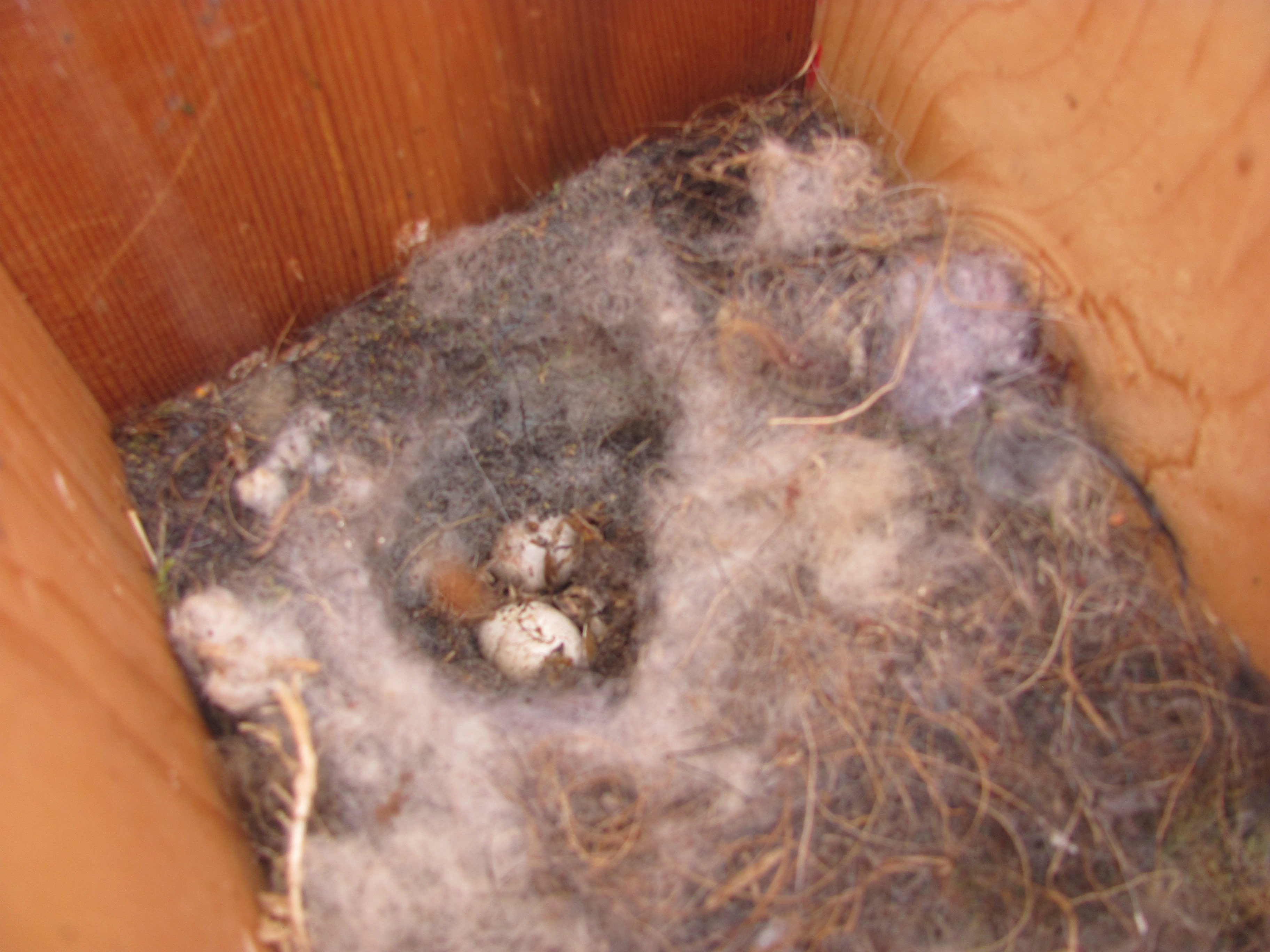
The box in the photo below was used three times in 2011, but the third attempt was thwarted by cold wet weather in the early autumn, so the clutch of eggs remains. When I emptied out the nesting materials I could see the three layers of nesting material. When I had emptied all the boxes the old nests were put in the compost heap.
In the meadow areas seedlings cover the ground, so our plan for self seeding meadows seems to be working out. In one meadow area a lone cornflower continues to throw up an odd bloom of the most beautiful blue.
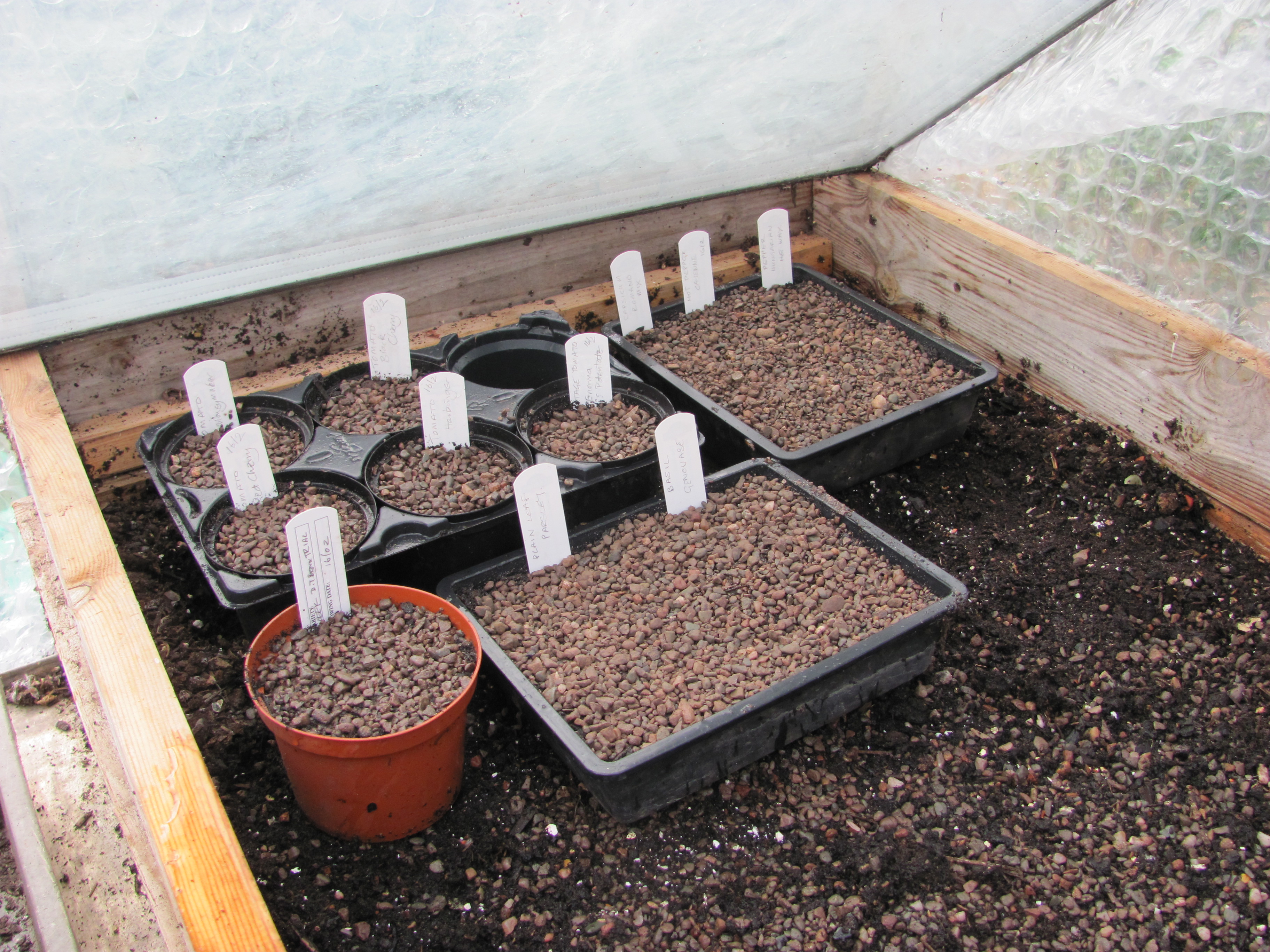
It felt oh so good today to be sowing the first seeds of the year! And to make things even better it was warm and cosy in the greenhouse. There are so many seeds waiting in my tin all organised in sowing date order.
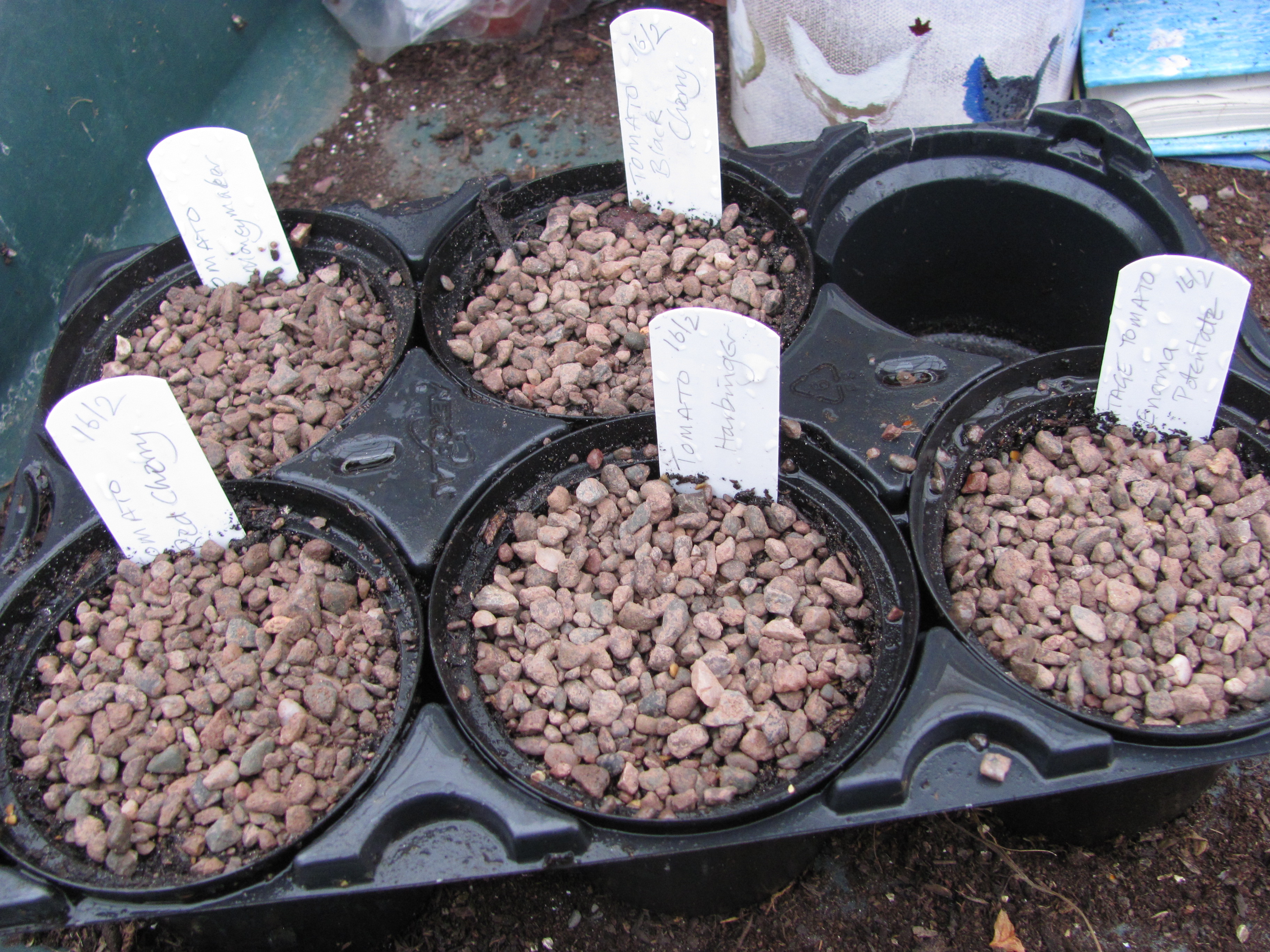
So today I sowed seeds of tomatoes, peppers (sweet, cayenne and hot), basil, parsley and leeks.
We always sow a variety of tomatoes to ensure lots of different colours, textures and flavours, so for 2012 we have Gardeners Delight, Moneymaker, Red Cherry, Black Cherry, Harbinger and a heritage variety called Potentate. Of course to go with tomatoes we need basil so we have sown Basil Sweet Genovase.
All the seeds sown today need warmth to germinate so we have put them in my home-made propagator which gives bottom heat and maintains an average 20 degrees celsius. Here they are in their special warm environment waiting for the lid to be closed.
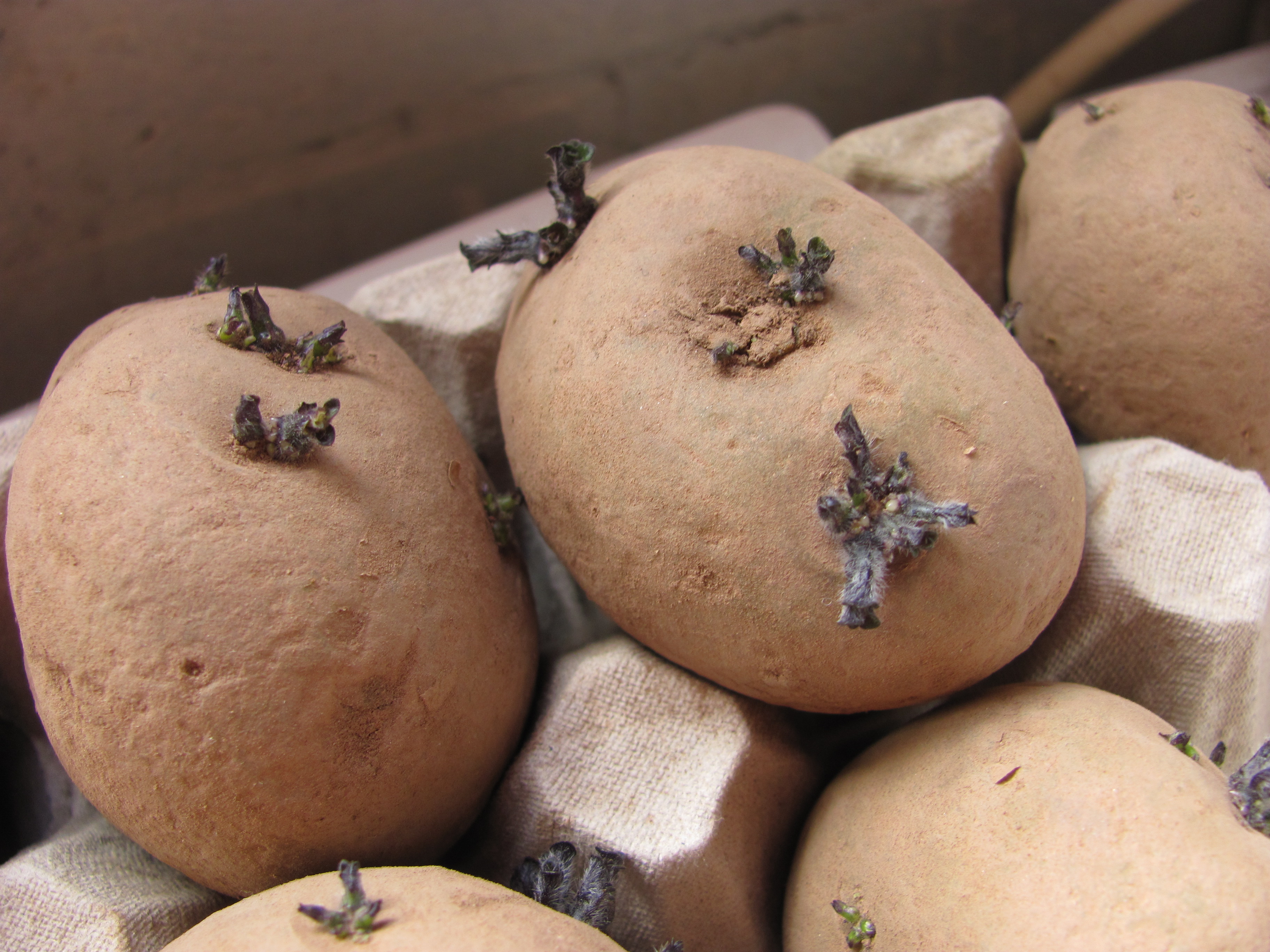
And the seed potatoes are “chitting” away in their egg trays. So the allotment year has been launched and it feels good!!
As I decided to create a blog at the beginning of each month illustrating what is going on in our garden, so I have also decided to publish a blog in the middle of each month to show what is happening on our allotment site.
So today we braved the cold and went for a wander. The weather although cold, at five below, was bright sunshine in a clear blue sky. the air felt freezing as it entered my lungs but the sight of the lotties cheered me. As we stepped from the car a kestrel was hunting low between the sheds in search of the abundant field voles. A day never goes by without seeing at least one kestrel quartering the site. A buzzard soared overhead in the thermals created by the warmer air above the cultivated plots.
First job was to fill the bird feeders at the two feeding stations. They were busy with blue tits, coal tits and great tits feeding from the hanging feeders and blackbirds, dunnocks and robins beneath picking up the feed dropped by the clumsy birds above them. All the while we could hear the call of nuthatches in the site’s mature oak and sycamore trees.
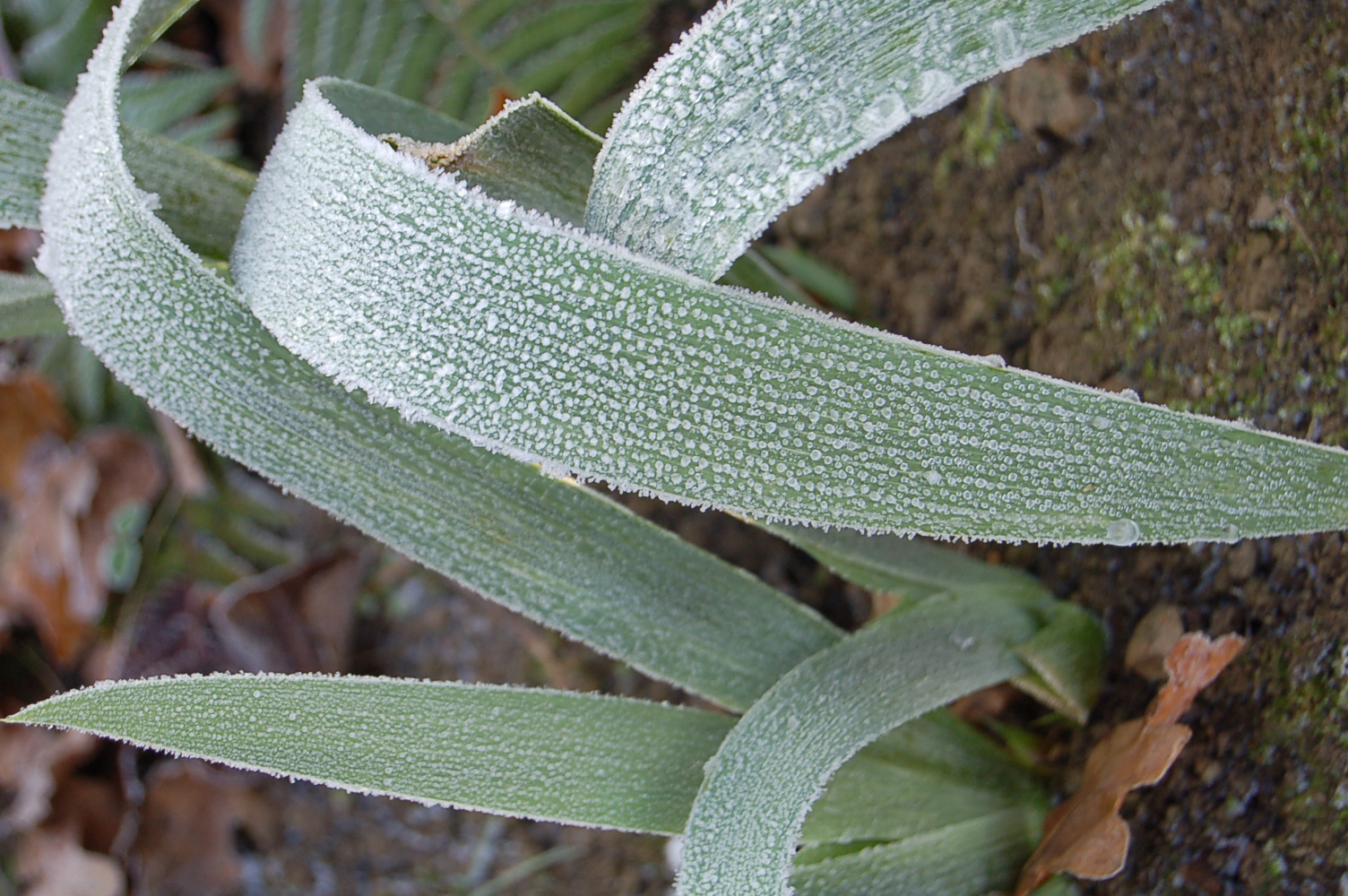
Frost sits on the bare ground and helps the gardeners by breaking it down and improving the texture in readiness for a final preparatory rake over. The fine tilth can then be home to seeds.
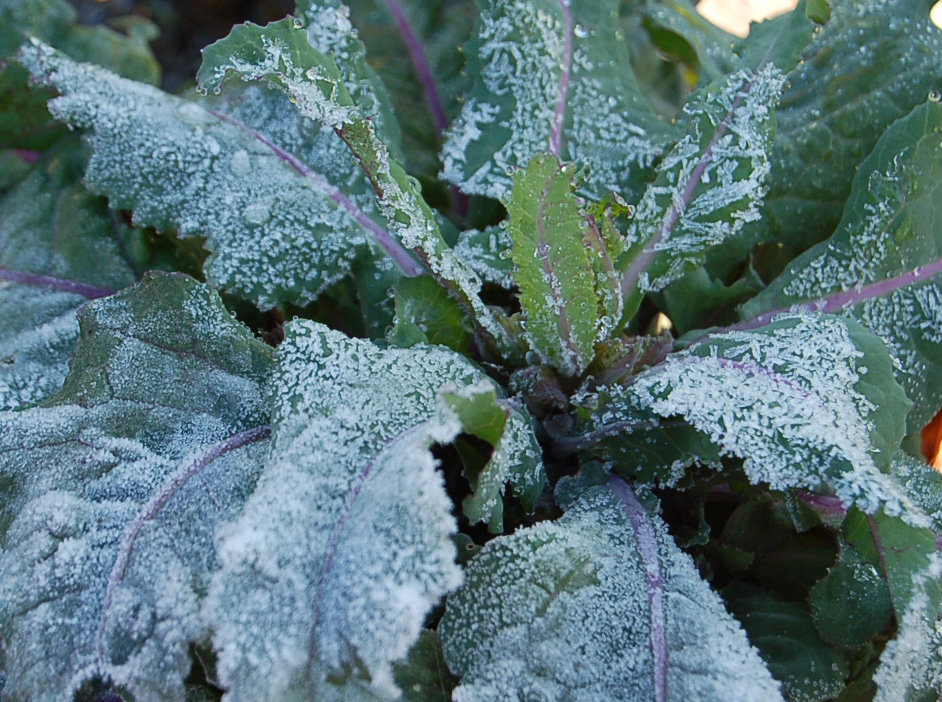
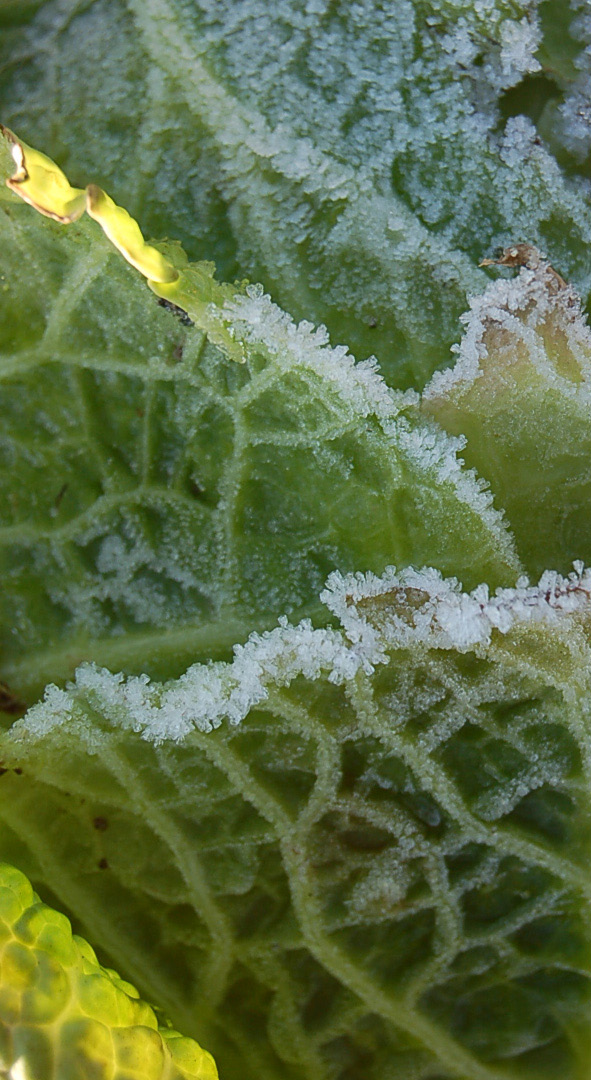
The plots themselves look very sad at this time of the year, drooping brassicas, frosted leeks and steaming muck heaps and compost bins, the warmest spots of all. The scarecrows have fallen in the recent strong winds, their clothes wet and bedraggled and their structures weakened. Frost emphasises leaf structures, settling deepest along the veins.
The strongly veined wrinkled leaves of the Savoy Cabbages withstand the cold wrapped into tight balls.
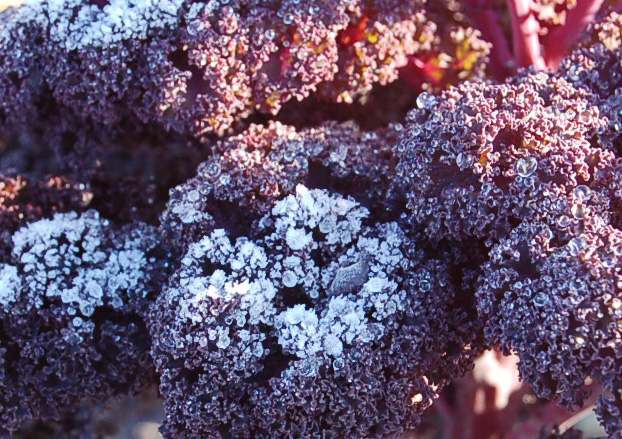
Kale defies the cold and stands upright and proud even with ice droplets and frost splattered on their tightly curled leaves.
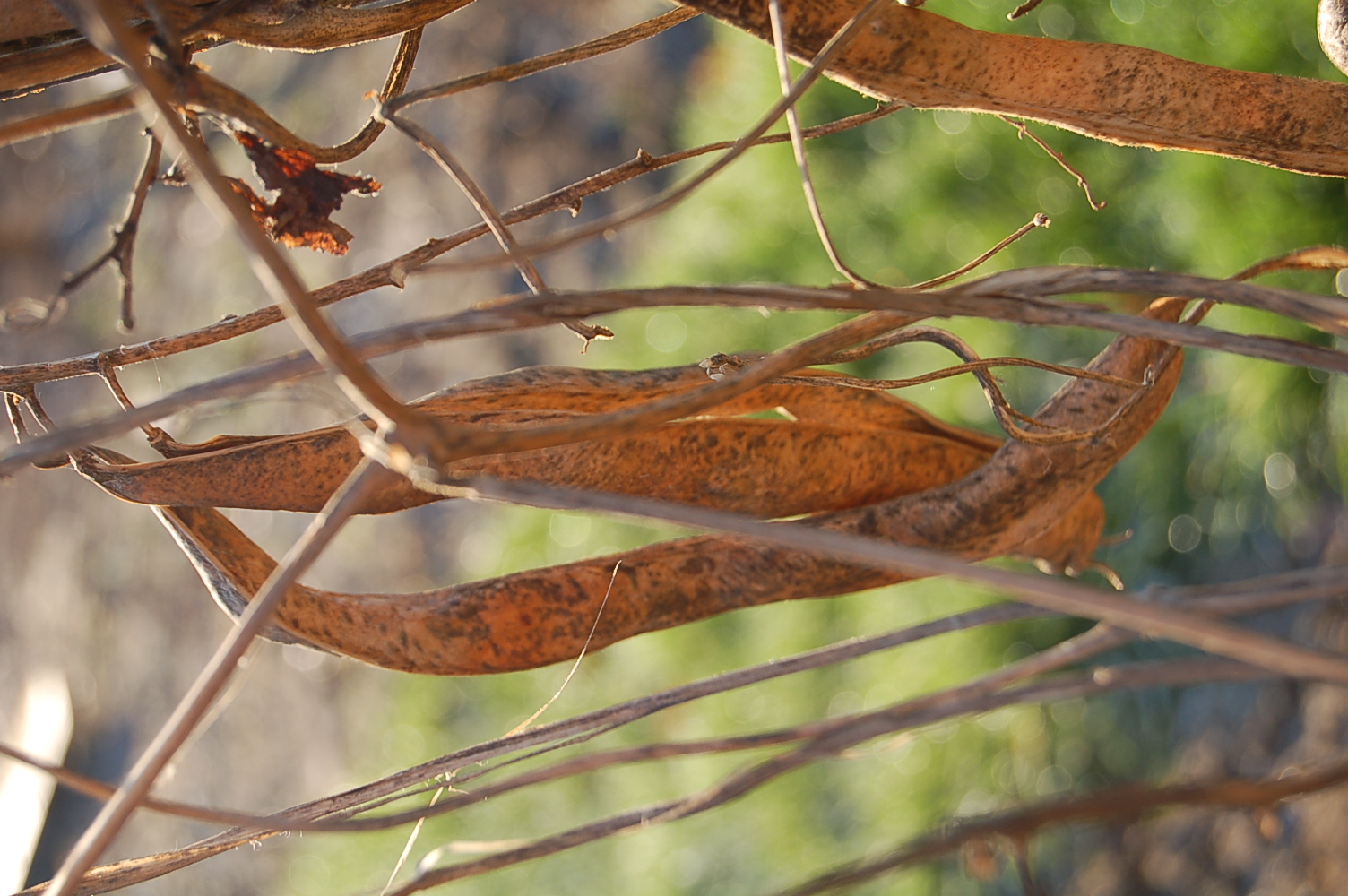
Sunlight makes the old runner bean pods translucent as they hang on the dead remnants of last year’s plants.
On our own plot the rows of Mooli, Broad Beans and Leeks look delicate in the frozen soil but will sit until spring arrives when they will have growth spurts and give us early crops.
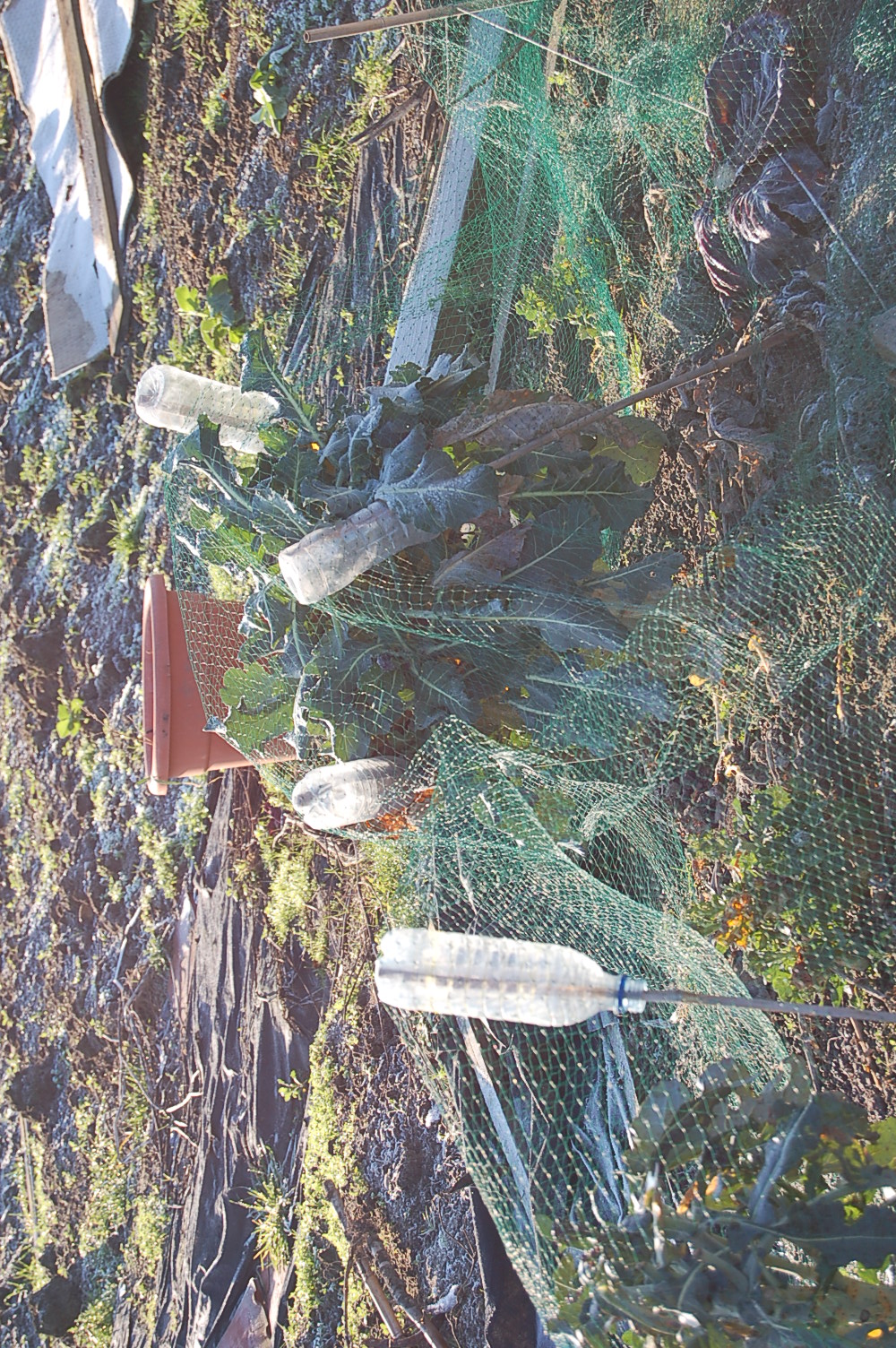
Plastic bottles on canes support last year’s netting and still protect any overwintering crops from hungry Wood Pigeons.
Blackbirds move low across the lotties settling onto any sun-warmed soil and dig for grubs, but this one sat looking sad.
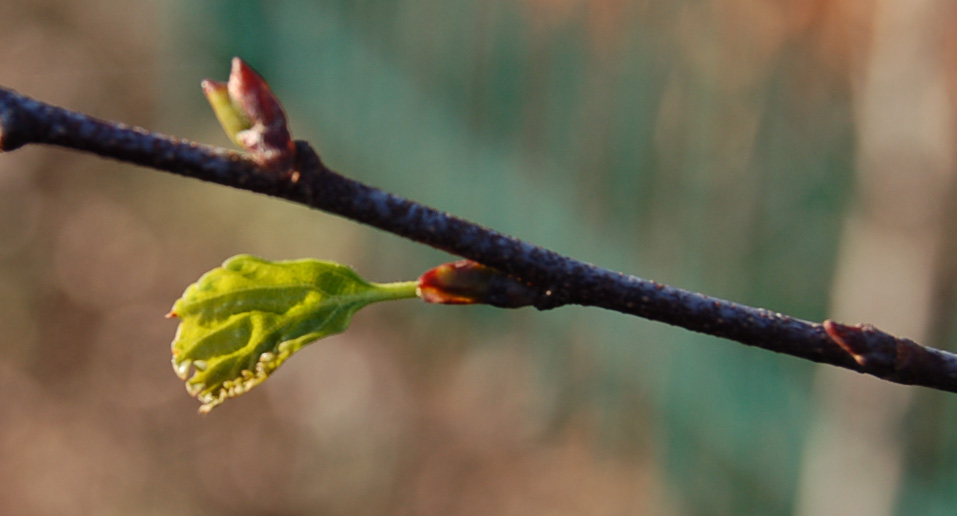
We took a leisurely walk around the “Interest Trail” which took us through or close to most of the community gardens – the orchards, wildlife borders, seasonal gardens and meadows. Near the car park the first green bursts of new life have appeared, the leaves and catkins forming on the birches. The young catkins stand bolt upright at this stage but will soften in colour and structure when they dangle down in the spring.
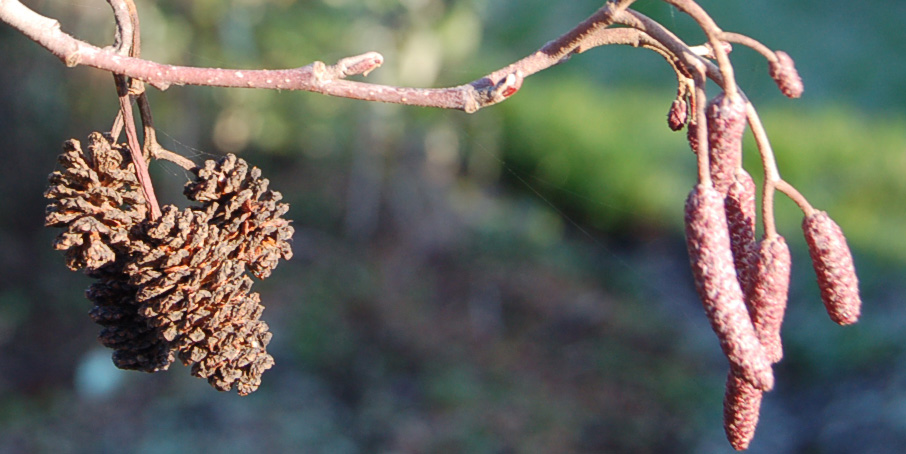
The purple catkins of the alder sit on the branches with the darker cones.
In the Autumn Garden seed heads of Asters remain long after the flowers of autumn, like tiny dandelion “clocks”.
In the first orchard th frost still lingered strongly on the logpile especially on this old chunk of bark.
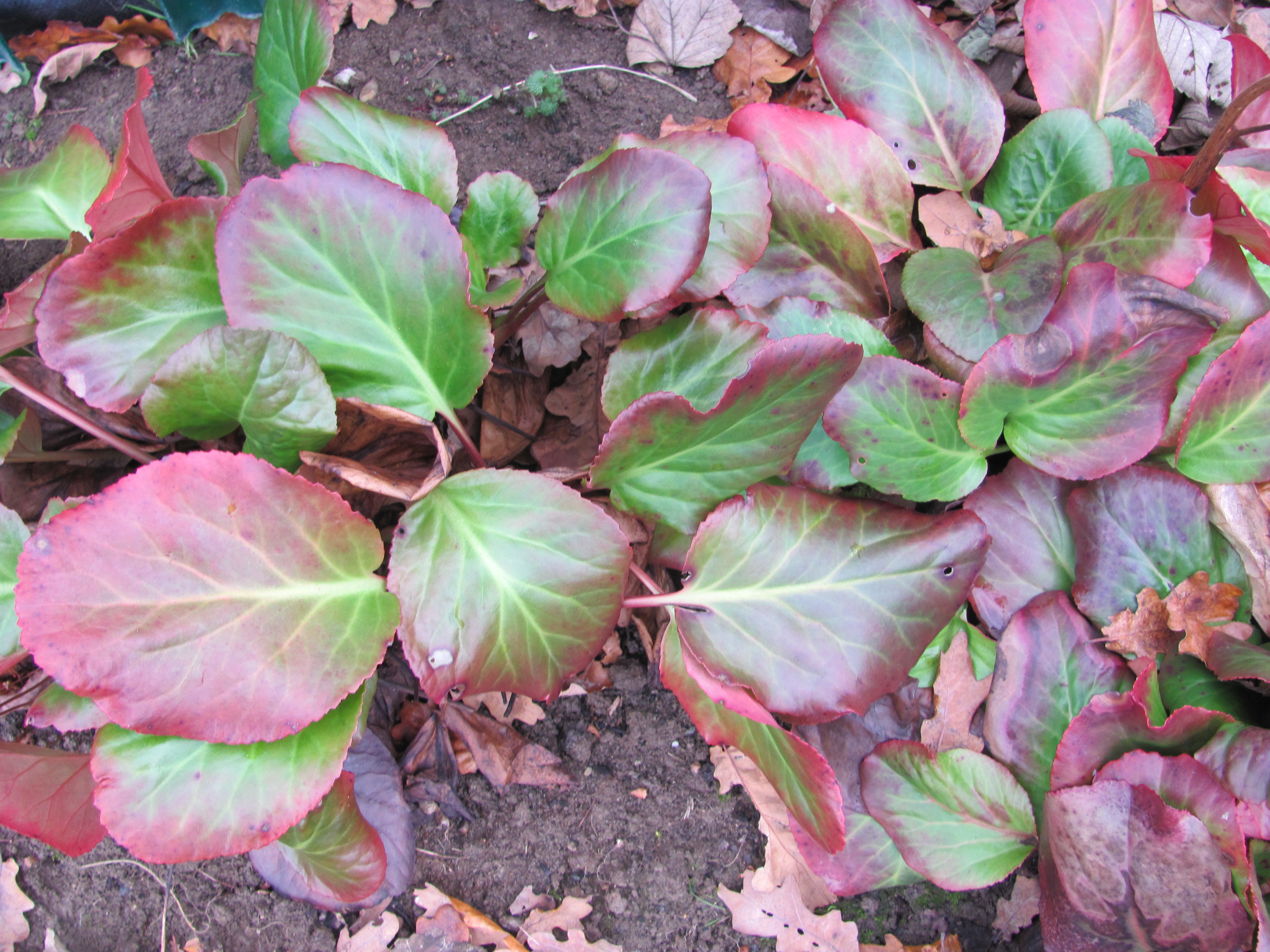
When we reached the Spring Garden we were struck by the contrasting leaf texture, shapes and structures.
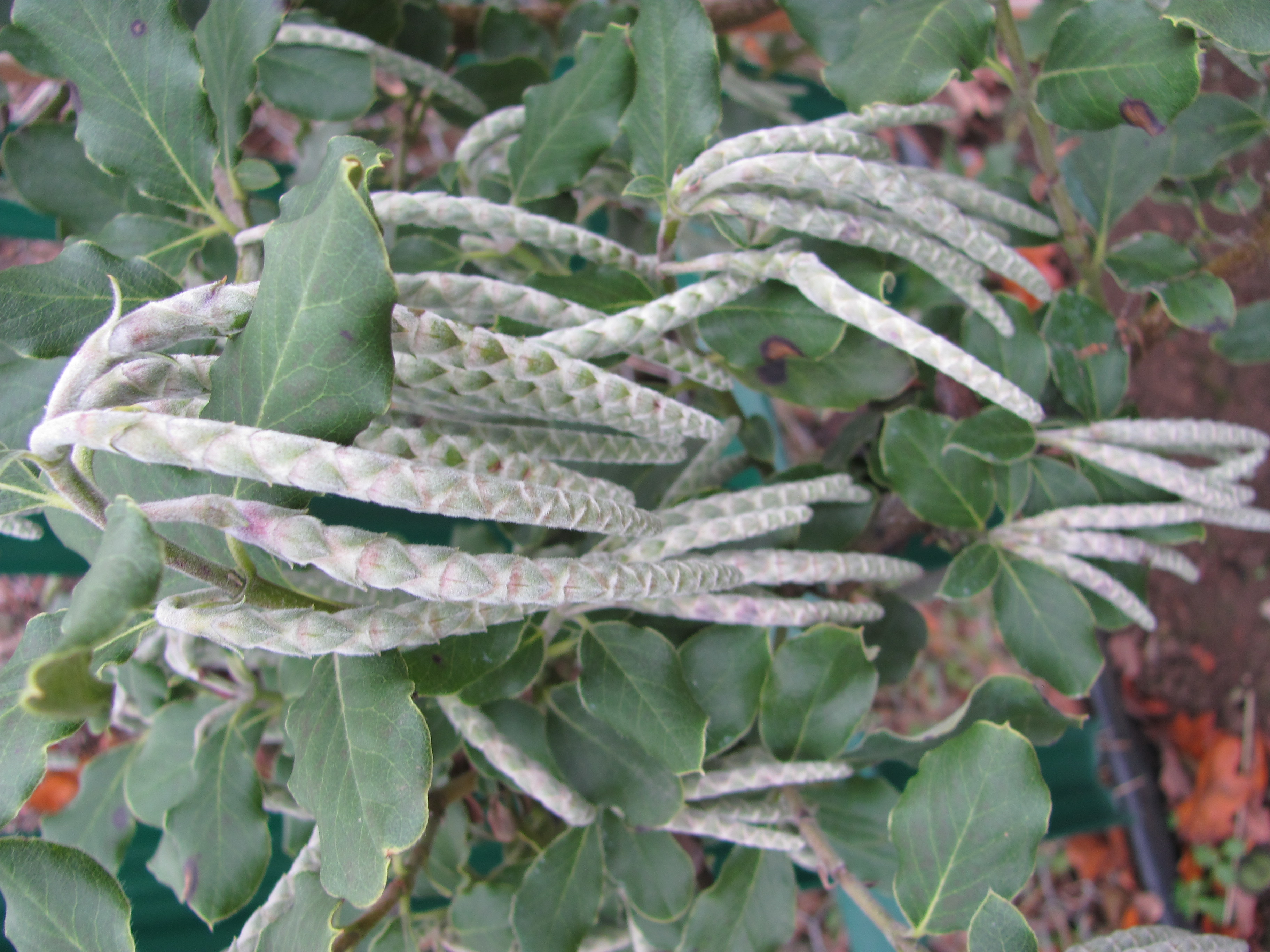
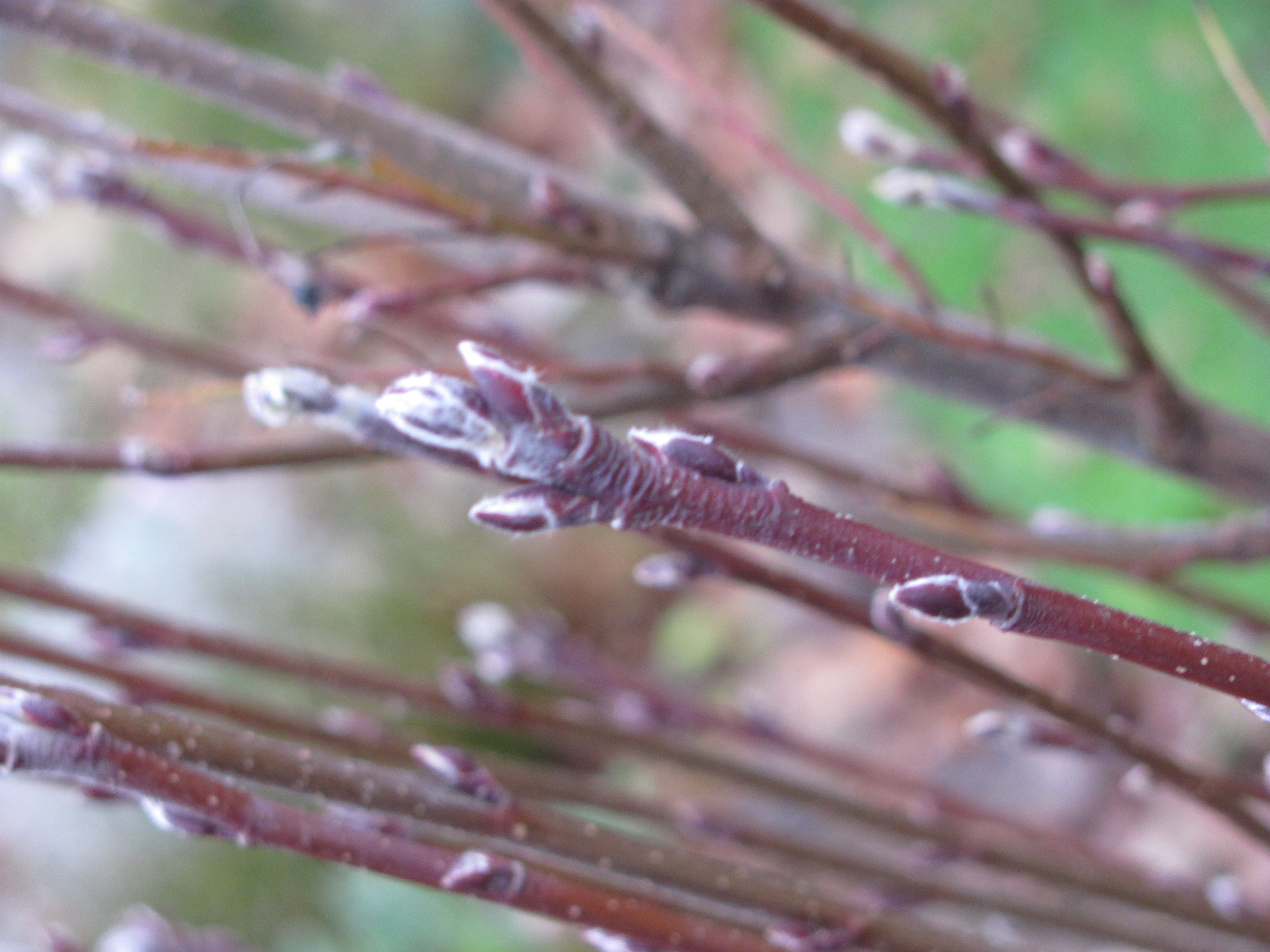
At the back of this garden the silver tassels of the Garrya hung in profusion and the new buds of the Amelanchier promised early flowers and foliage.
Further round the trail we arrived at the “Winter Garden” where the low rays of the sun sent long shadow lines of the fence right across the border between the coloured stems of the Betulas and the Dogwoods. It also illuminated this peeling bark, giving it the impression of slithers of orange brittle toffee.
The blue spruce looked bluer than ever with the whiteness of the frost laying on its needles.
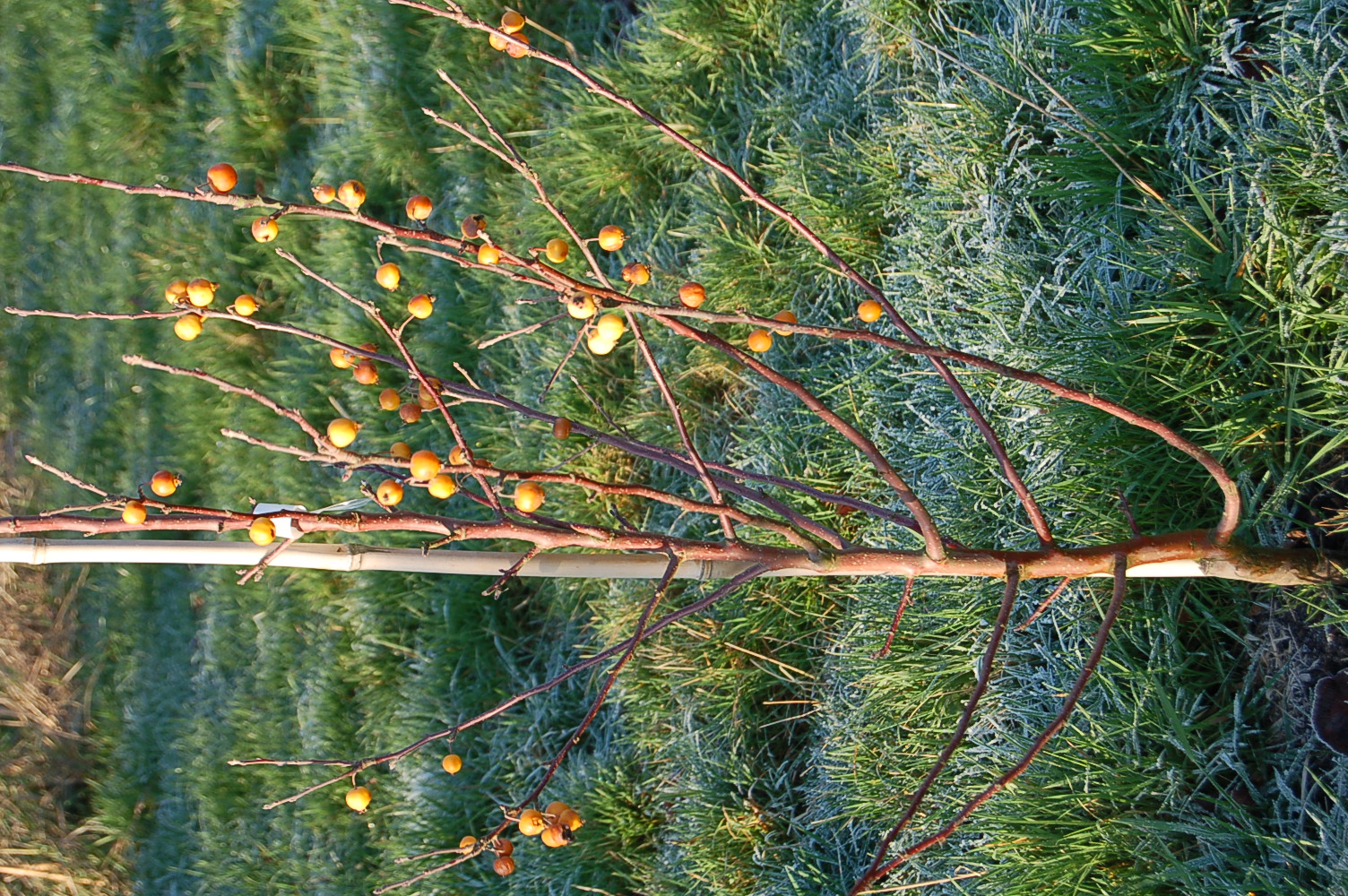
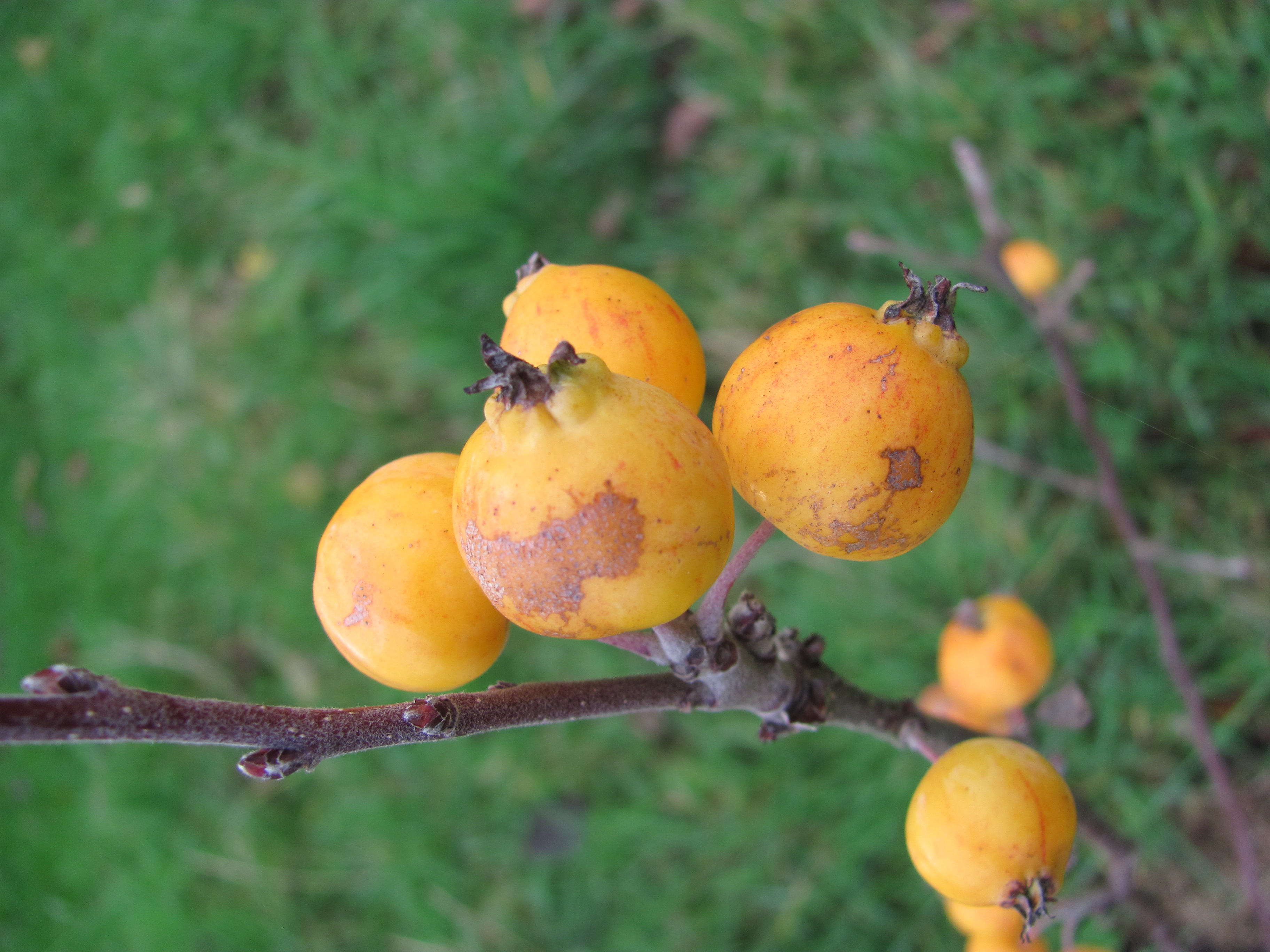
Our Winter Garden has so much of interest that I shall publish a blog just featuring it within the next few days, so for now we shall move on to the second orchard where the golden fruits of Malus “Evereste” have escaped the attentions of the winter visiting thrushes but I suspect they will soon be discovered and devoured. The insect stack in the orchard is there to attract beneficial insects who provide our very wildlife-friendly pesticide. The stack should give them some shelter to help them survive the winter cold and wet.
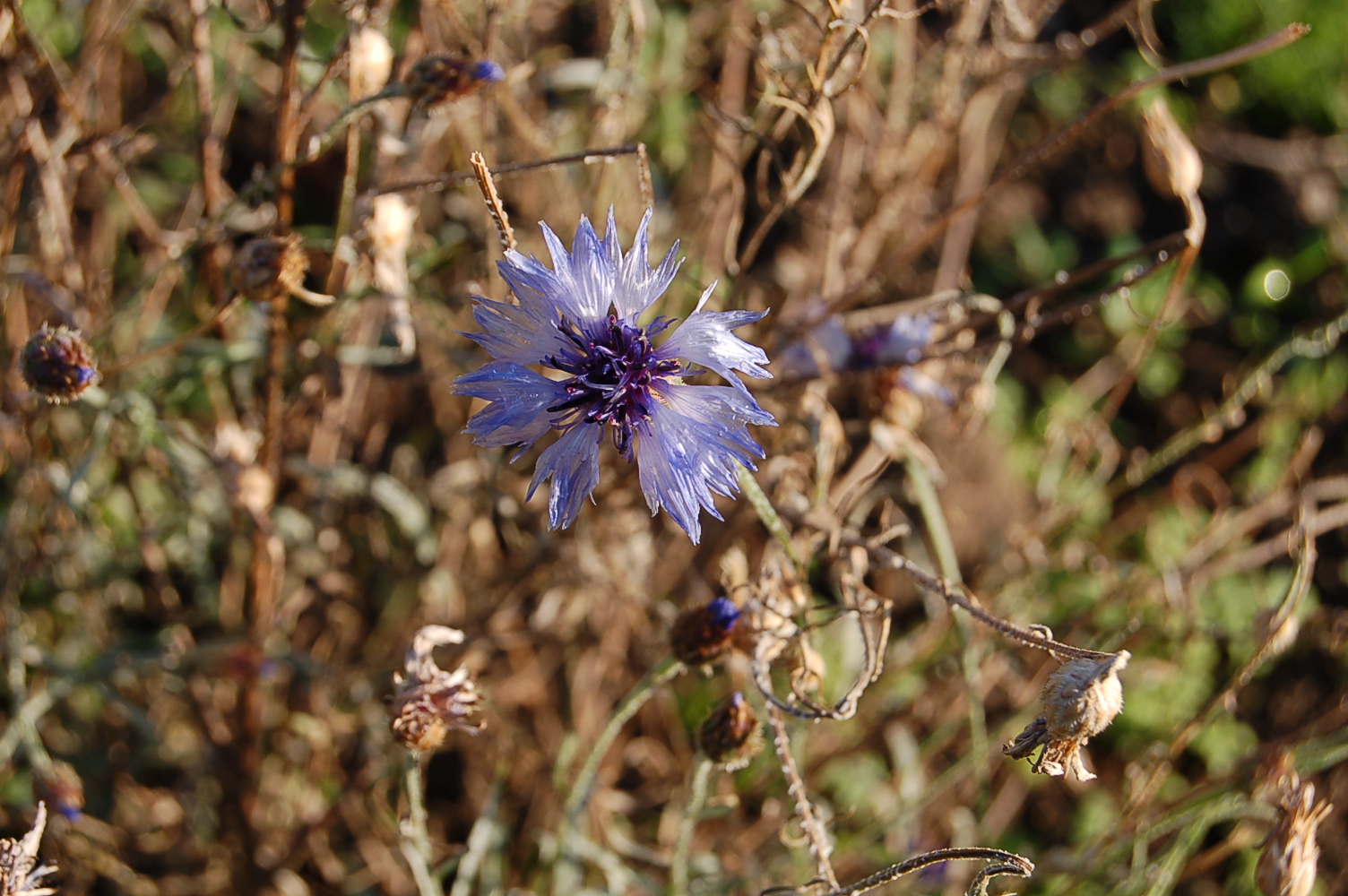
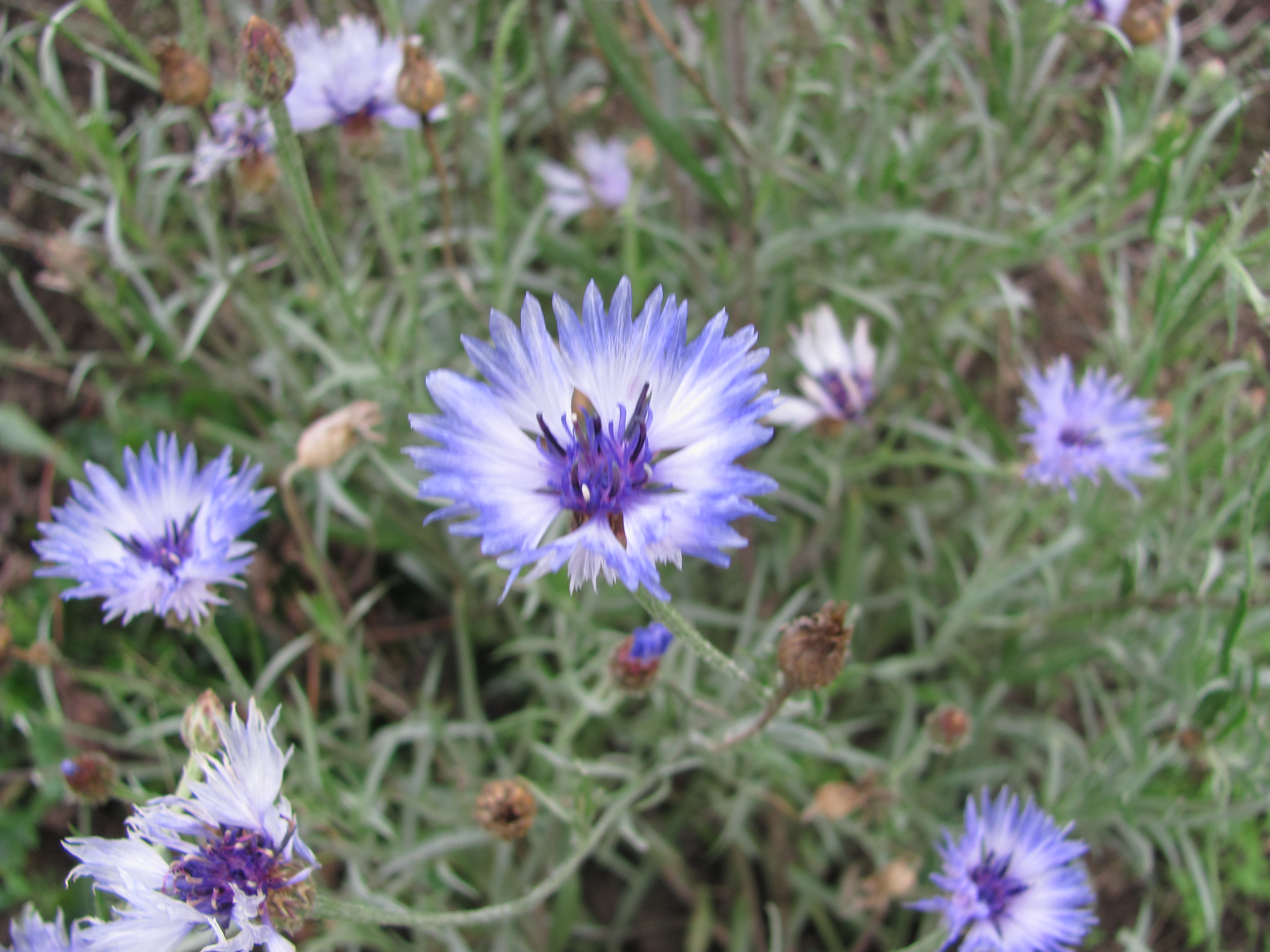
As we wandered back towards the car park we passed through the wildflowers meadows long since cut to the ground, but showing promise for next summer in its tiny seedlings. One lone flower braved the cold – a pale blue cornflower. Leaving the lotties we noticed promises of flowers from the bulbs in the car park border and in the half-barrels in the gateway.
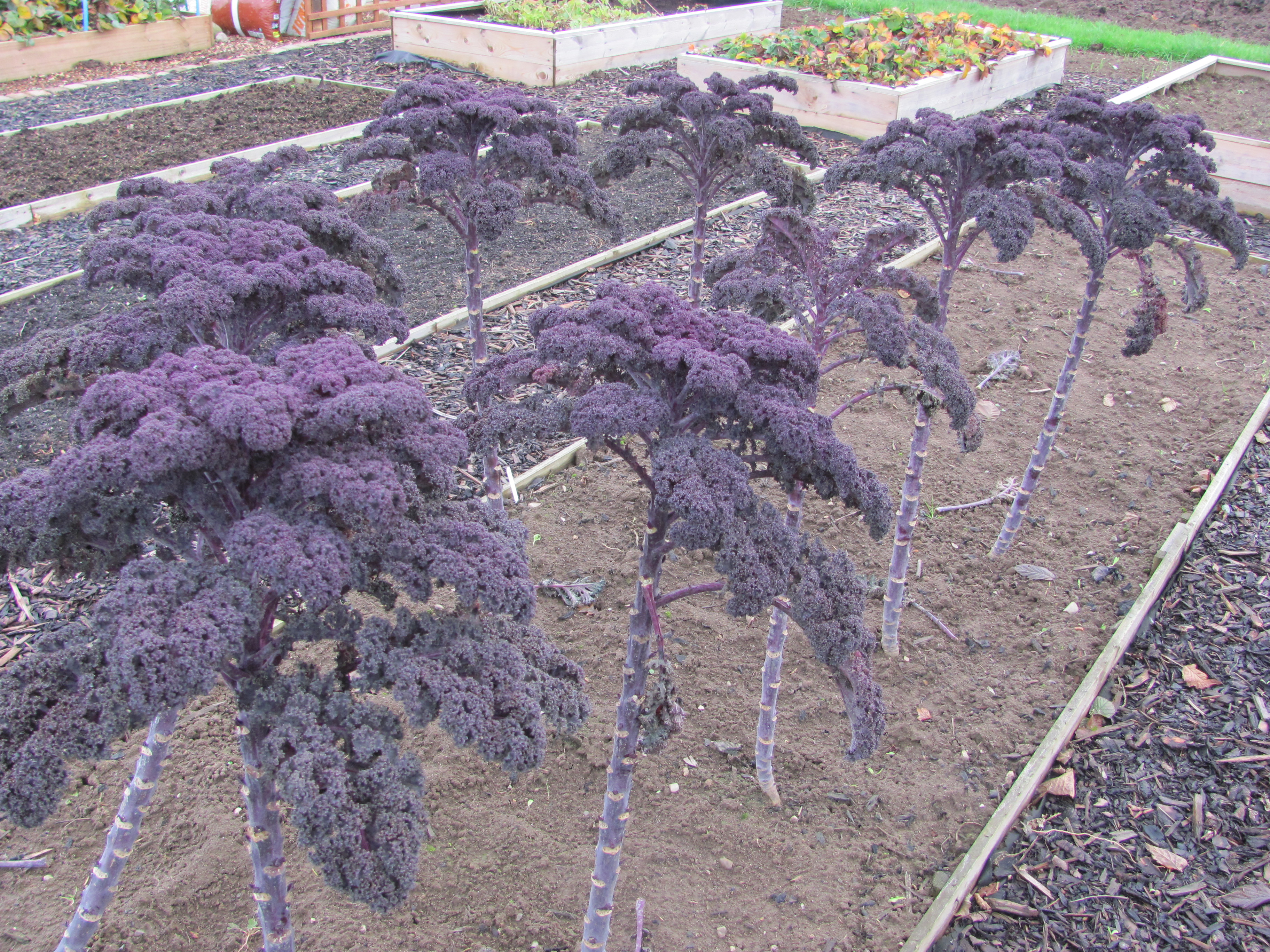
While wandering around the lottie site and having a nose at other gardeners’ plots, I spotted these kales which immediately reminded me of soldiers on parade. Standing tall at three feet, straight as can be and in neat rows they were on parade. Kales standing to attention!
Although now when I look at the photos, I am more inclined to think of Dad’s Army and the kale on the left of the back row is Corporal Jones!
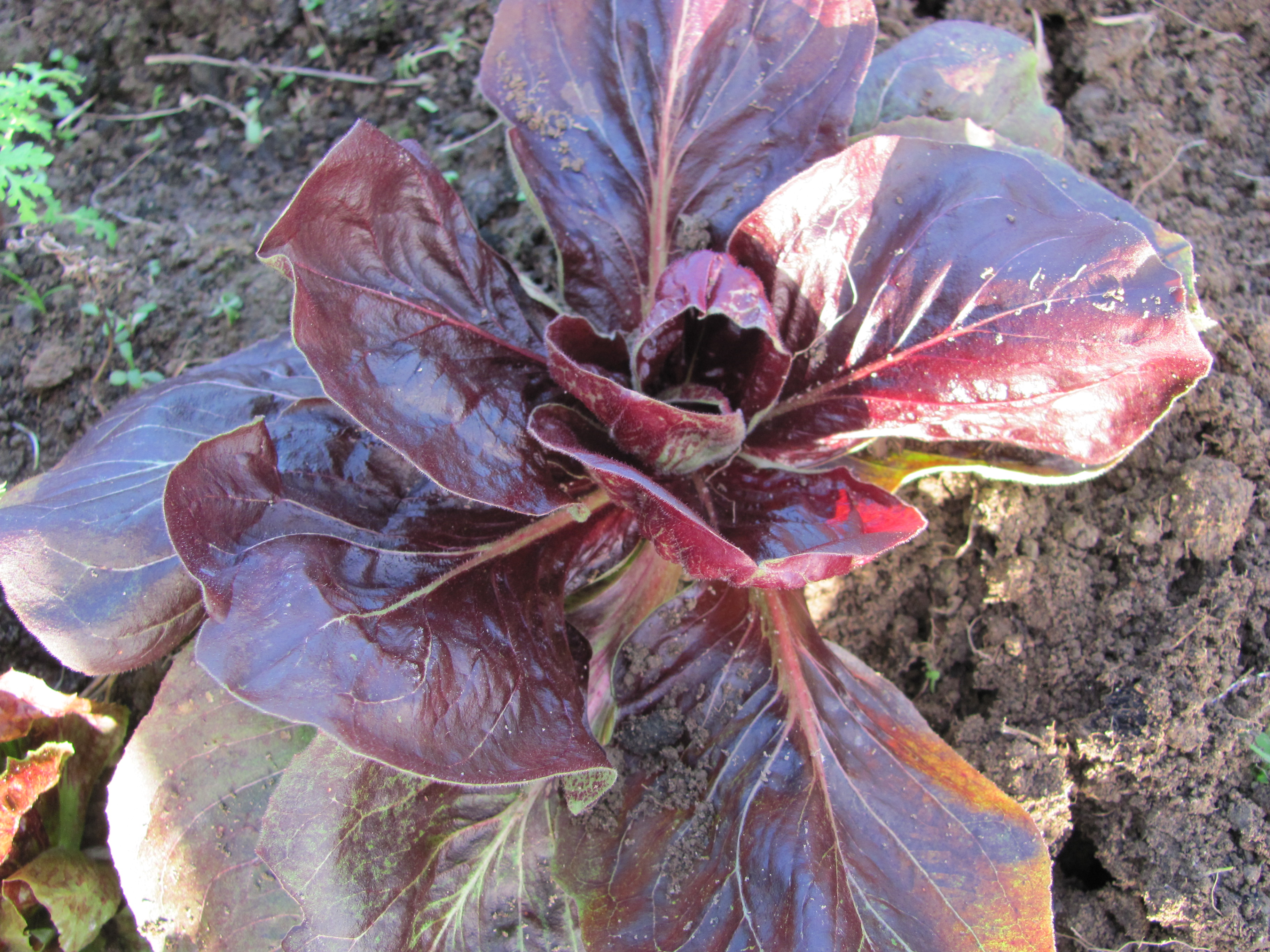
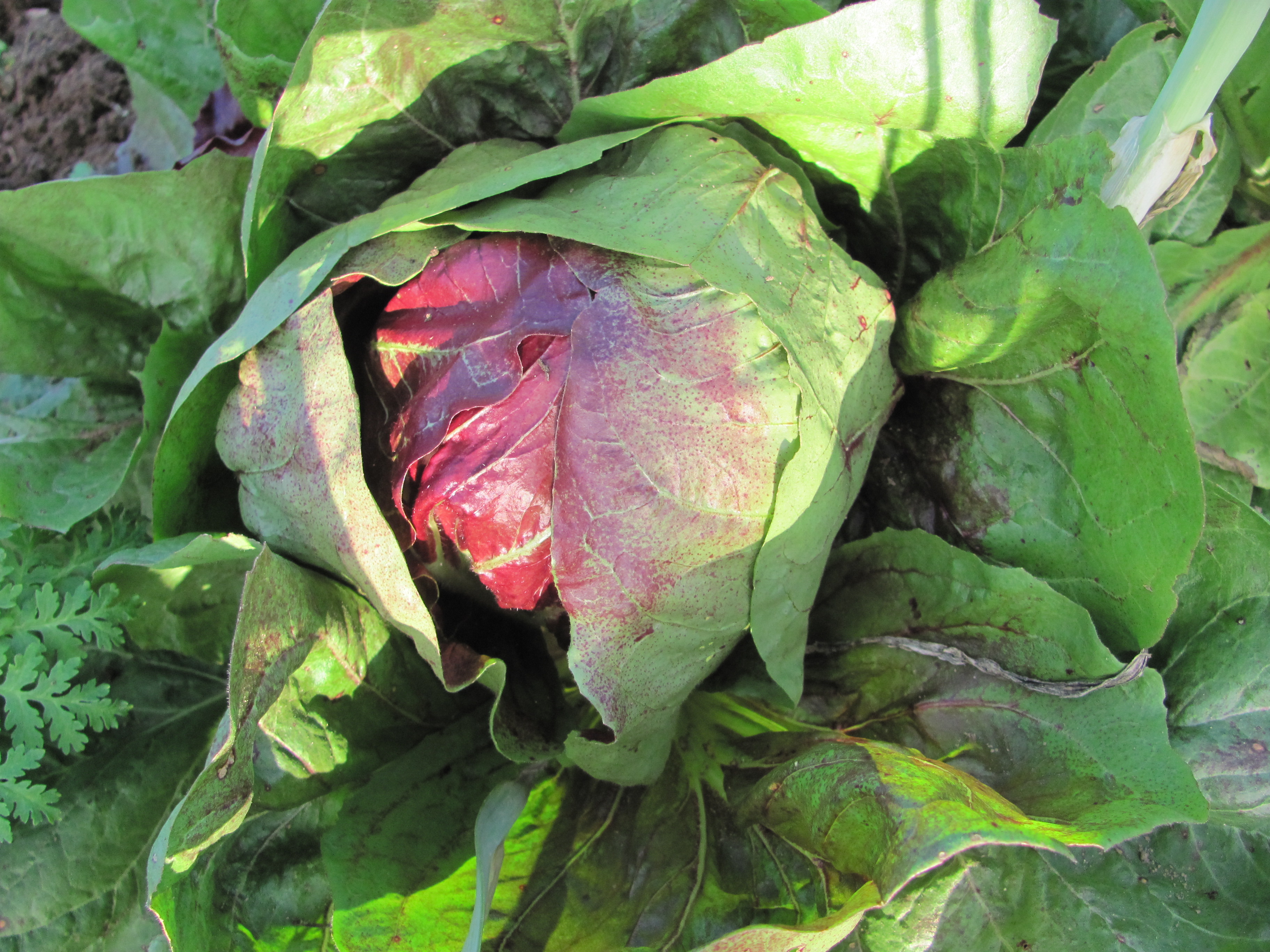
What a crazy day to be on the lottie with gale force icy cold winds howling across and freezing fingers, toes and cheeks. But when the sun burst through the clouds – very short but bright bursts – it acted as a spotlight that featured wonderful coloured leaves. Salad leaves provide the real stars of the show like these ruby leaved radicchio. They enjoy being in the spotlight, being the centre of attraction, glowing with pride.
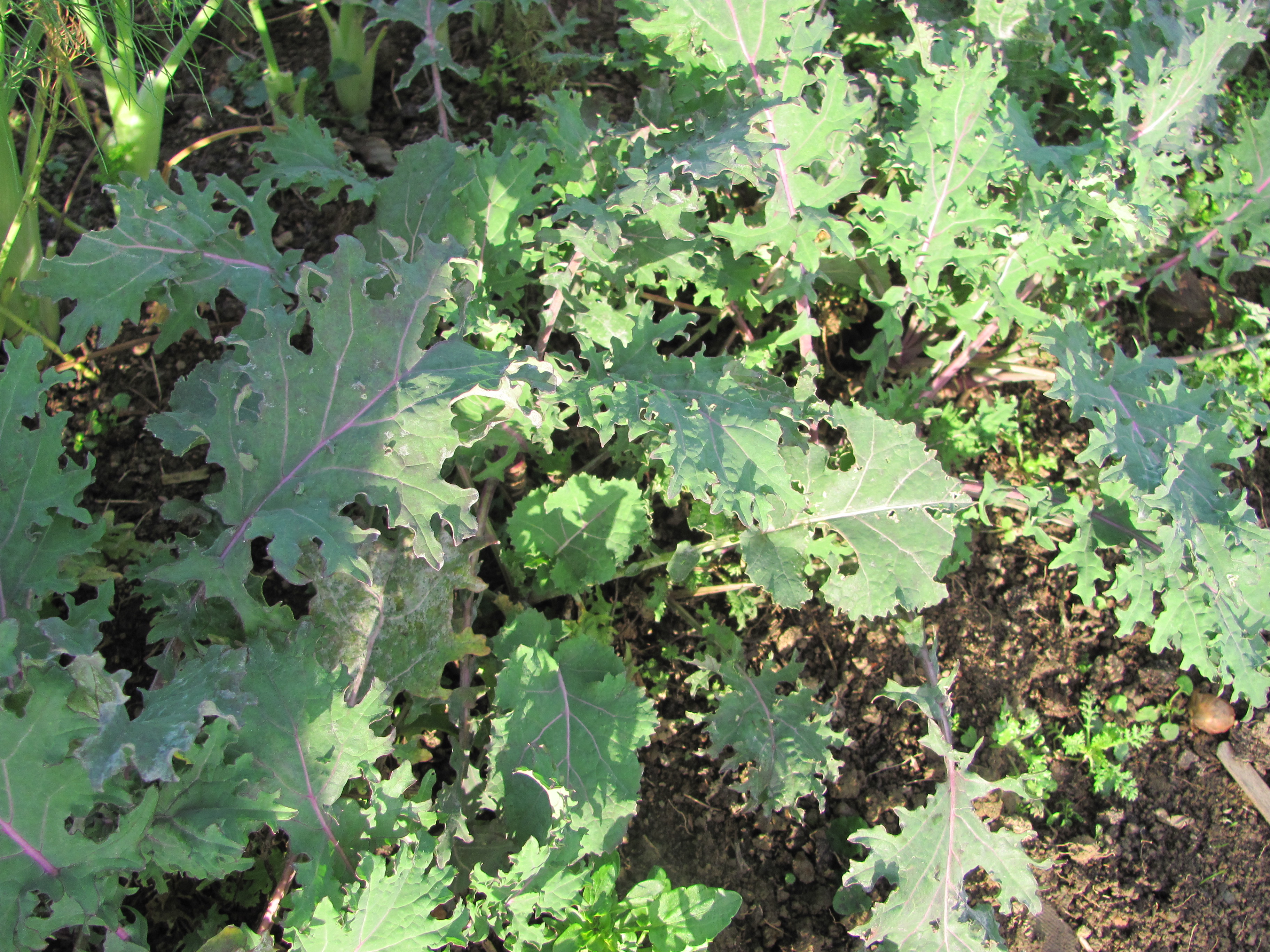
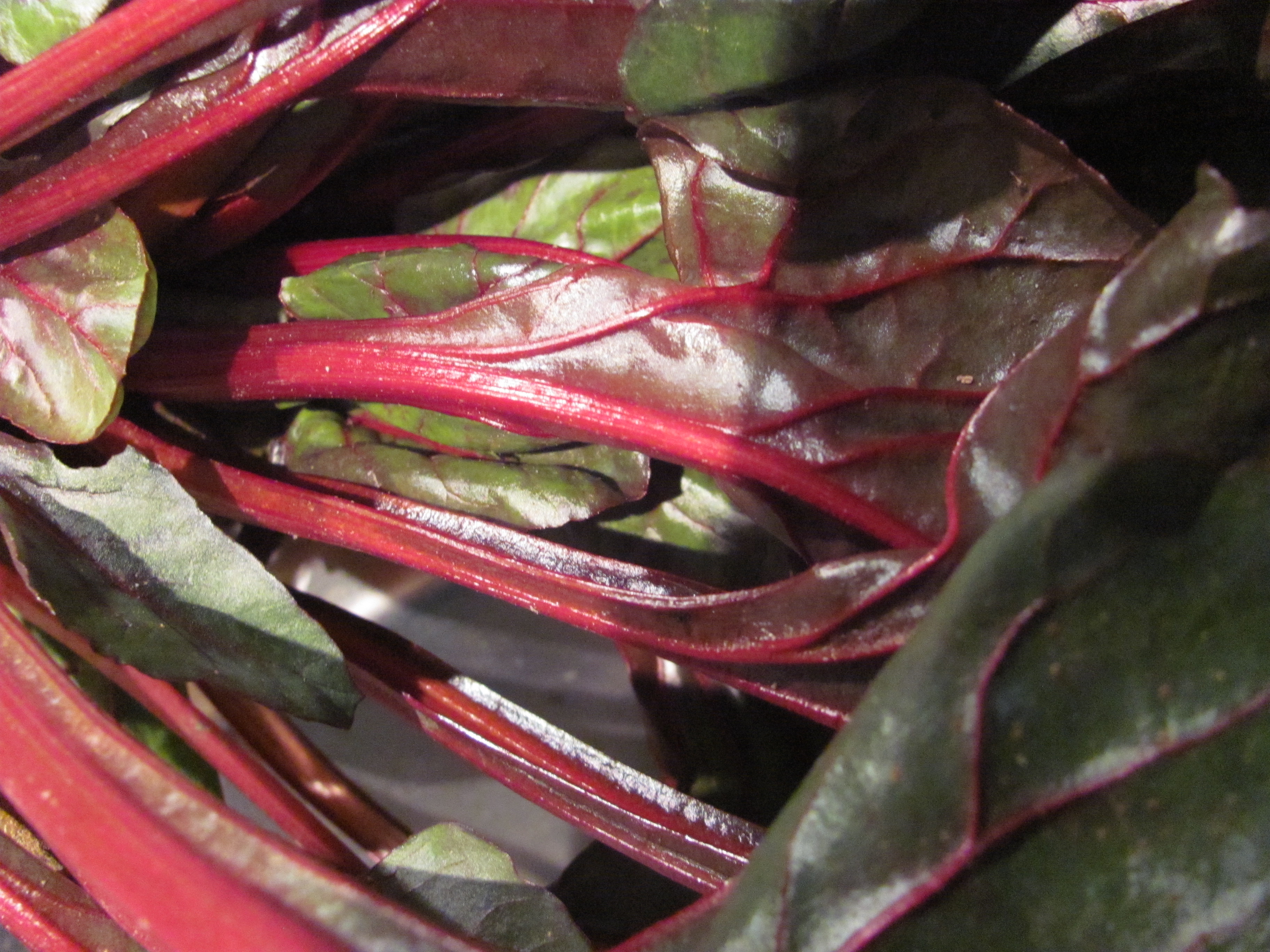
The brassica family are not to be outdone with their contribution coming from kales. The final shot is of a bunch of chard leaves that I plucked for the chickens. The light shows the glossiness and rich red-purple colouring of the leaves and stems.
The wonderful thing about these dark colourful leaves especially those with red and purple featured in their make-up is that in addition to being good to look and tasty to eat they are also better for us than their green-leaved relatives.
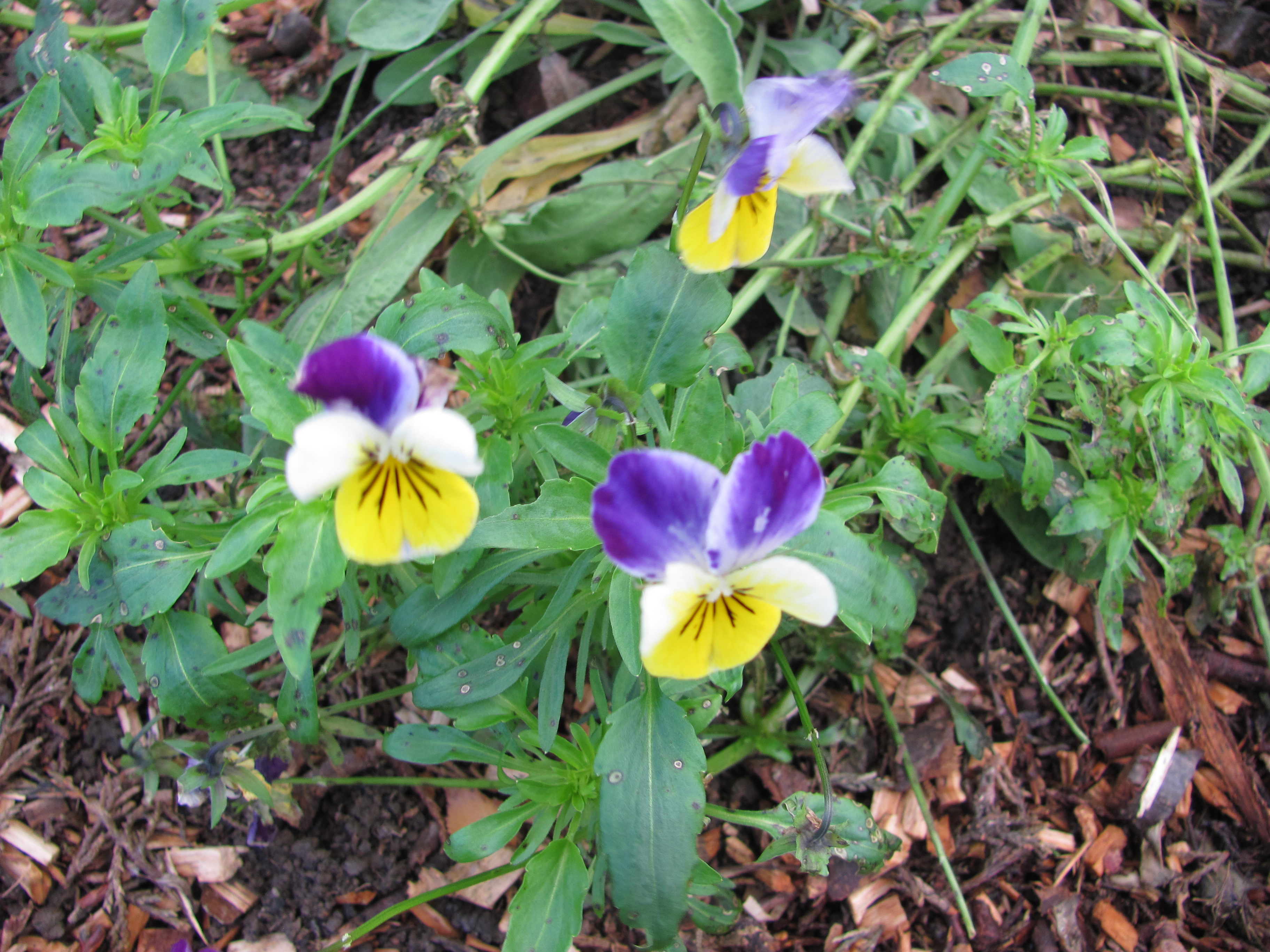
After putting away our tools and closing up our shed we took a few moments to wander around the site and see what was happening. we found surprise bonus flashes of colour. Flowers blooming out of seasons calendula and violas in the Winter Garden and a catanache the last bloom in the wildflower meadow.
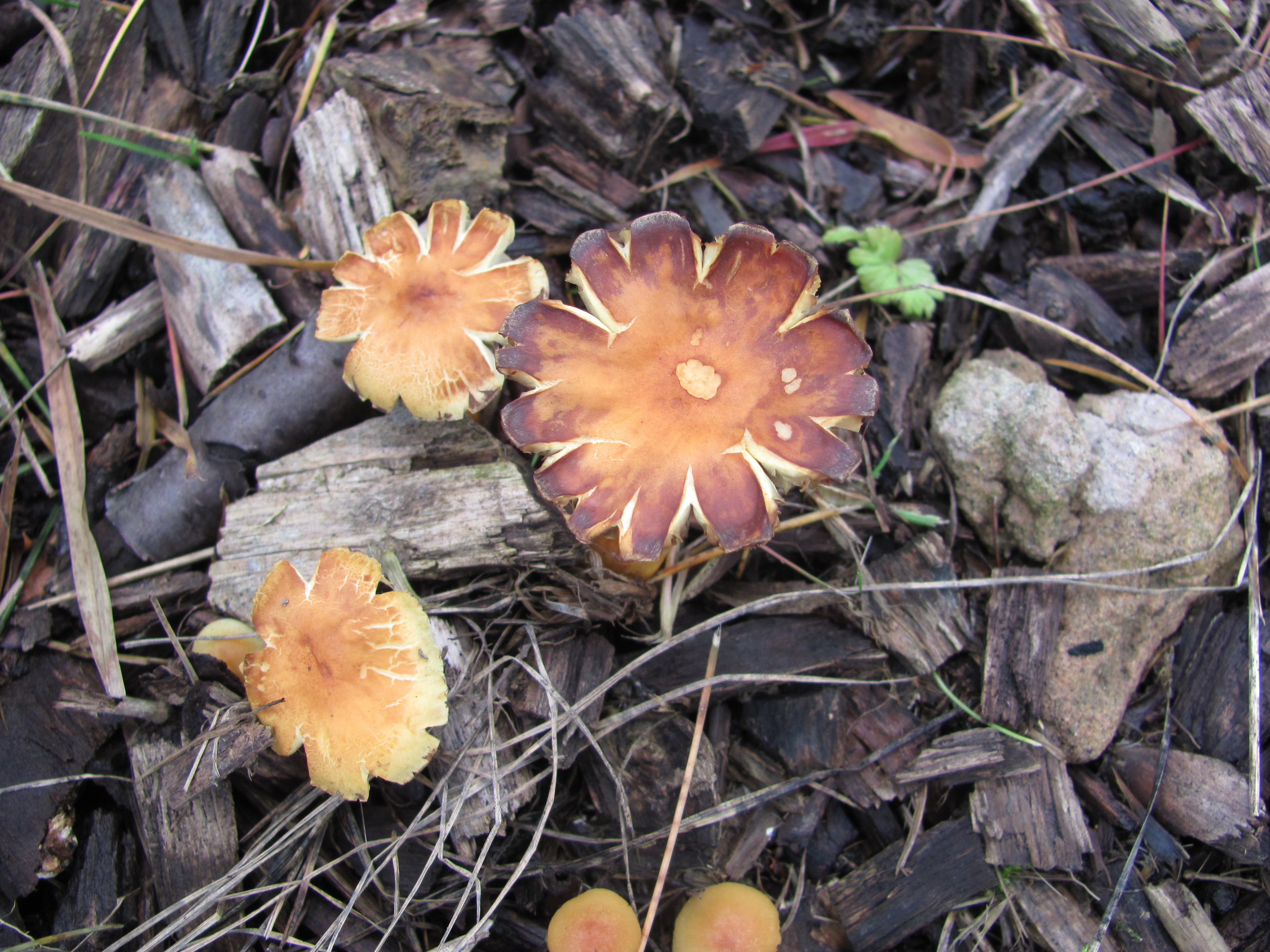
In the small orchard the yellow of the crab apple, Malus “Evereste”, glowed like beacons hanging on defying the sharp cold and strong winds. In the turf spiral maze clumps of fungi take advantage of the protection form the turves They emerge from the bark chips we use as the walkway through the maze. They begin their life a colouful yellow but as they age their edges turn chocolate brown and they look like burnt buns until they begin to go over and dry. Then their caps split and let yellow cracks appear giving them the appearance of flowers.
We spent today on the lottie catching up on a few jobs and taking advantage of some sun and warmth, a December treat. We popped up for half an hour to plant 3 rose bushes owed to us from our big delivery of David Austin roses last year. So we added three Wenlock roses to our site’s community Summer Garden. The half hour became an afternoon as we planted whips of native trees and shrubs in the native hedge and “Edible Hedge”, rowan, elder, dogwood, wild cherry, cherry plum etc.
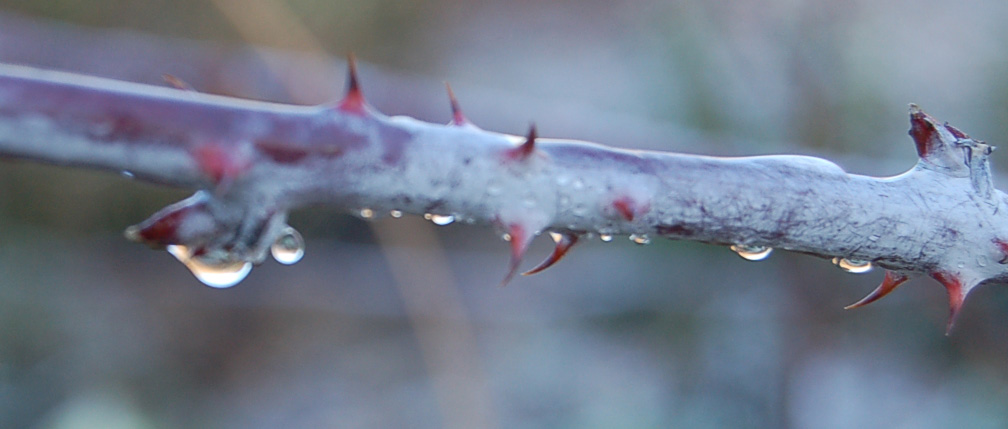
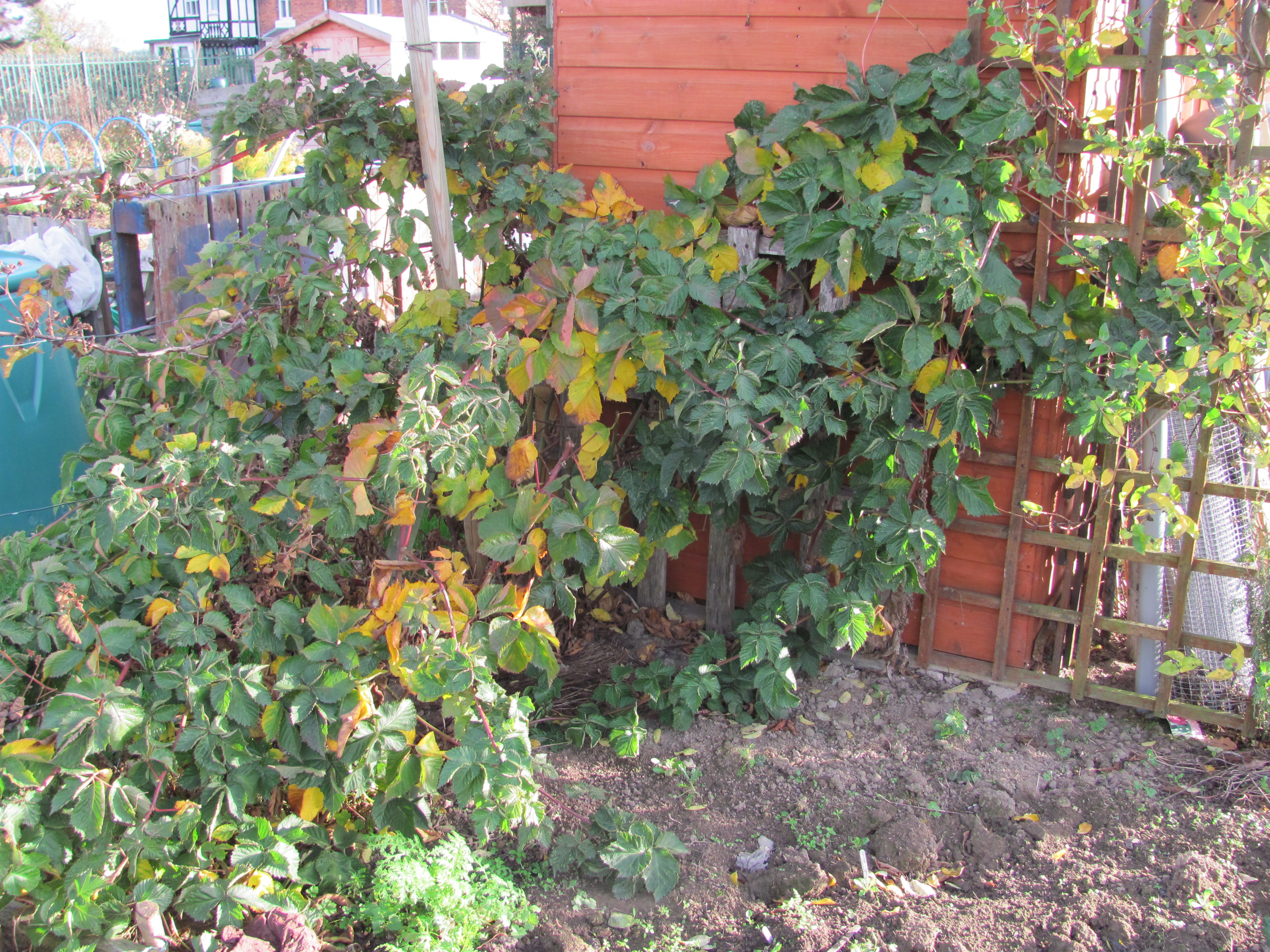
Then we turned our attention to our own lottie where the blackberry and tayberry were crying out for attention. The blackberry had put on masses of growth last year so I set to pruning out the brambles that had fruited this year and thinned out some of the new growth. Luckily it is a thornless variety. Once tied back in it all looked much more tidy and we looked at it willing it to be productive for us next year. The tayberry, although not thornless, is still a young bramble so took less work.
The Blackberry prior to pruning.And after pruning.
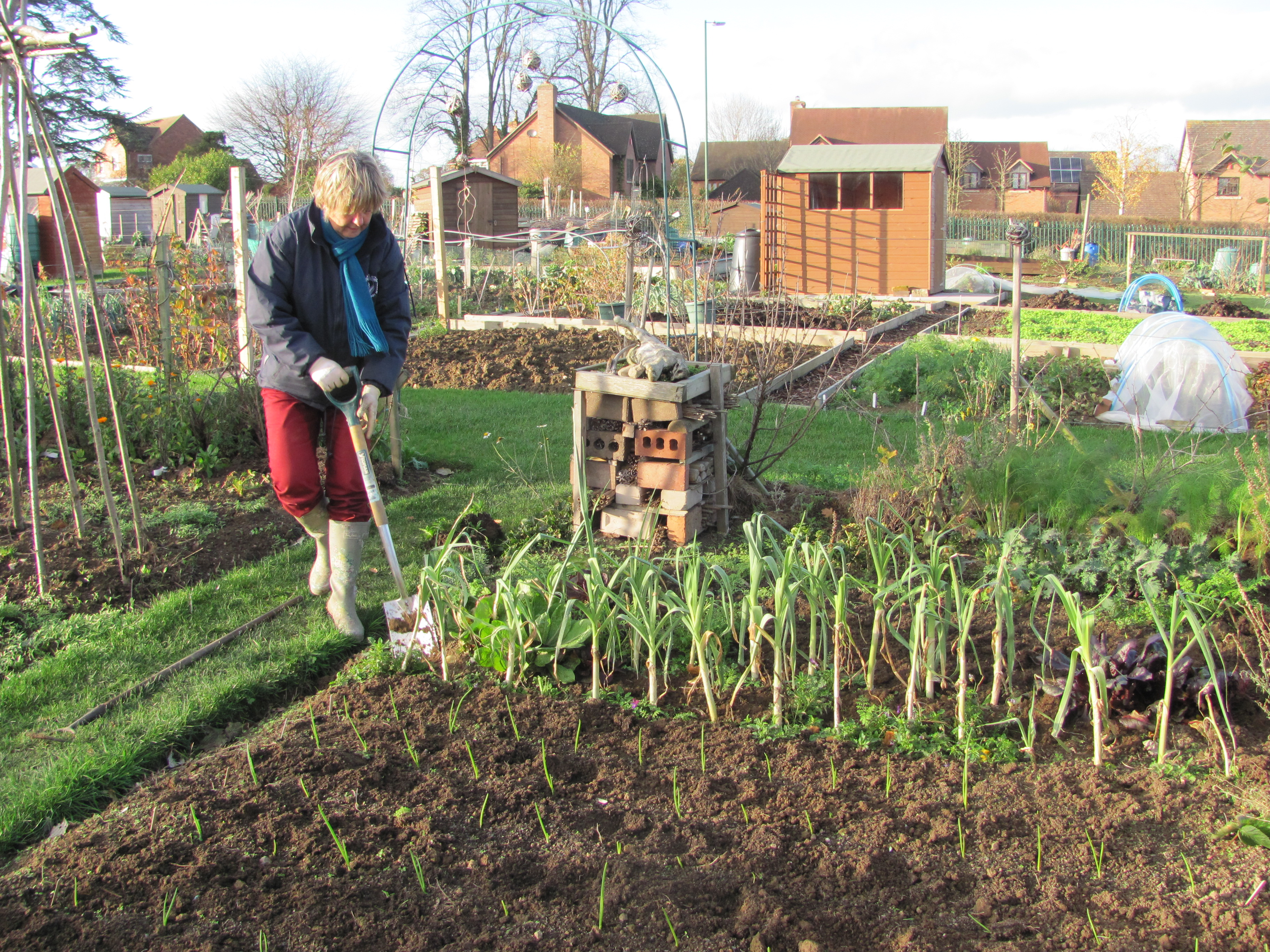
Meanwhile as I tackled the brambles, Jude the undergardener hoed between the rows of overwintering crops. This is the most efficient way of keeping an allotment plot looking tidy as well as killing any tiny seedlings even those yet to emerge from the soil.
The fresh growth of garlic, onions and shallots spear the soil and its compost topping with bright green freshness, a real treat in the winter cold. The broad beans planted in early autumn and the mooli sown in late summer add a welcome lushness of growth.
Broad bean plants patiently waiting out winter.Moolii, the radish with white icicle roots for winter enjoyment.
Ground left bare through the winter would be thrashed by winter rains and its goodness leached out so we cover such patches with green manure such as winter tares. This year when we sowed it in early autumn the weather was so dry that germination was delayed and growth of the seedlings has been so slow that they are still small. We are hoping they will catch up if the weather allows. The Phacelia in the photo below however germinated well and has grown on healthily. It was self-sown from a patch of wildflowers sown as a bug bank.
So as we are now officially in winter and temperatures are dropping to nearer seasonal norms, the plot is looking good. Next year’s seeds are ordered as are the seed potatoes so we are well ahead of ourselves. The photo below looks through the newly pruned tayberry at the rows of leeks, mooli and broad beans.
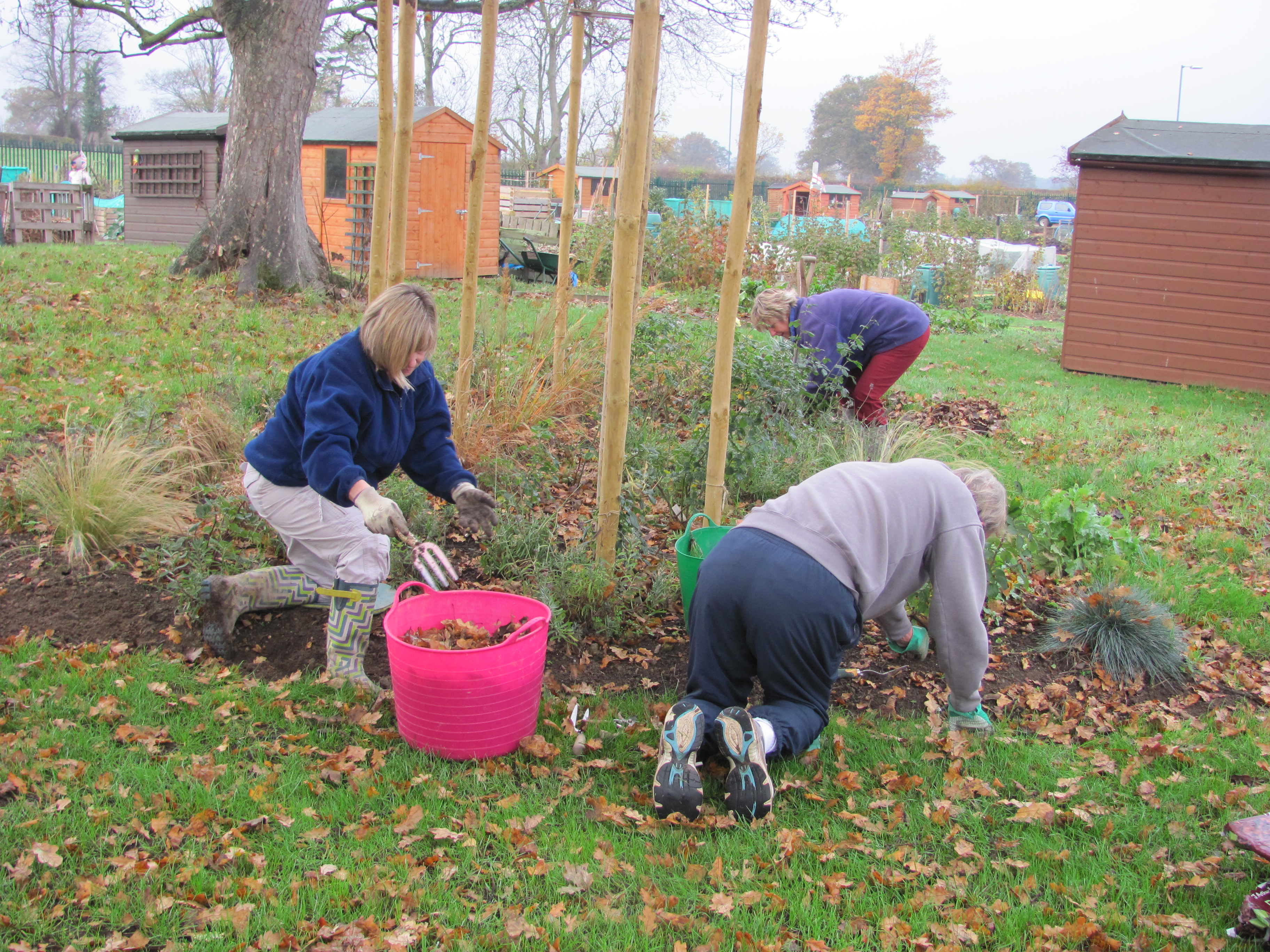
The final working party of the year at the lottie site at the weekend. The hardy members worked hard under dull November skies stopping frequently for coffee and laughter. We cleared our list of jobs to be done so went home exhausted, aching but satisfied.
The first job was to weed the Summer Garden, collect up the fallen leaves, give the roses a good dose of good old-fashioned cow muck and finish off by mulching the surface with woodchip to protect the bed from the winter cold and rain. One of the Charles Darwin rose bushes was still in flower so gave a glimpse of yellow and a burst of scent as we worked.
We then treated the three Buddleja Beds and the sensory garden to a weed and mulch. So now all the beds on the site have been weeded and have a protective duvet of woodchip on them.
We then split up with Geoff giving the small meadow a haircut and weed. We were amazed by how many seedling of wildflowers decorated its surface. this job would normally be done much earlier in the year but this meadow has only just finished flowering. The rest of us planted bulbs in one of our orchards including Camassia and crocus, and took hardwood cuttings of coloured stemmed dogwoods and willows.
'The most important and informative publication on wildlife of our times' - The Independent. This blog is a member of The UK & Ireland Natural History Bloggers group: www.uknhb.blogspot.com















































 greenbenchramblings