May is a busy month on the allotment, seeds need sowing, seedlings need thinning, weeds need hoeing and early crops reward us with early harvests. And of course our grass paths separating the four areas of the plot need regular mowing.
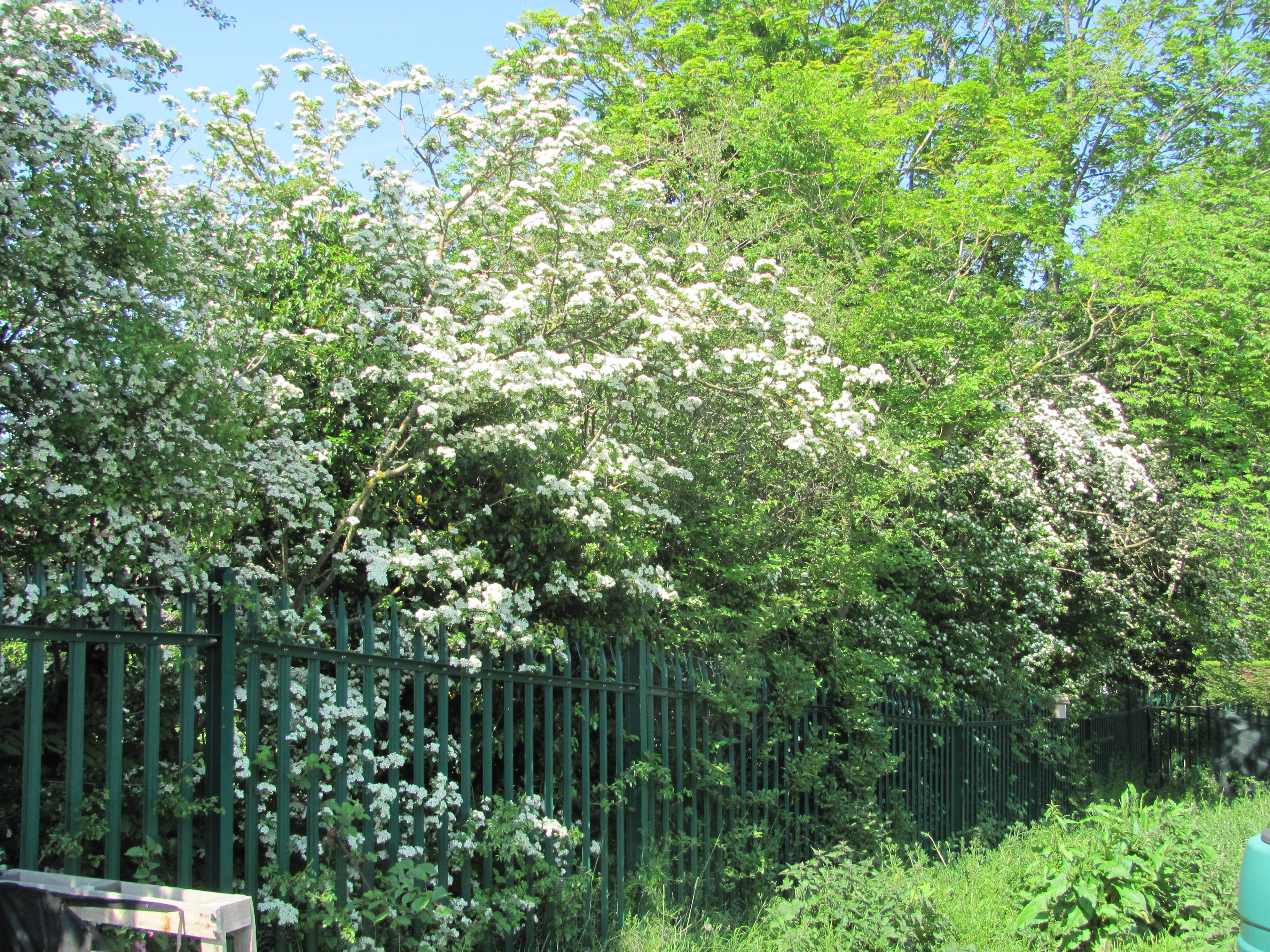
The Hawthorns in native hedges around the site are smelling good and looking good.
The wildlife all around is equally busy, seriously going about the business of breeding with all its inherited trials and tribulations. The weather, predators, prey availability and the search for food for both adults and nests full their young all contrive to make their lives difficult.
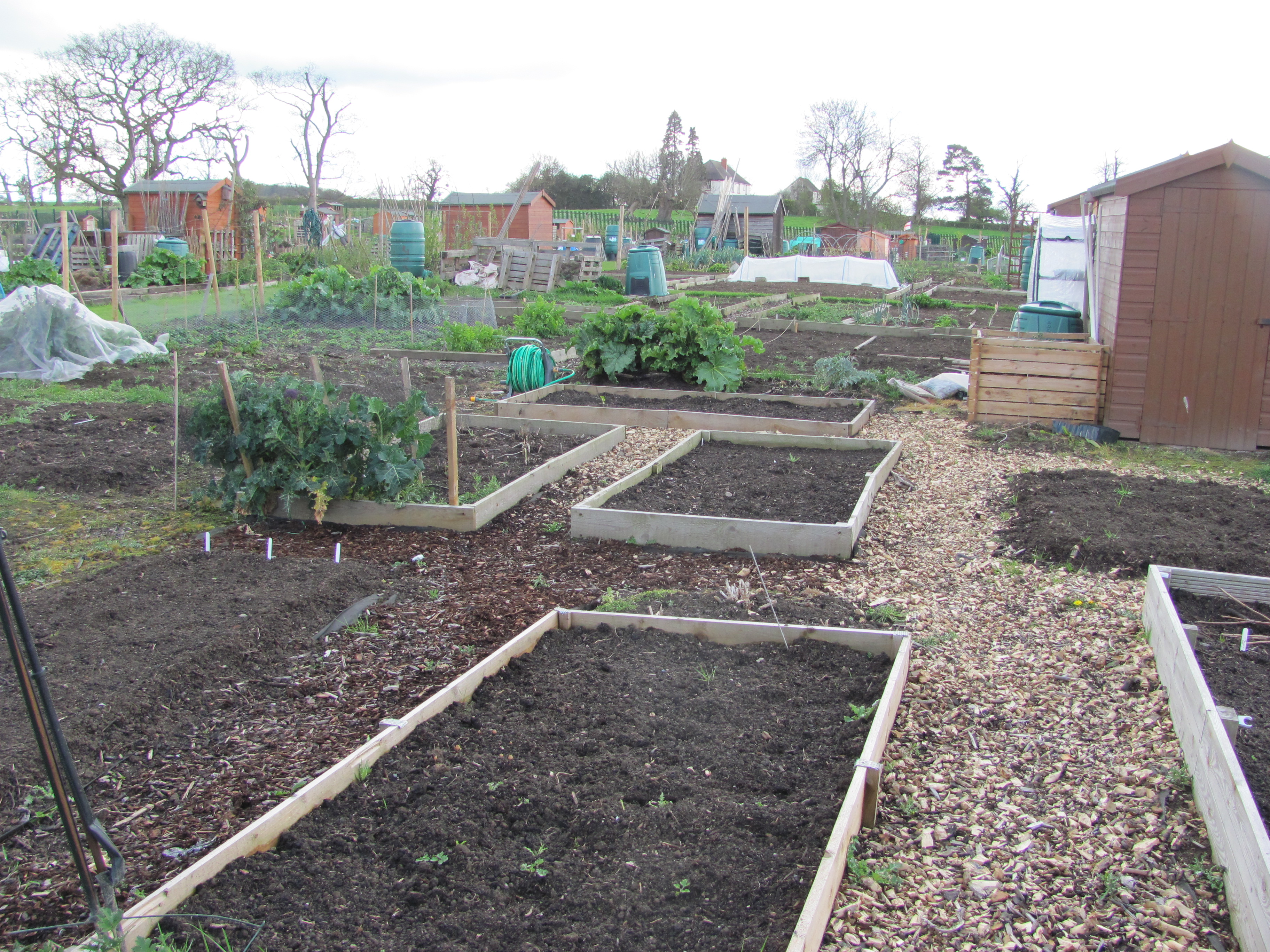
We shall begin our May lottie wander on our own plot to see what is going on. The soil is now easily worked so using the hoe to remove seedlings is easy so the plot is looking tidy.
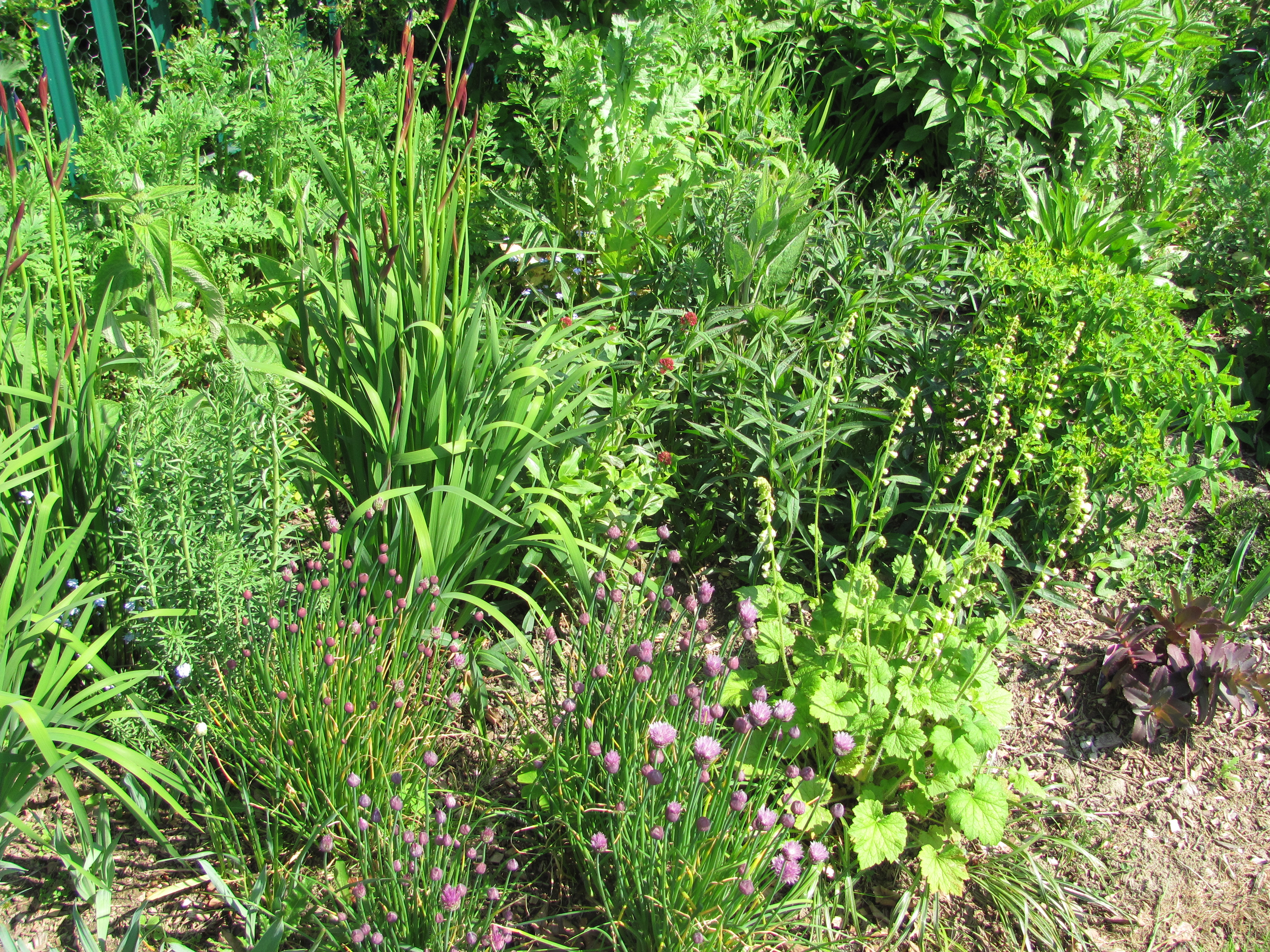
Our brassicas are coming along well underneath their protective cover.The perennial bug borders are looking good.Multi-coloured radiccio.
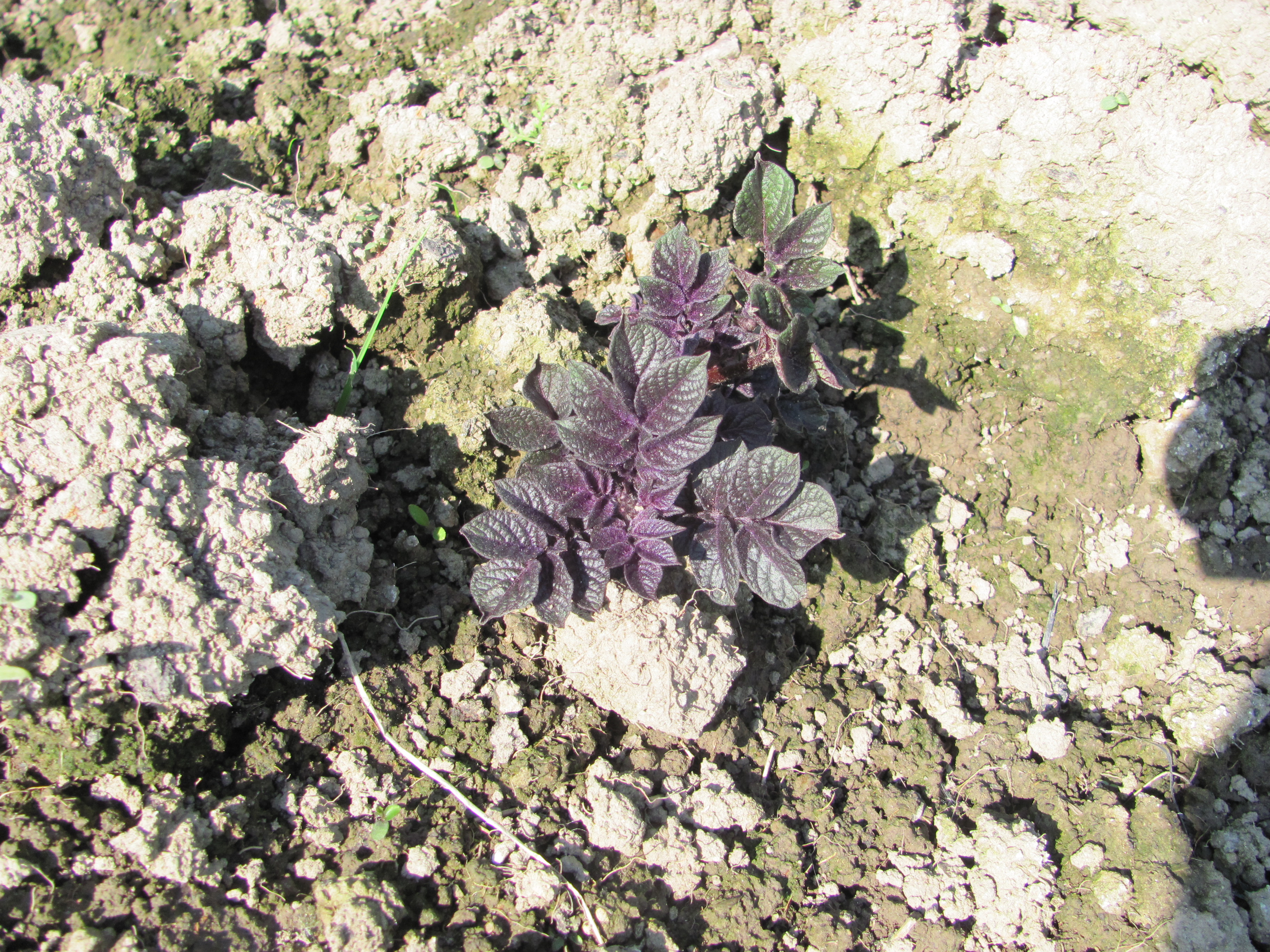
Whenever we are working our plot or helping maintain the green spaces around the site, we are entertained by birds of prey, Buzzards and Kestrels soaring or hovering over our heads and around our feet Robins, Blackbirds, Blue and Great Tits, and Song Thrushes search for food for their young hoping we disturb grubs and bugs with our digging, raking and hoeing. More secretive in their search for fodder for young are the Black Caps, Woodpeckers and Nuthatches. Overhead the hirondelles, (Swallows, Swifts and House Martins), having recently returned from their winter haunts greedily scoop up insects on the wing.Although the weather has been warm and dry for a few days now the end of our plot where the clay comes nearest the surface and the topsoil is very thin, water still saturates the land, making working it impossible. But in this wetness in the ridged soil our Red Duke of York potatoes are pushing their purple tinted foliage out towards the sunshine.
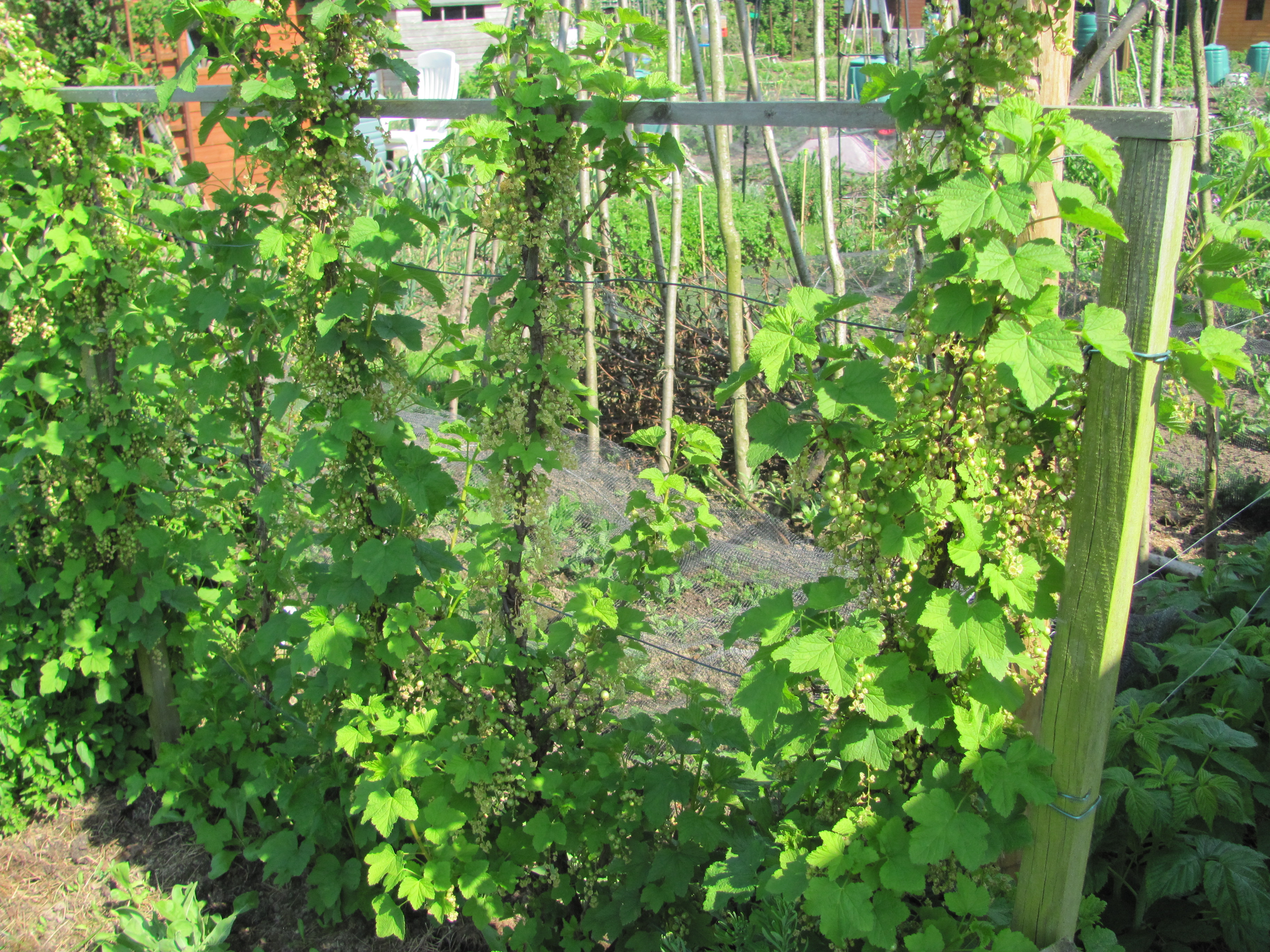
Red Duke of York appearing above the algae tinted soil.Our cordon Red Currants are flowering heartily and starting to set fruit.
In the orchards and over the meadows wildflowers are blooming alongside naturalised ornamental bulbs, attracting butterflies, the crinkle winged Commas, the Orange Tips with orange tips to their wings and the wonderful ethereal Holly Blues.
Bulbs and Buttercups under the fruit trees in the orchard.We attract predator insects into the orchards with these insect homes. They are a wildlife friendly pesticide.
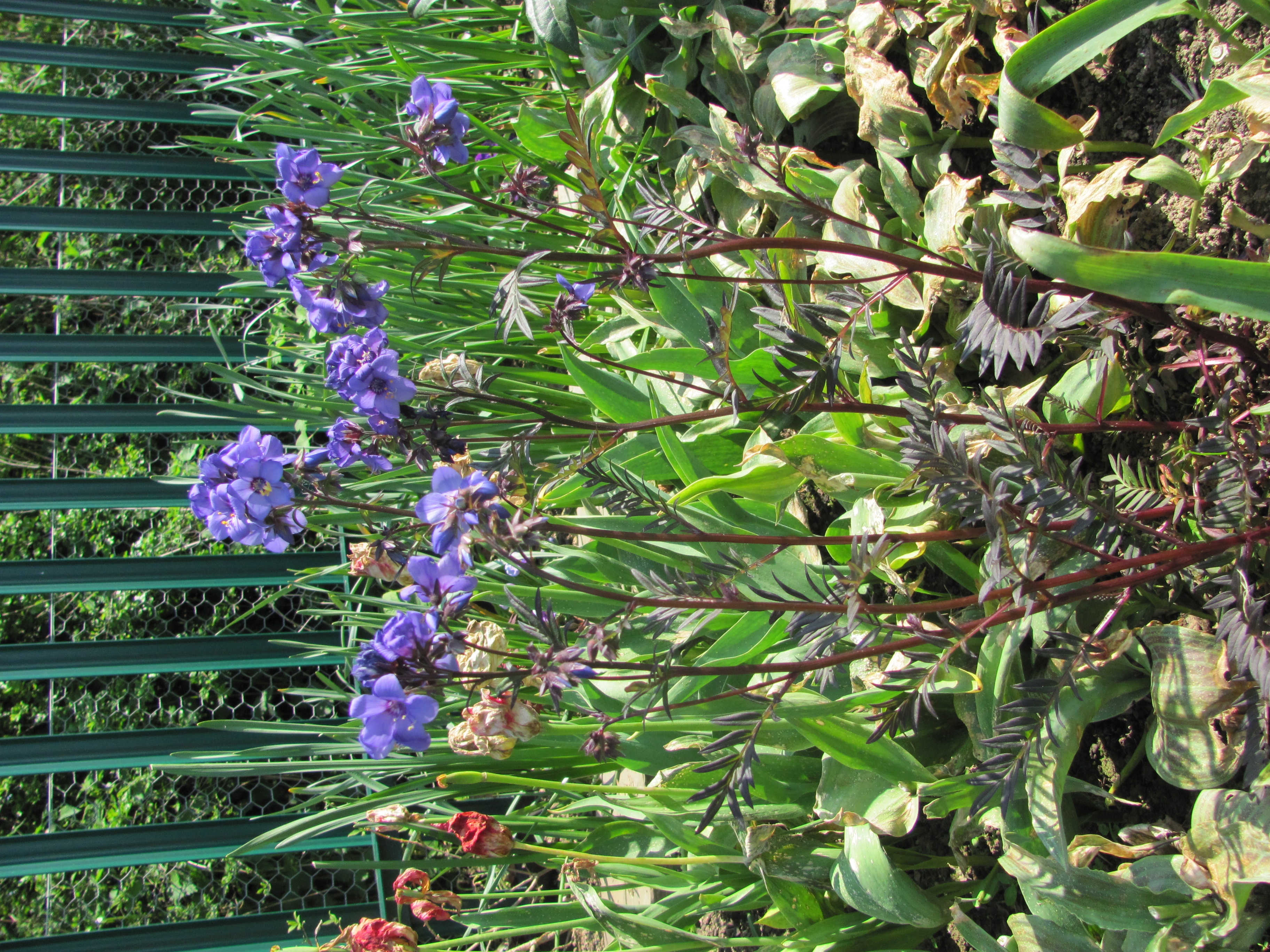
The Buddleia Borders are coming to life now and the Spring Garden remains very colourful.
Two plot holders, Phil and Doreen, have created a new bed in a shaded area near their plot and made it accessible for all to enjoy.
Most plots are ready for sowing and planting or partly planted up and sown.
Our May Working Party jobs were decided upon by where the shade was, as it was too hot to work in the full sunshine. We managed to get most of our tasks completed though.
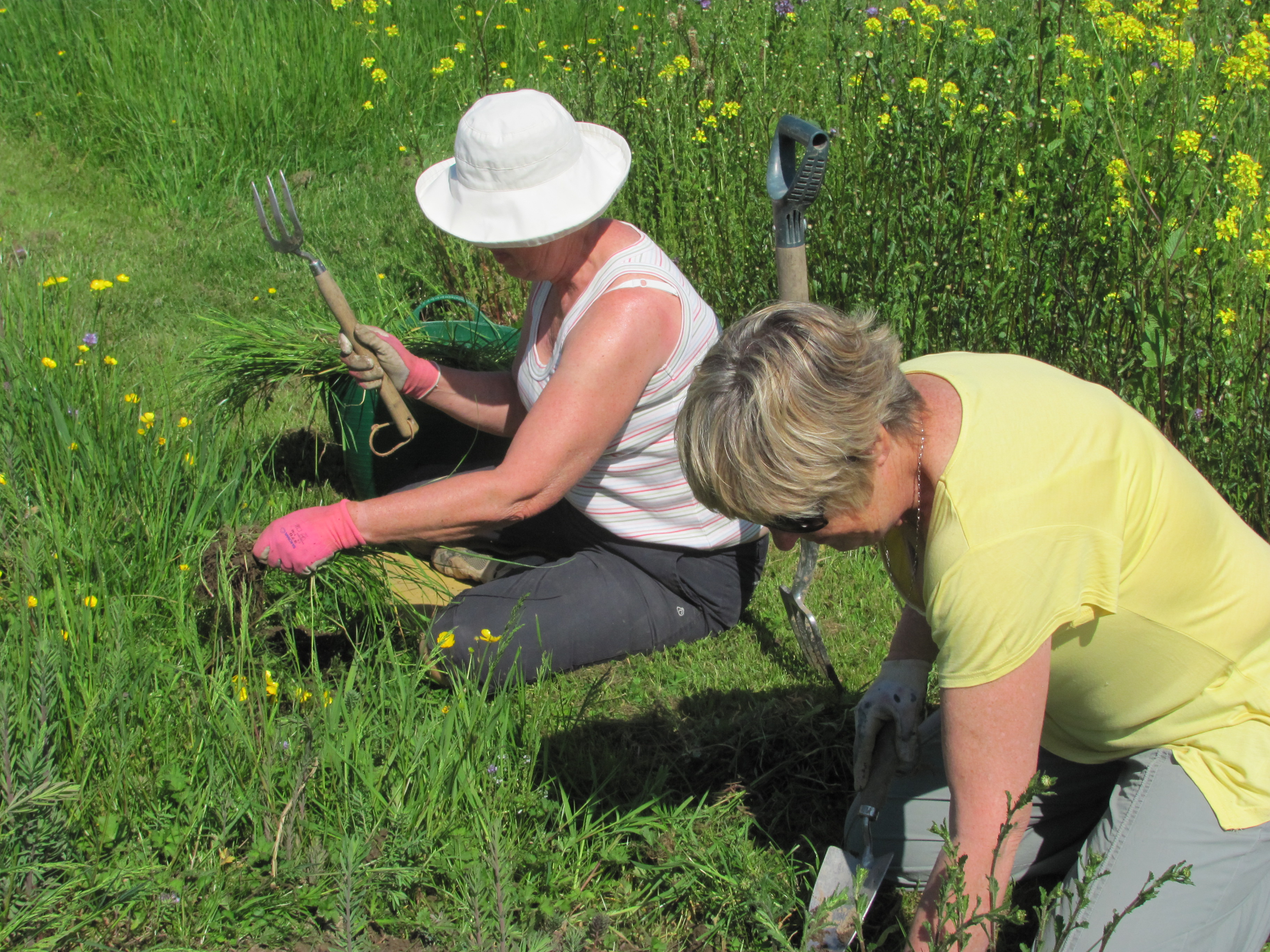
Heads down for weeding the meadows.Kneeling down on the job attacking those pernicious weeds that creep into the meadows.
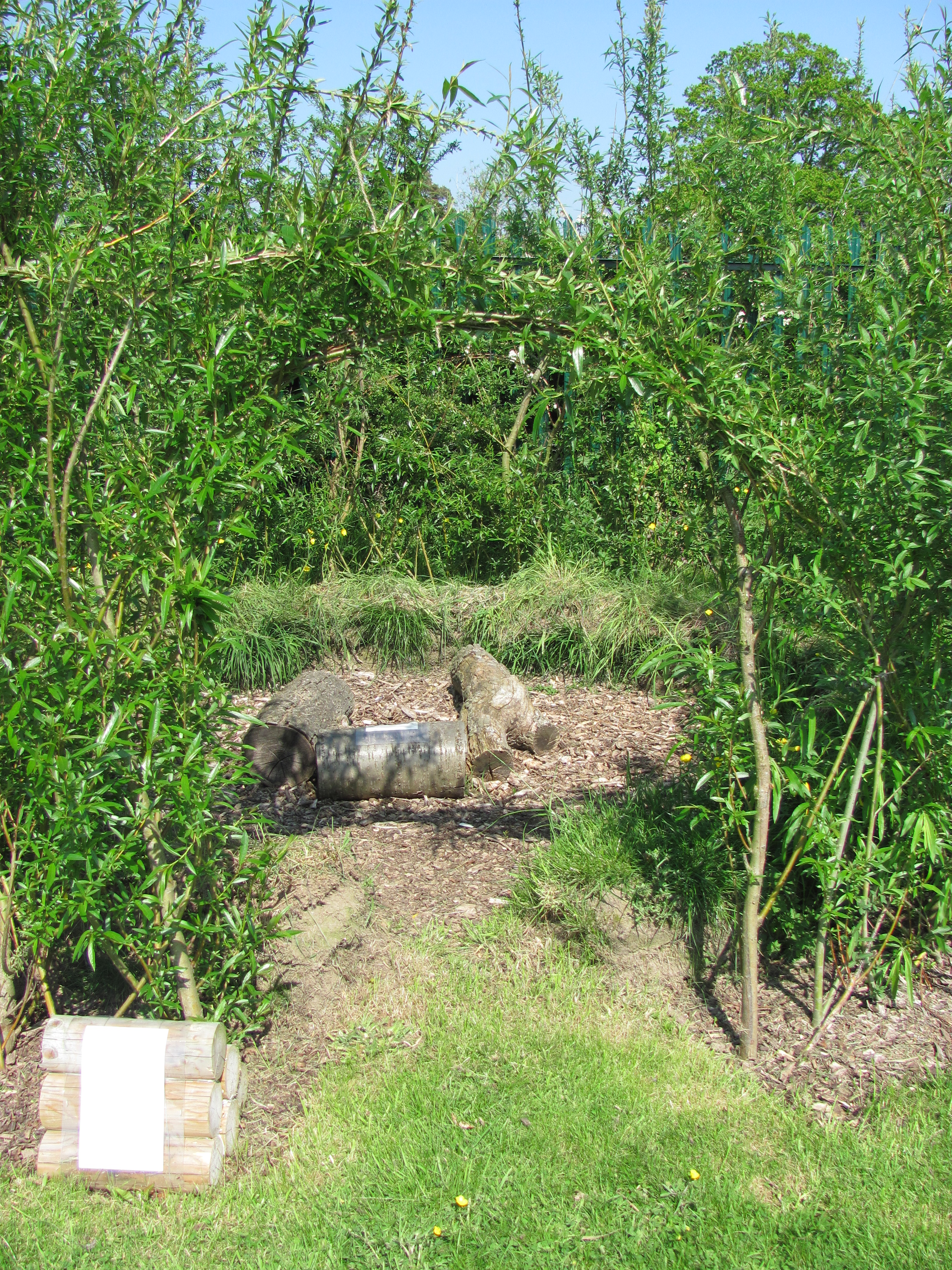
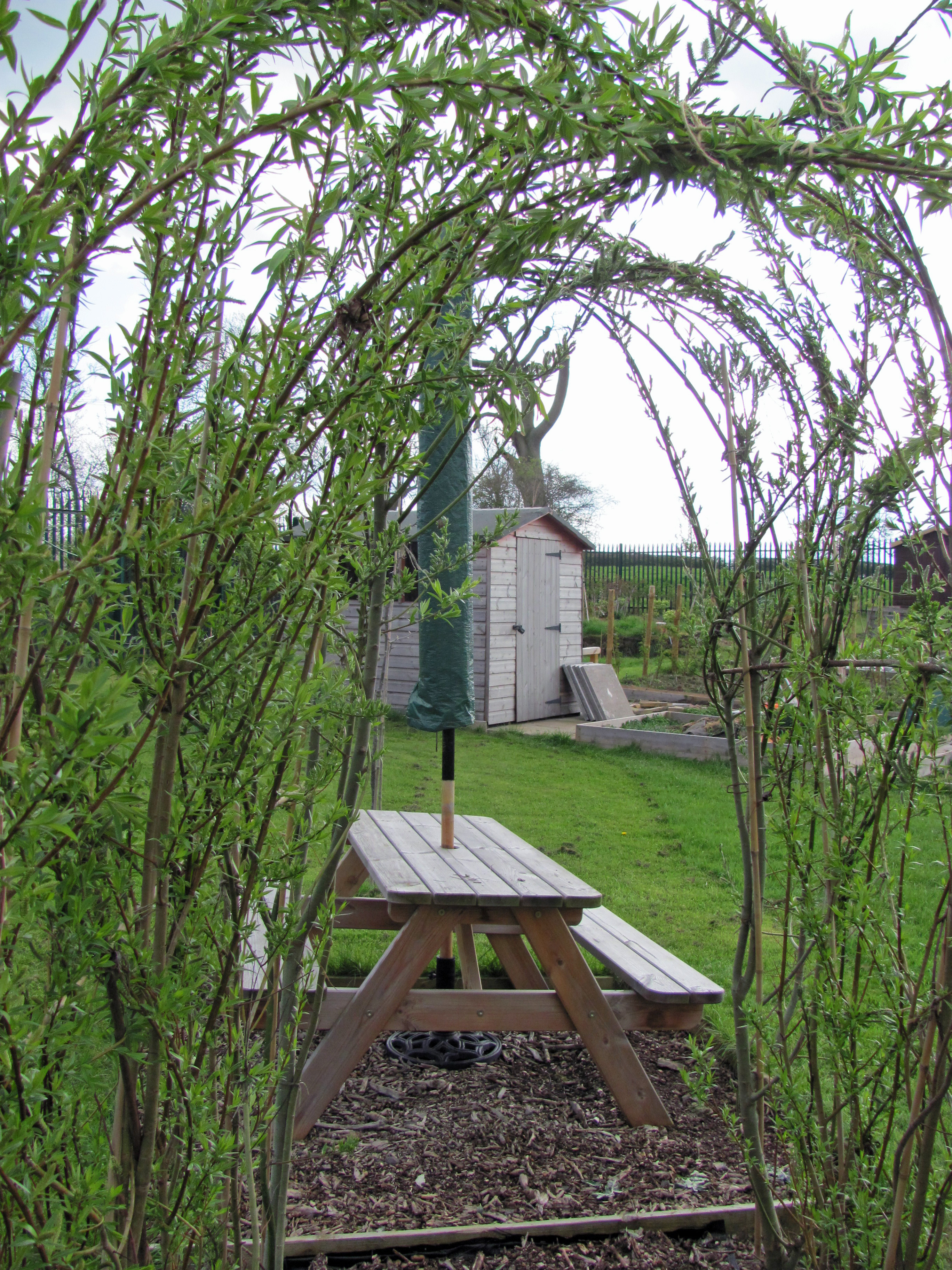
Our Willow Dome has had its doorway and windows woven and neatened up and the sides pruned and woven. It is a favourite feature with children as somewhere to listen to a story, or as a play den, and as adults for somewhere to escape to at coffee time from the heat of the day.
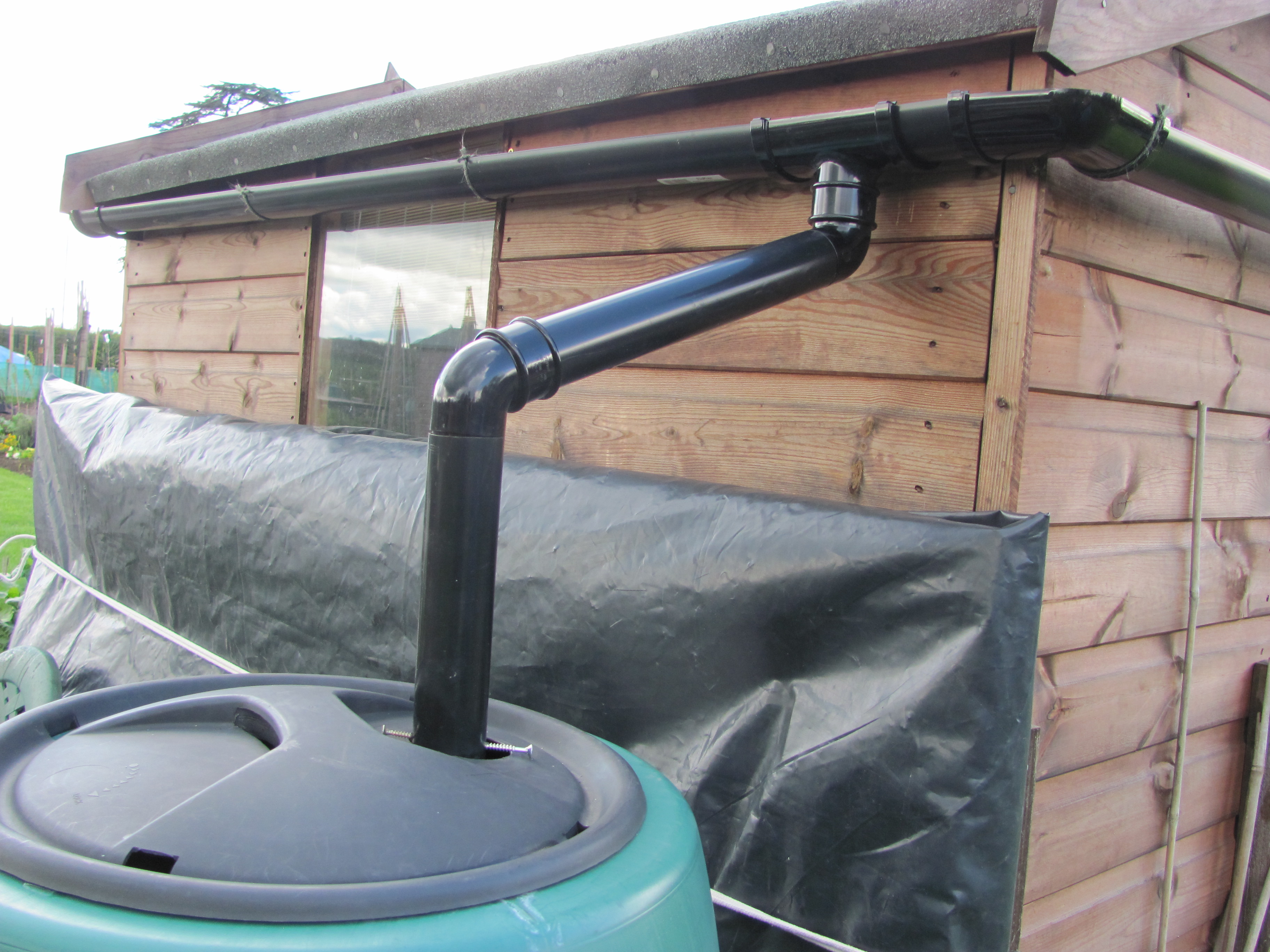
As we have recently launched our site’s Wise Watering Campaign it is heartening to see guttering and butts appearing on several sheds.
Here we are with the fifth garden wander post. And the garden is looking good! Take a wander with us and have your nose at the ready as the scents are strong.
Throughout the garden Bluebells and Wallflowers are sending out their rich sweet scent messages for all to enjoy, permeating every nook and cranny. Birdsong dominates the early hours of daylight and youngsters begging their parents for more food can be heard in every nest box. A family of fledgling Robins have taken to following us around the garden hopping and hoping our gardening activities disturb a bug or two.
We begin our wander in the front garden where we are entertained by a Spotted Flycatcher who perches on the topmost branch of the holly and sits waiting to ambush any passing insect at which he launches himself and then returns to exactly the same place to enjoy his prey and to begin all over again.
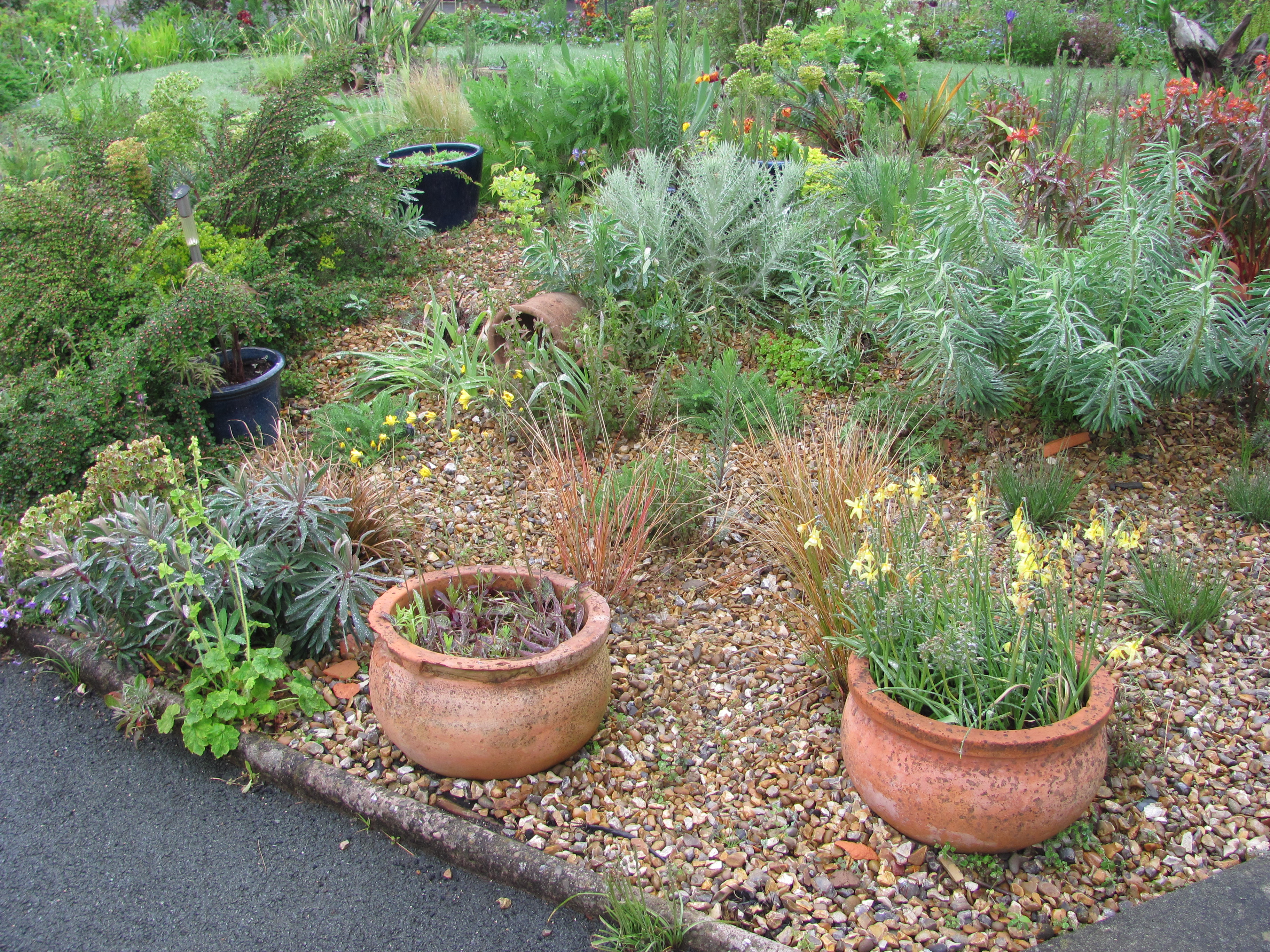
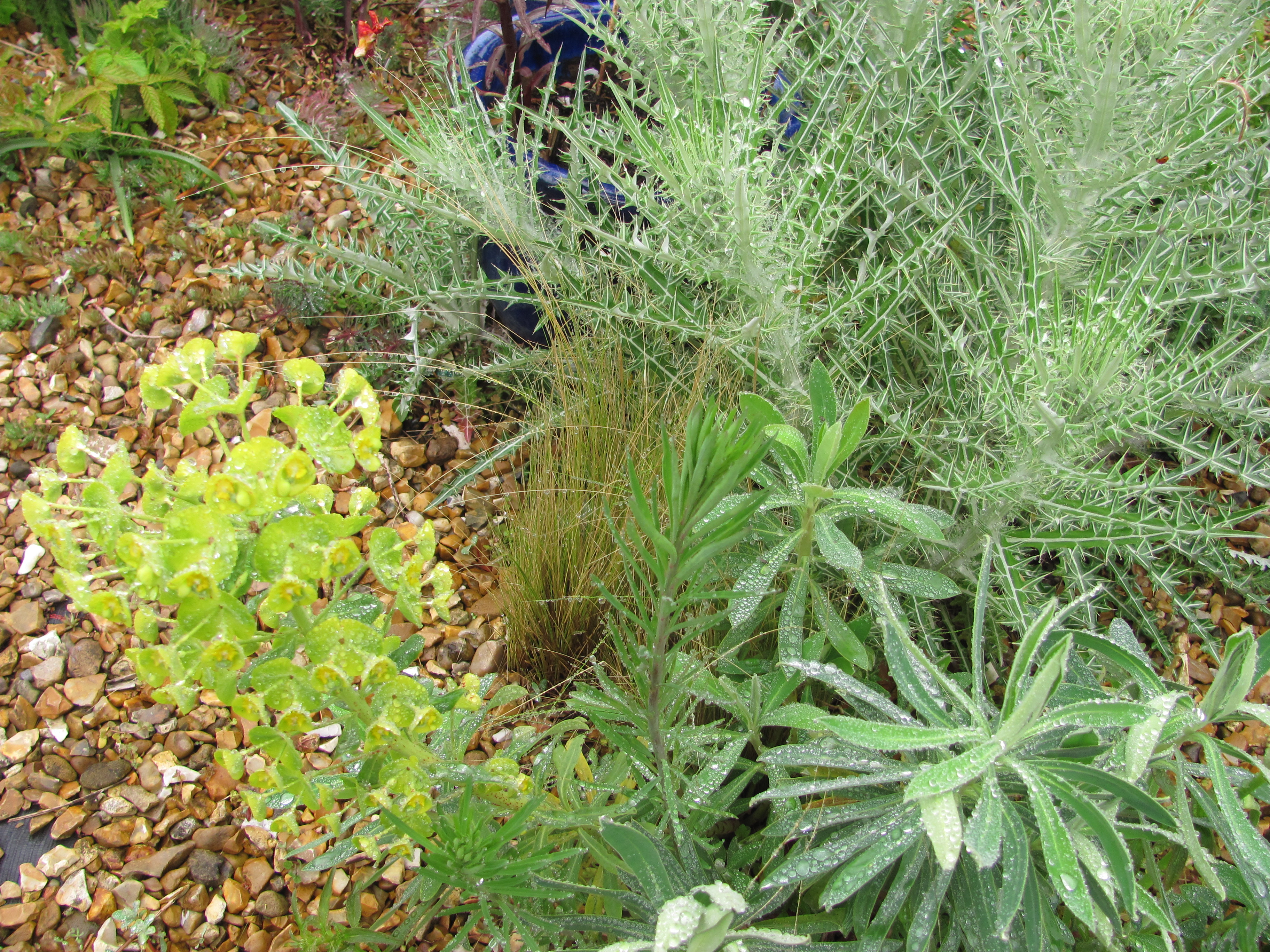
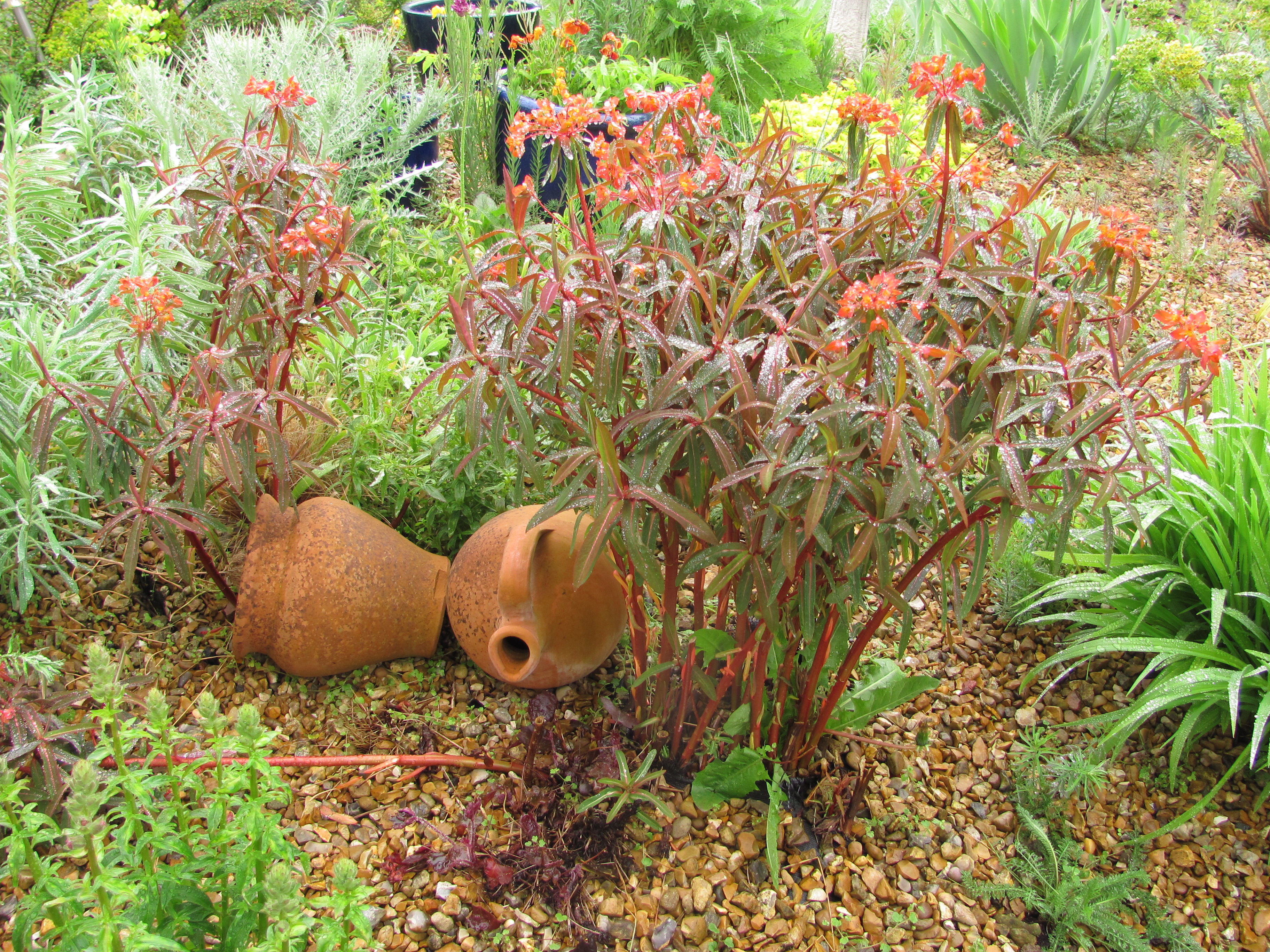
Here is our gravel garden which we call the Chatto Bed, after Beth Chatto, as after making a couple of visits to her garden we were determined to create a gravel patch which would never need watering and in true Beth Chatto style we chose plants to suit the conditions.
On the gravel our bearded irises are in healthy leaf with buds fit to burst, all but one which is already flowering, the dark, sultry Iris Cherry Garden.
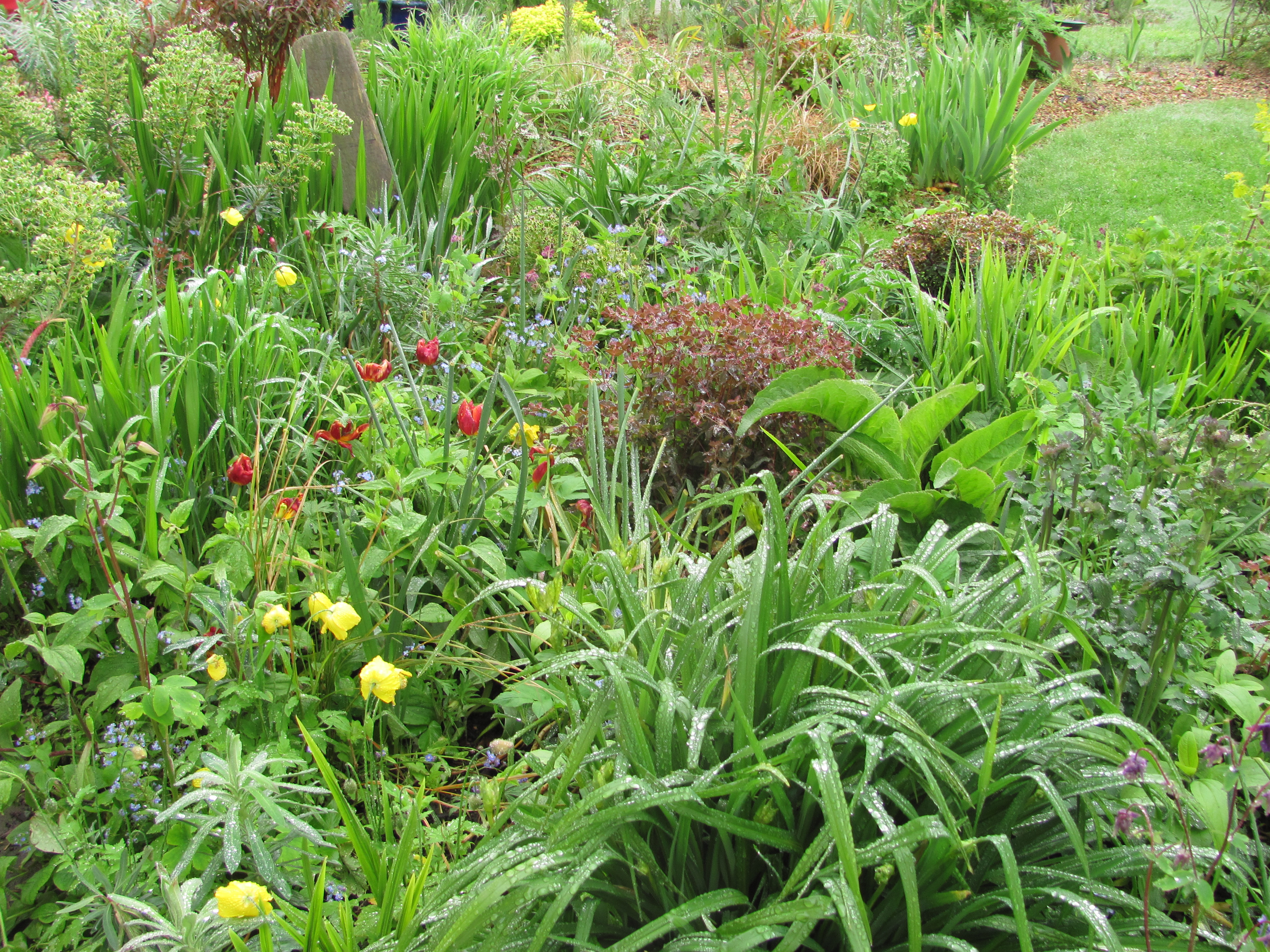
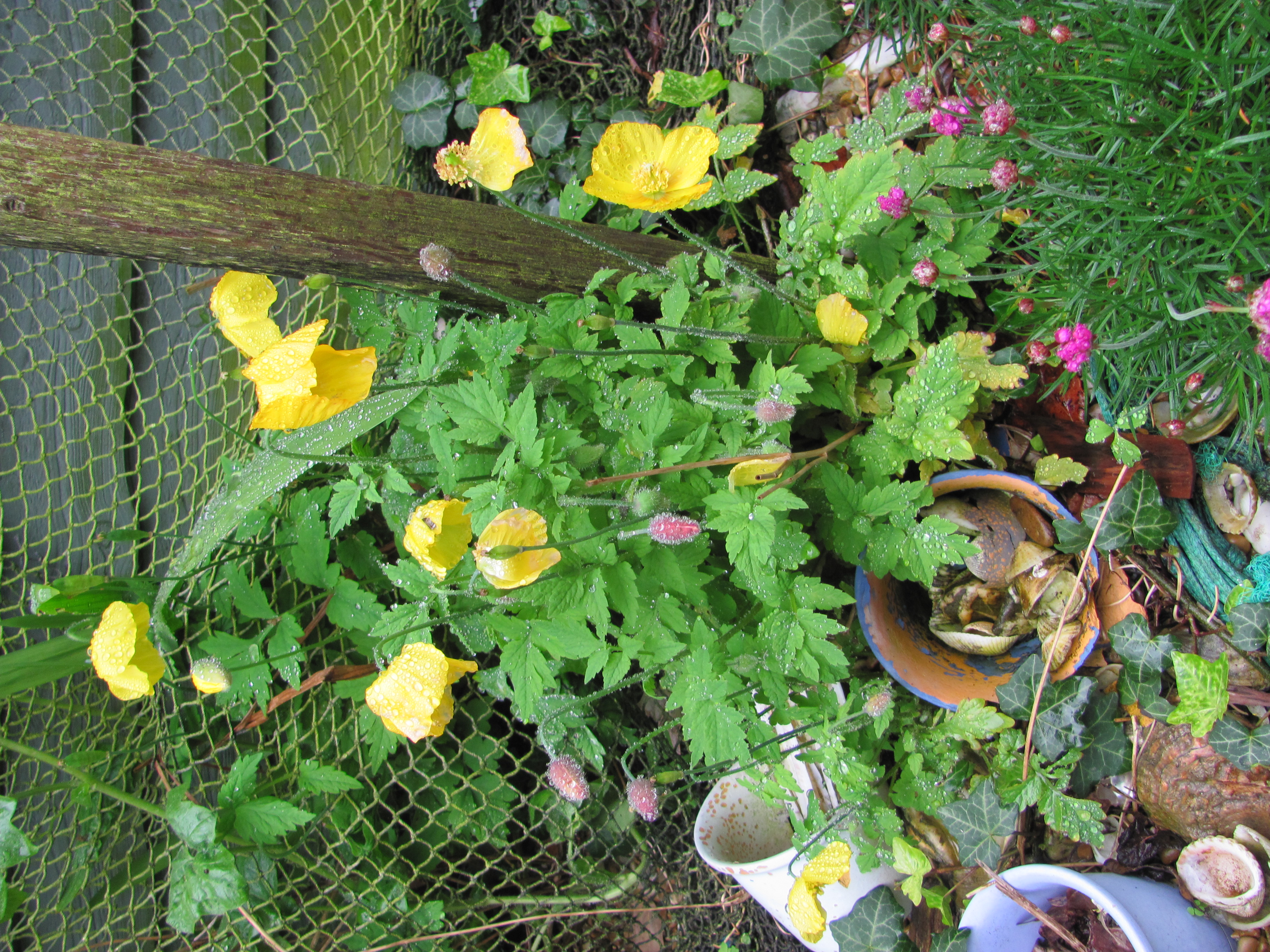
Entering the shade garden we are struck by the lushness of the foliage dotted with special blooms. Apart from the Welsh Poppies and Bluebells all blooms here seem to be in unusual shades of pink at the moment.
Our Hot Border is not yet hot but gradually warming up – just on the verge of luke warm I’d say. Opposite this is Jude’s Garden which she claims is more tasteful than my Hot Border.
Moving to the side garden opposite our main house entrance is our Freda Garden, named after a lovely lady and impressive gardener who died too young a few years ago. We grow plants here that she loved.
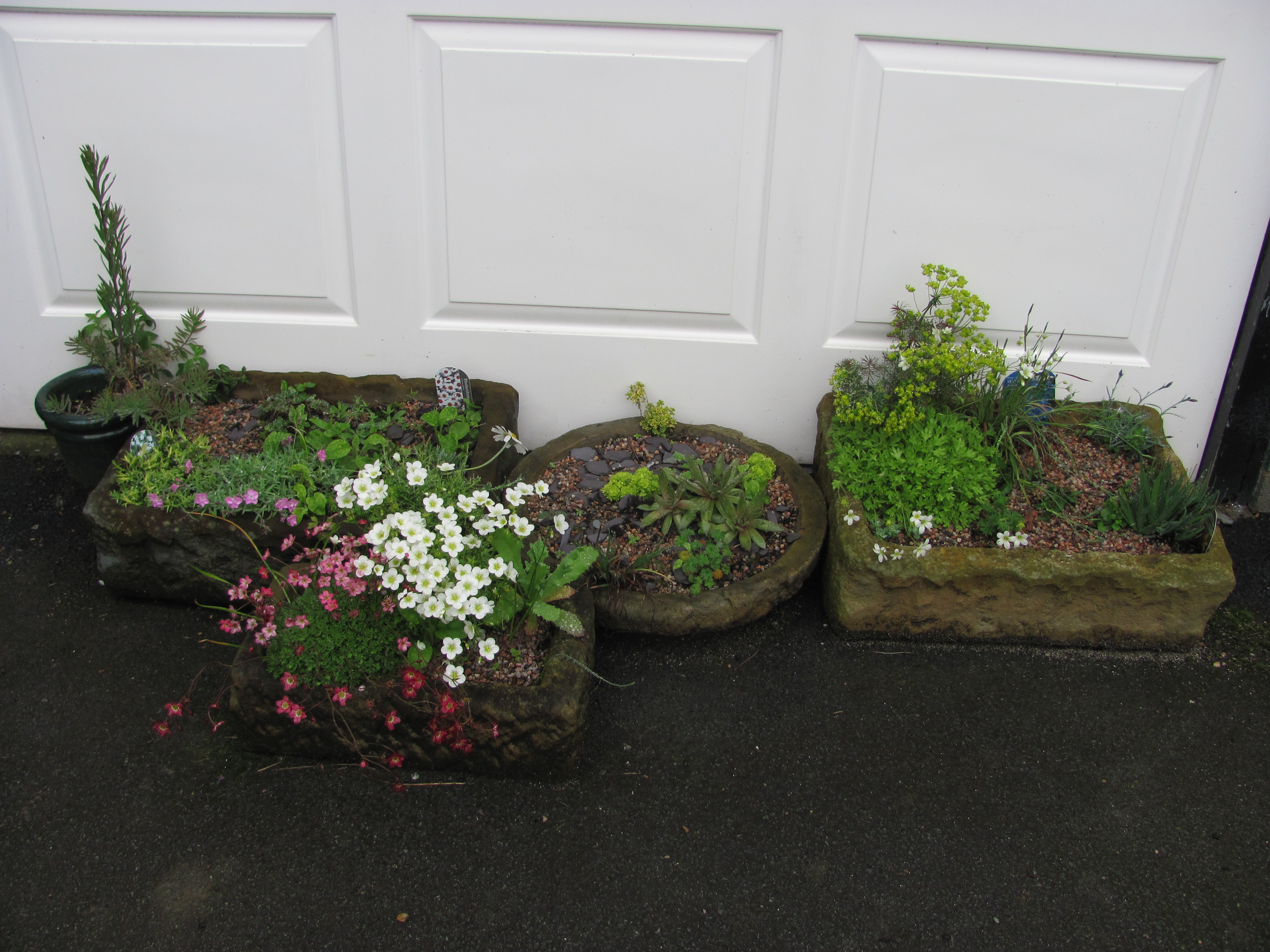
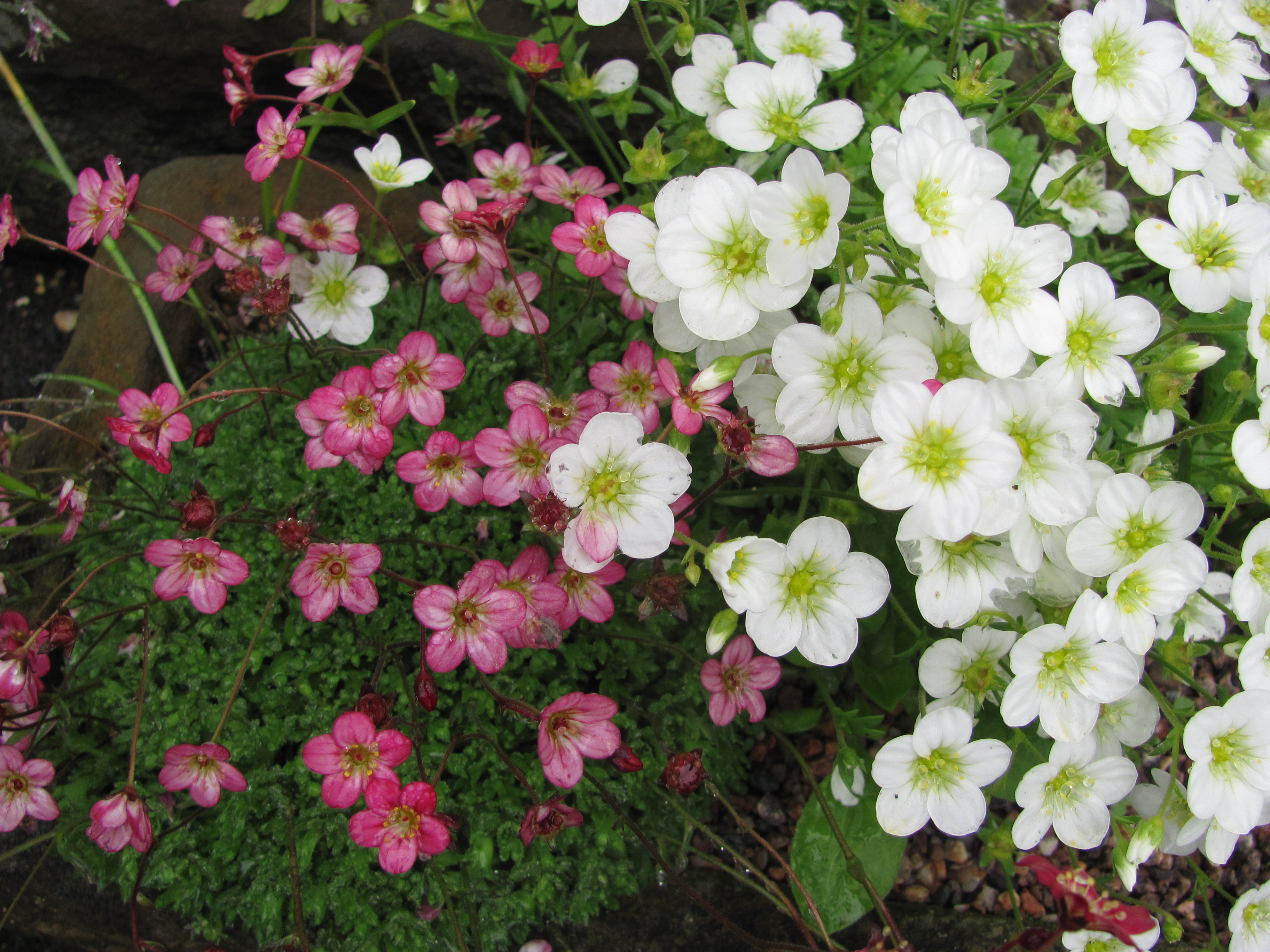
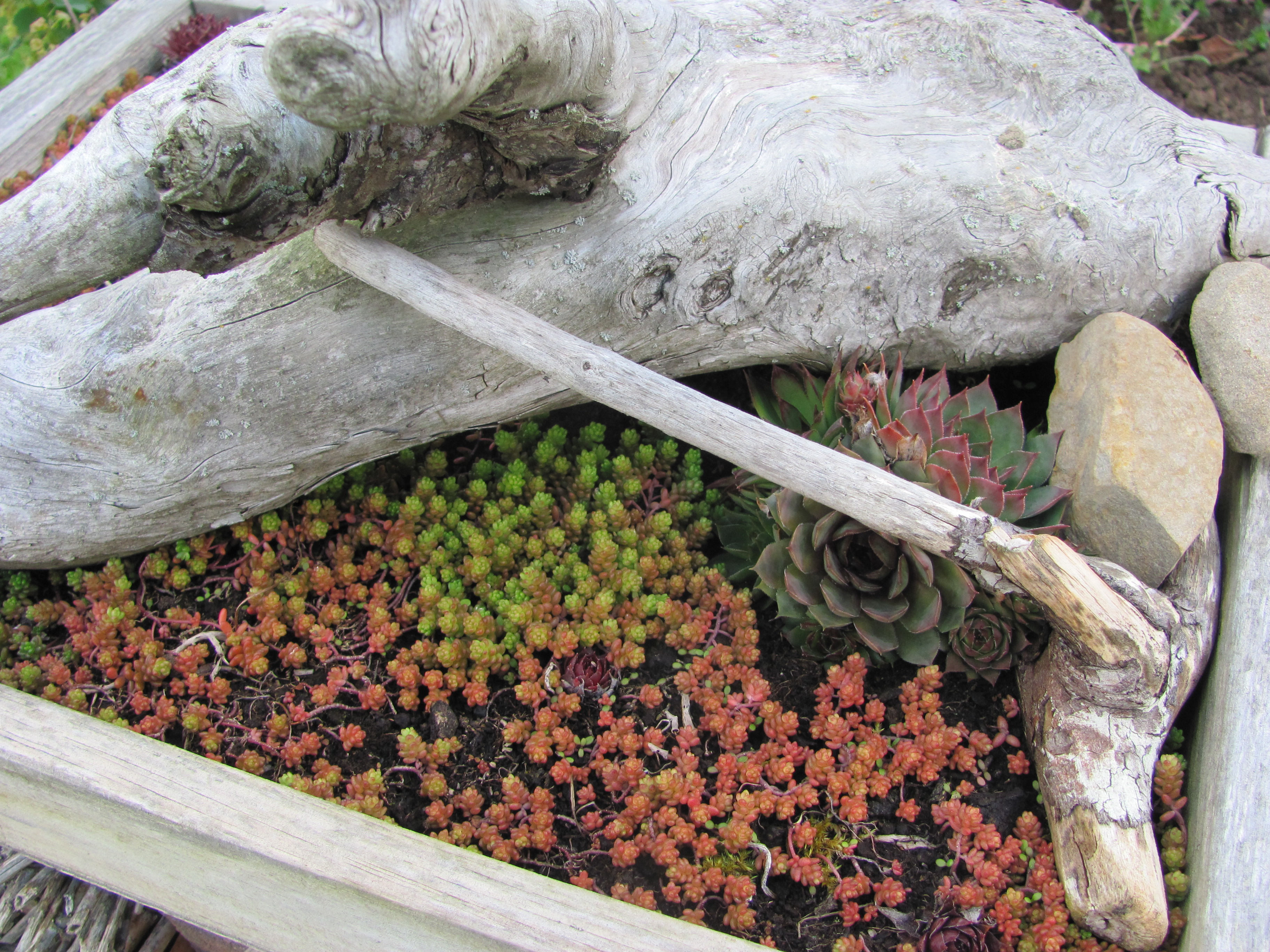
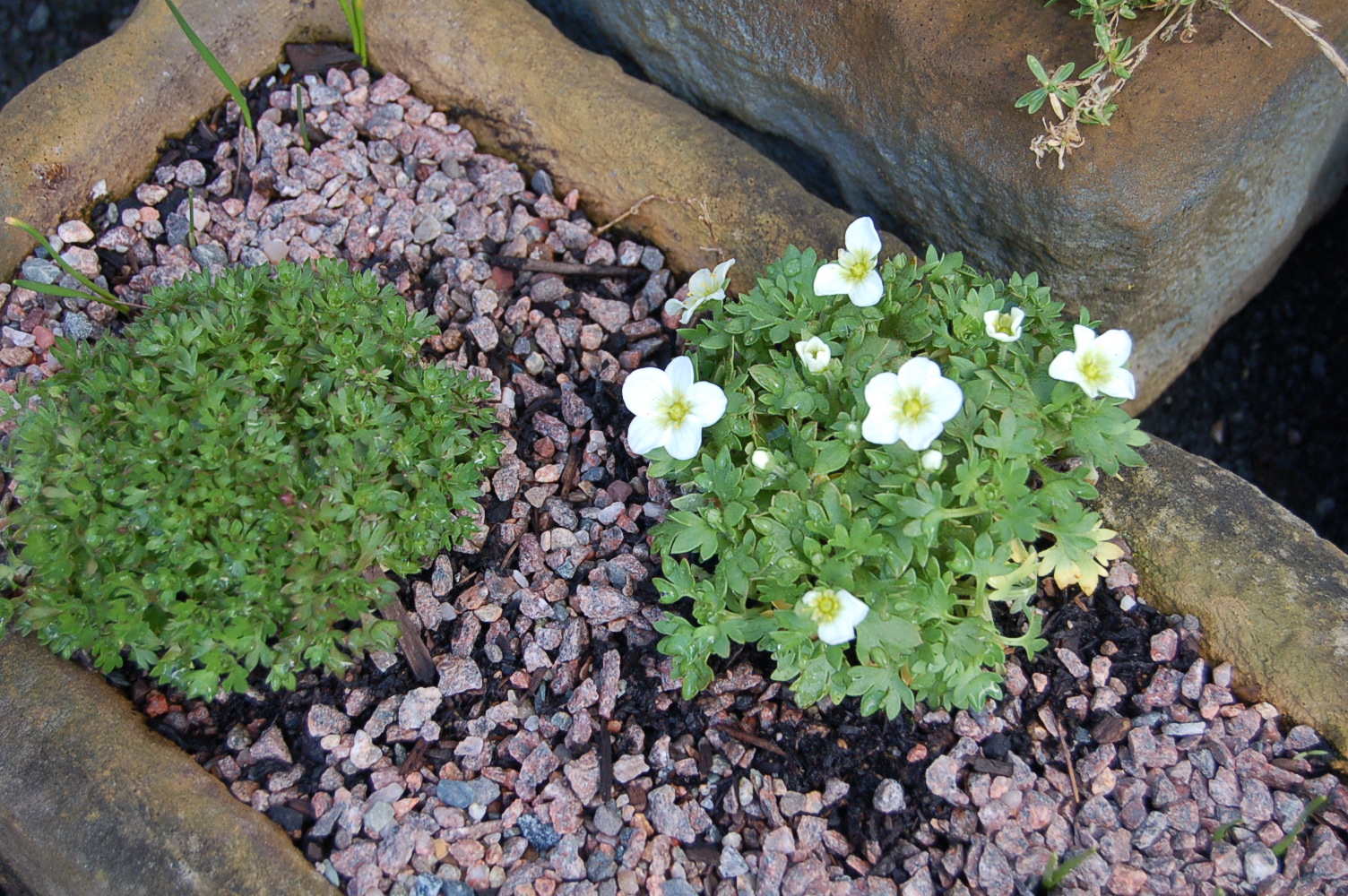
Close by is our small collection of alpine troughs still looking good, especially the Sempervivum.
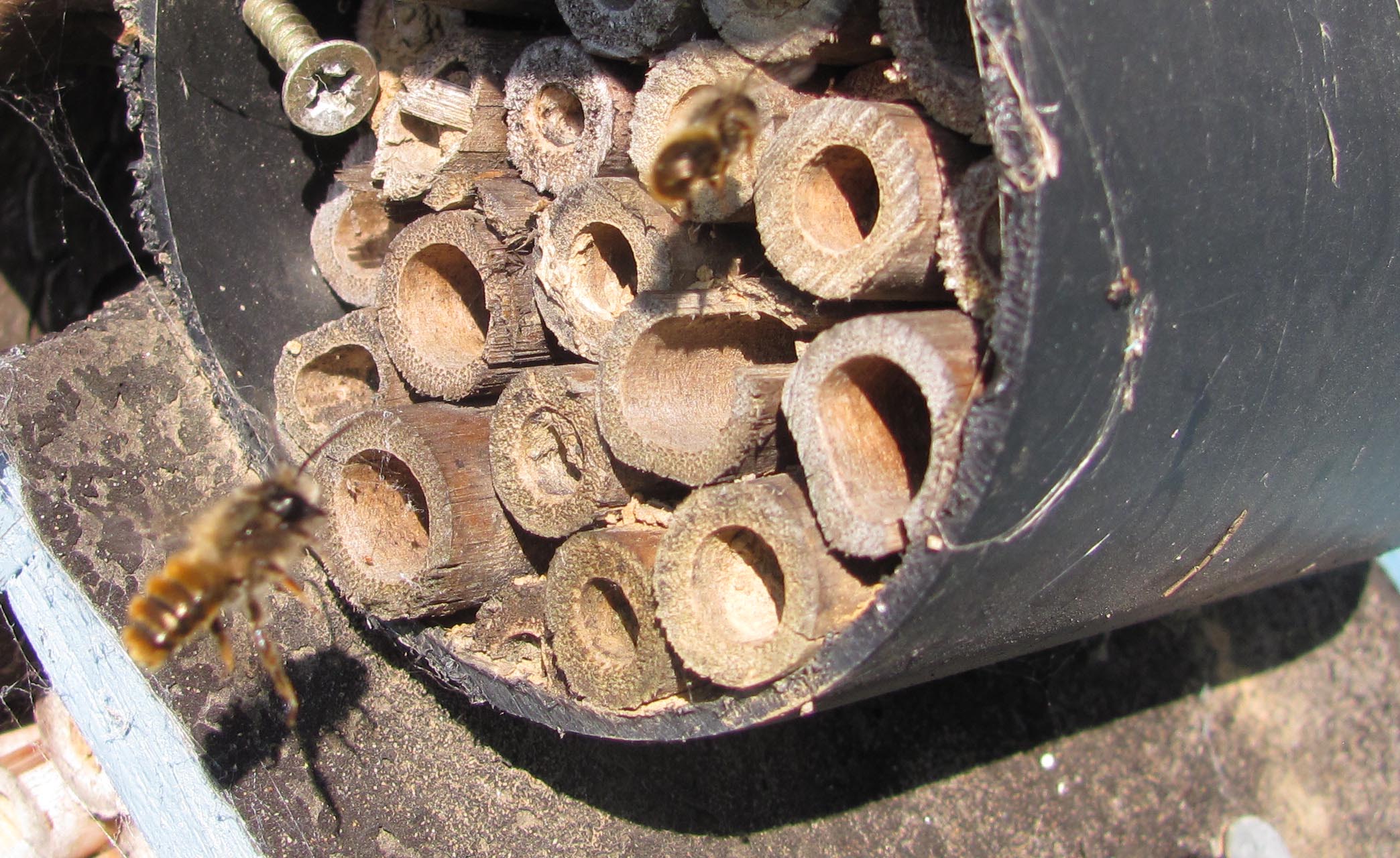
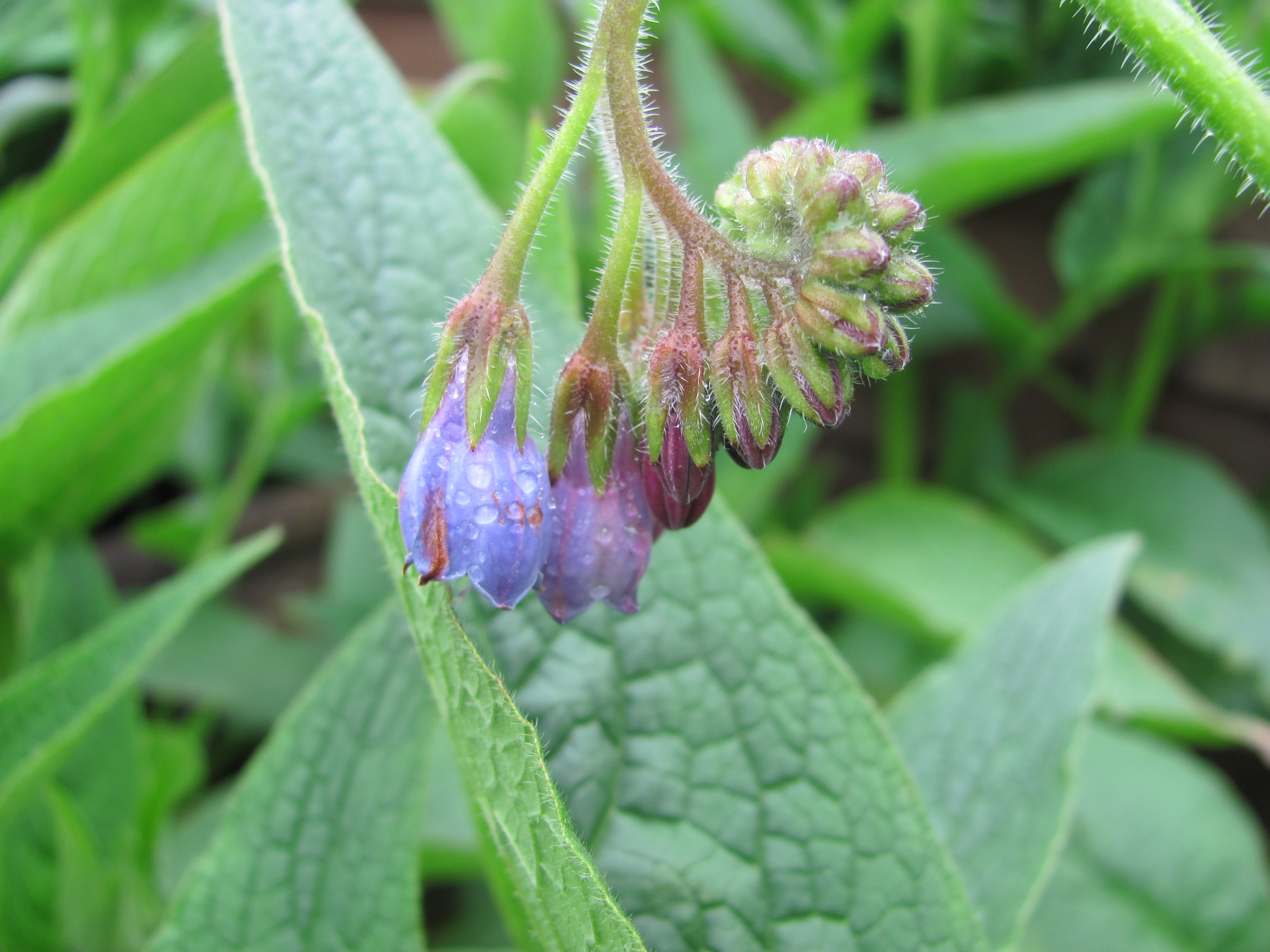
As we pass the garden shed on our way to the back garden the buzzing sounds of bees fills the air, for as the temperatures have risen in the last few days the solitary bees in our bee shelters have been hatching and emerging constantly, literally hundreds of them. They immediately head for the flowers of the Comfrey and Ceonothus we provide for them. I love this moment every spring!
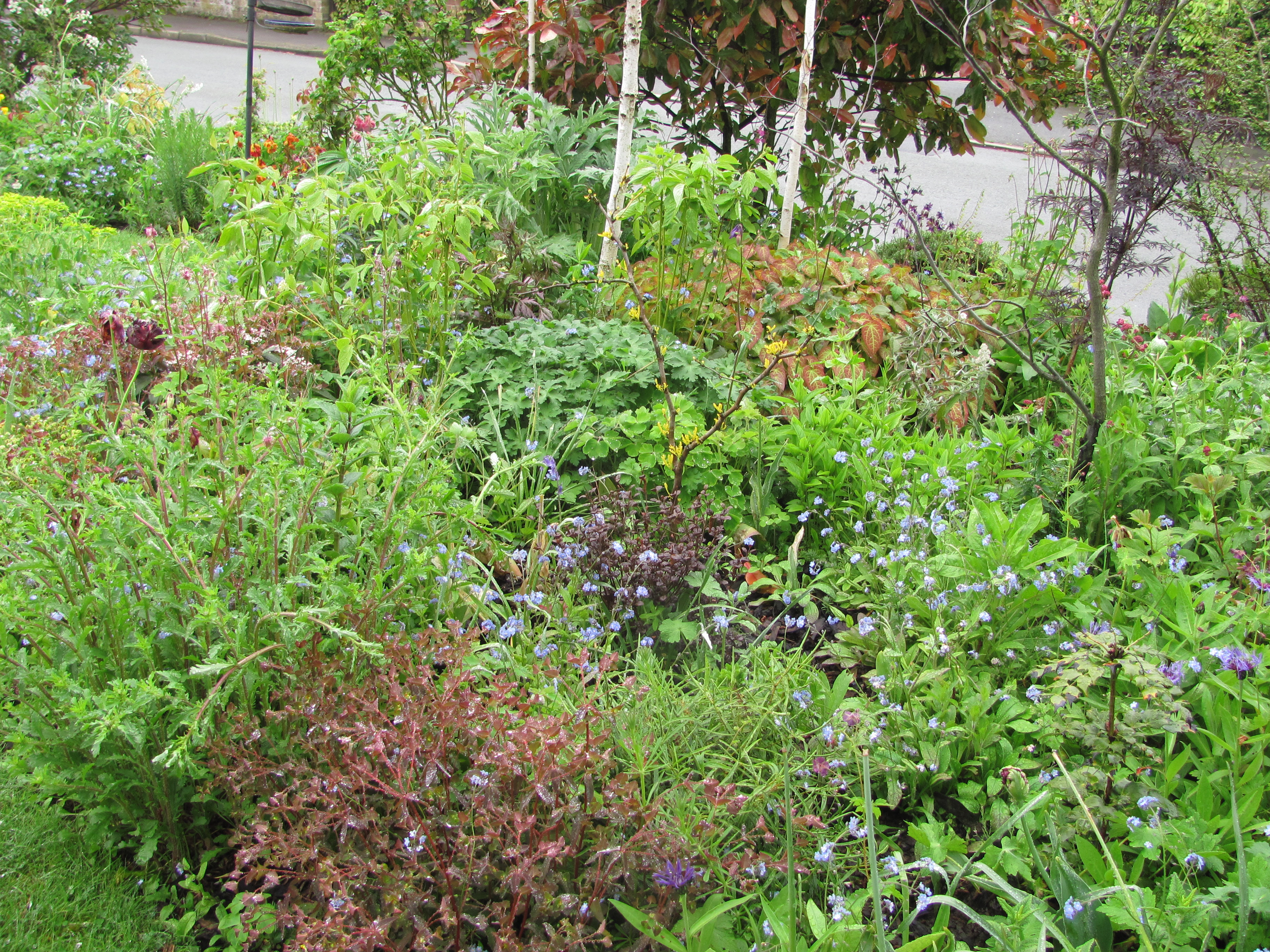
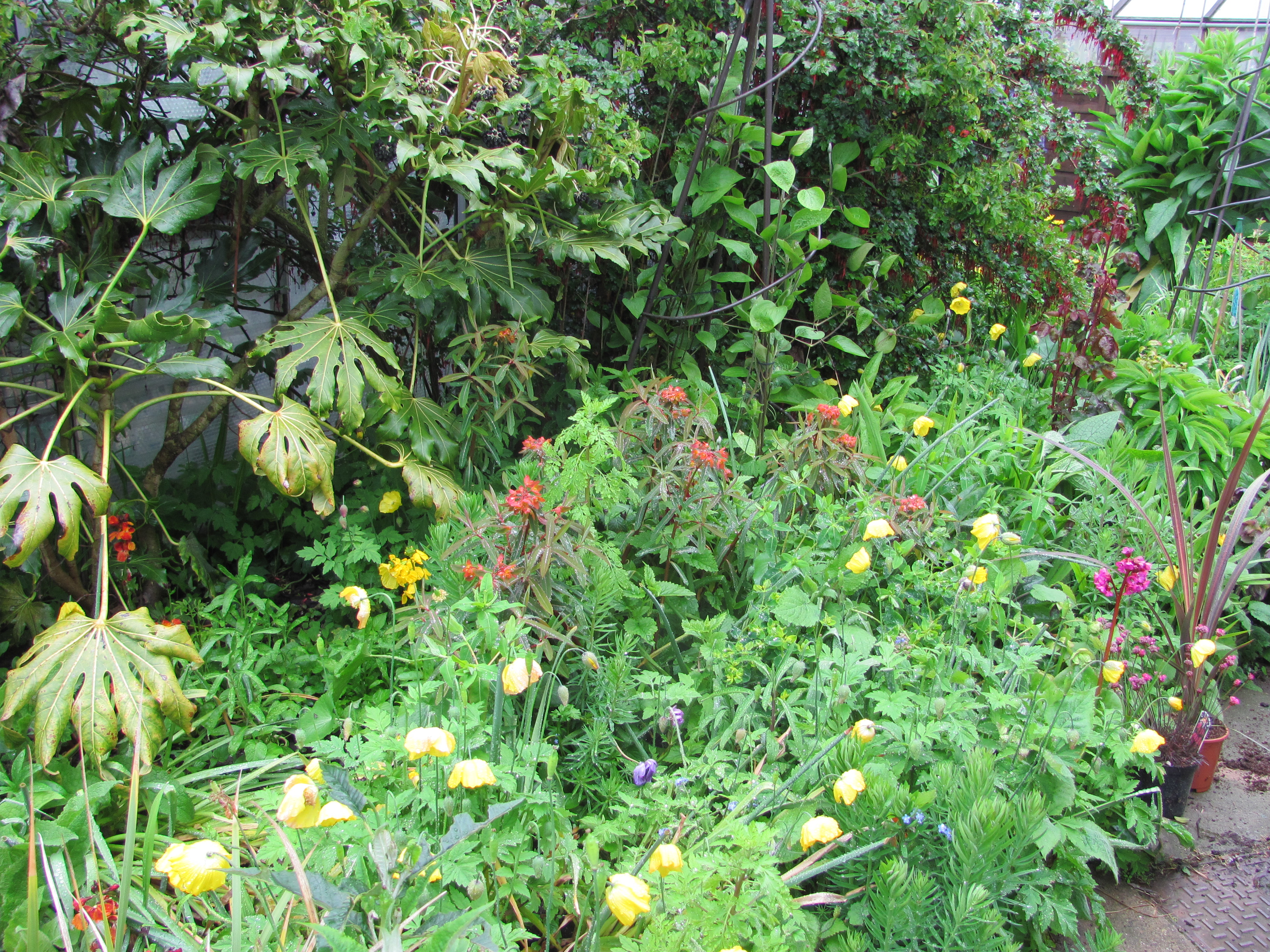
And so into the back where the scent of Wallflowers and Bluebells afford us the luxury of rich sweet perfume. Rich colours burst from the vibrant fresh spring greens.
It has been a strange May so far, no flowers on any rose bushes but some narcissus still in bloom. The Cuckoo has been calling incessantly for weeks as have the Skylarks. We are bit fed up with the repetitive two note call of the Cuckoo but the beauty and complexity of the Skylark’s song means we still love listening to it.
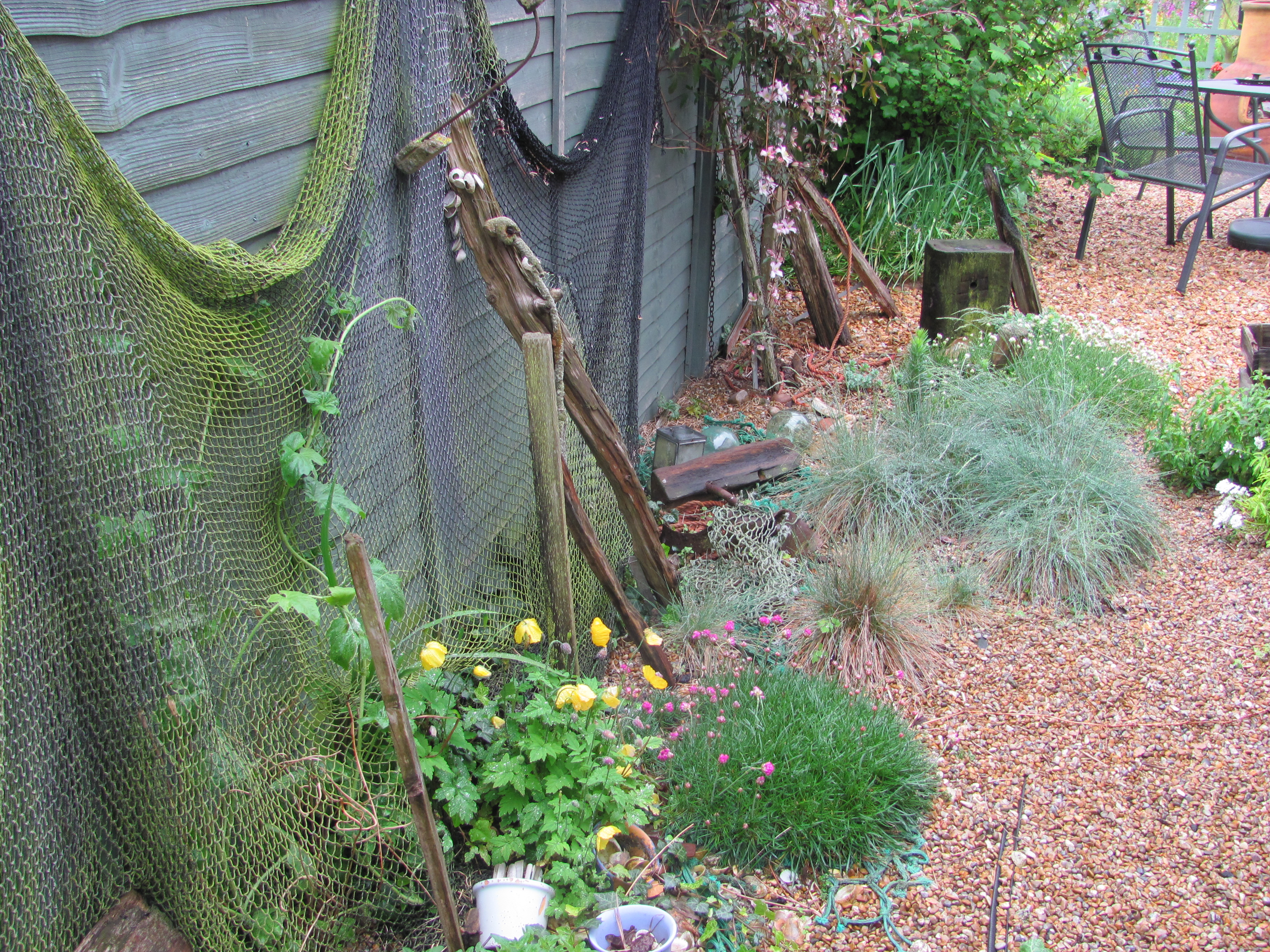
We shall finish this wander in our Seaside Garden, part of our plot not yet featured much in my blog. Perhaps a separate post all about it will appear soon?
It is easy to create secretive and decorative nesting places for bees.
We always describe our garden as being wildlife friendly. But what makes it good for wildlife? What elements of our garden invite wildlife in? We are proud of the fact that we have gardened with organic principles at the front of our minds for decades. A garden cannot be regarded as wildlife friendly if the gardener is not working with these principles constantly driving what goes on.
We make deliberate decisions to attract wildlife by providing food, shelter and nesting places. Each time a plant is bought, a bed restructured or new beds made, wildlife is a factor. Equally how we manage the garden has to be friendly towards our natural friends.
But let’s be honest, we don’t do all these things just for wildlife, as there is a selfish element to it. We like being surrounded by birds, butterflies, insects et al. We need to hear, see and experience the natural history of our plot. A cup of coffee outside is all the better if accompanied by the song of birds, the movement and colour of butterflies and the constant flittering of insects.
I have recently read a wonderfully informative and thought-provoking book by John Walker entitled “How to Create an Eco Garden”, and in it he proposes the concept of “eco-fitting” your garden. This idea is all about making the garden “more self-sustaining, less wasteful of valuable resources, more reliant on renewable sources of energy and friendlier to wildlife”. This will provide a useful guide when considering the content of my blog, and it will be at the forefront of my mind as we go on a journey around our garden looking at how we make it good for wildlife.
Throughout the garden, the trees and shrubs we have planted were chosen partly for their berries to feed the birds, blossom to attract pollinators and how well they give shelter, homes and nesting places.
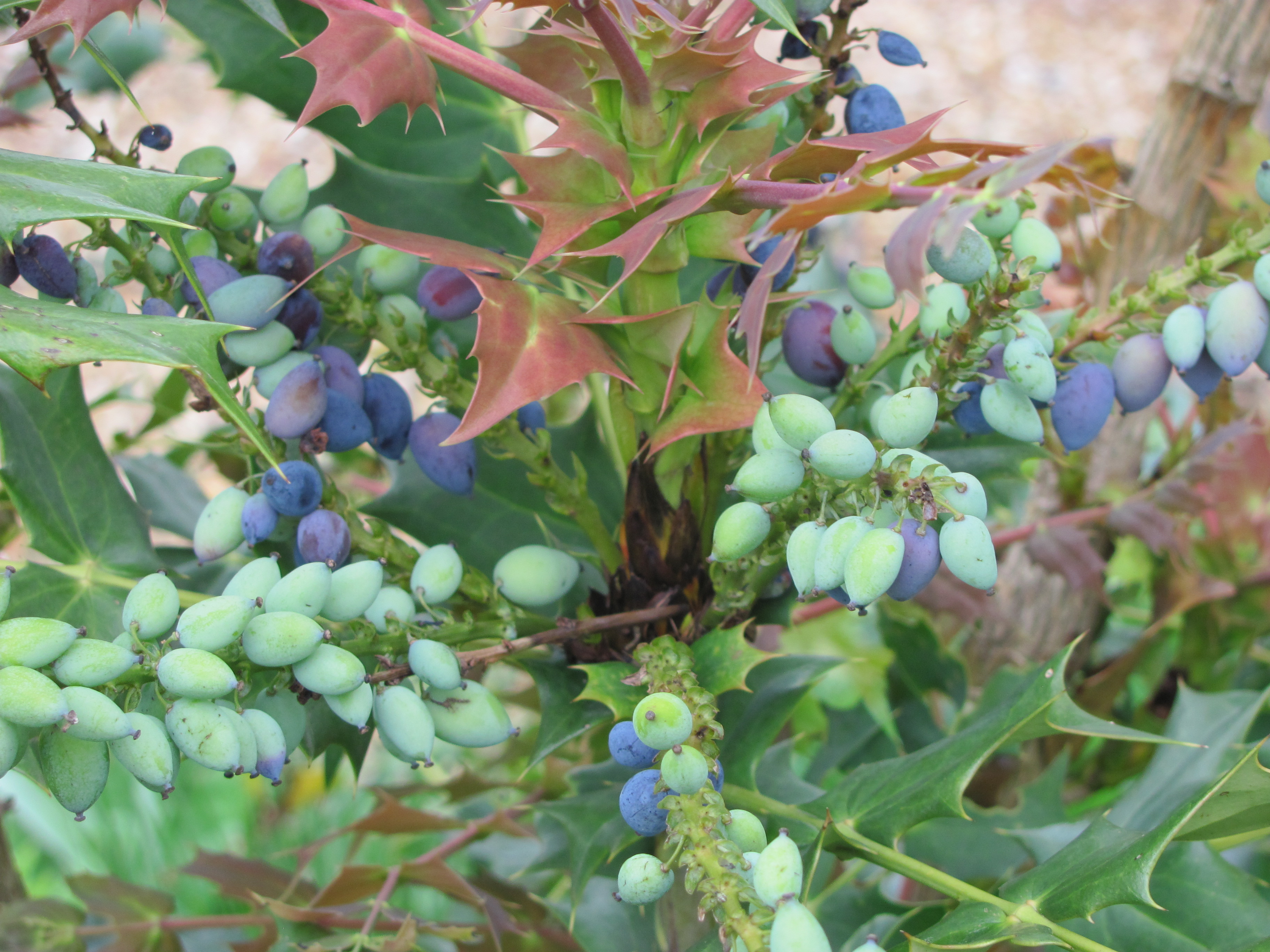
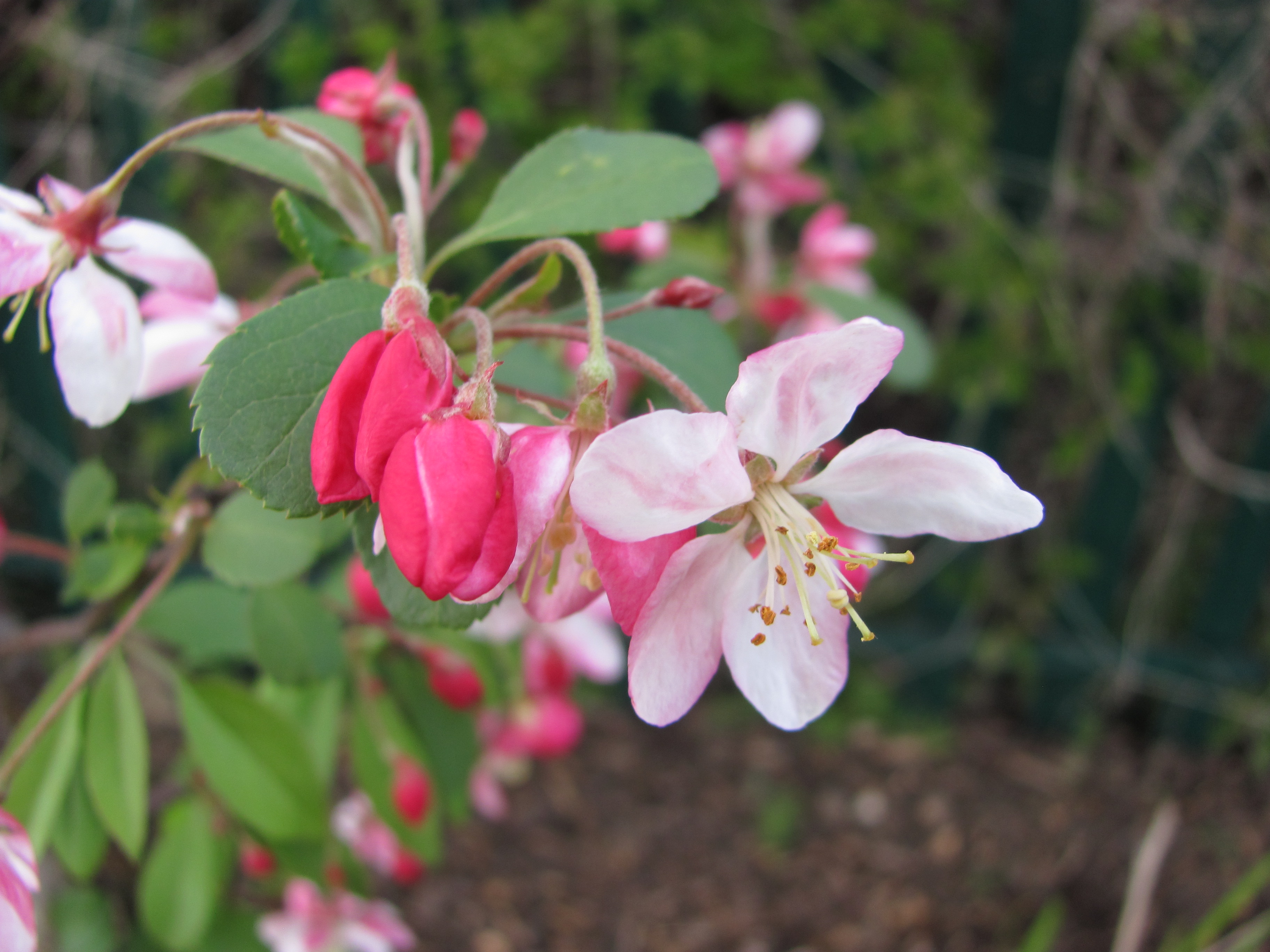
The dark berries of mahonias are enjoyed by Blackbirds but only after all the red berries around have been eaten.Apple blossom provides pollen for bees and hoverflies early in the year and fruit for us later on. Fruit that rots in store or goes too wrinkled is put out for Blackbirds and Thrushes to enjoy.
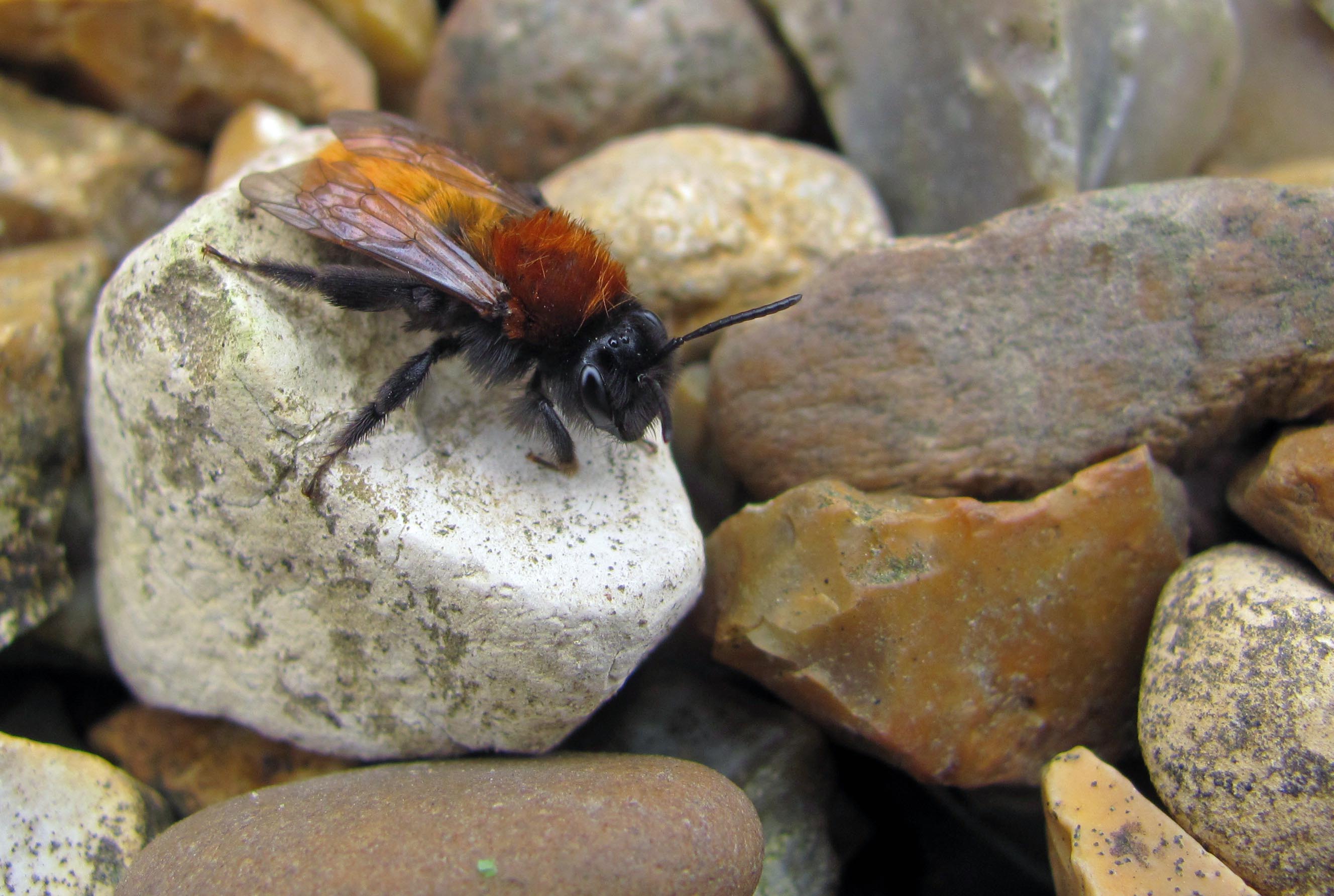
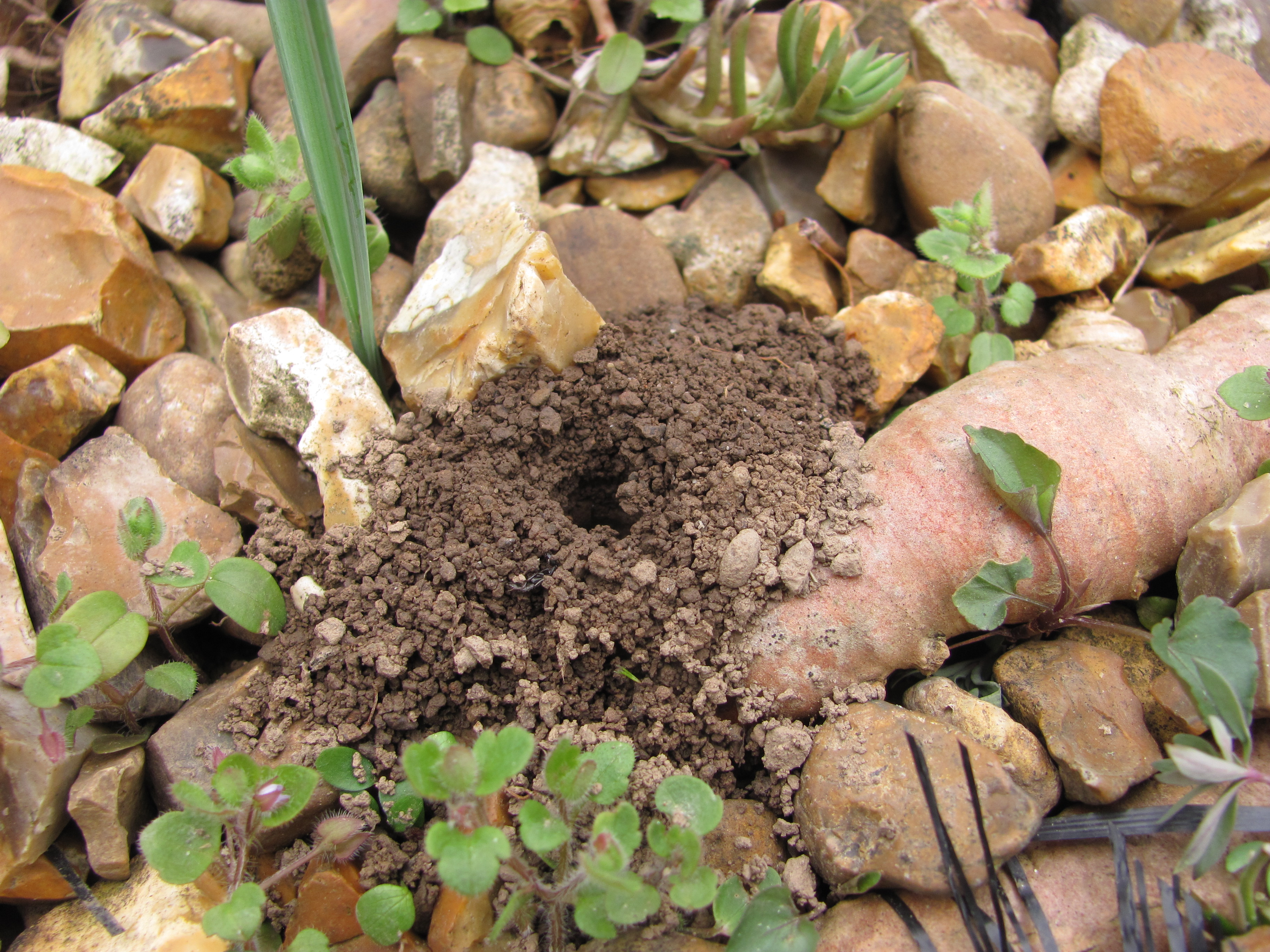
Look into our front garden and in full view of all windows is one of our three bird feeding centres where we provide mixed seeds, peanuts, suet balls and suet blocks. The front lawn supports White Clover and Dog Violets both loved by bees. Although we cut the grass and keep it quite short these wildflowers react by flowering on shorter stems. We use no weed killers or fertilisers on our grass as we enjoy knowing that Blackbirds can safely feed there. Tawny Lawn Bees make their homes here and in the gravel patch alongside. They make miniature volcano shaped piles of fine soil as they construct their tunnels.
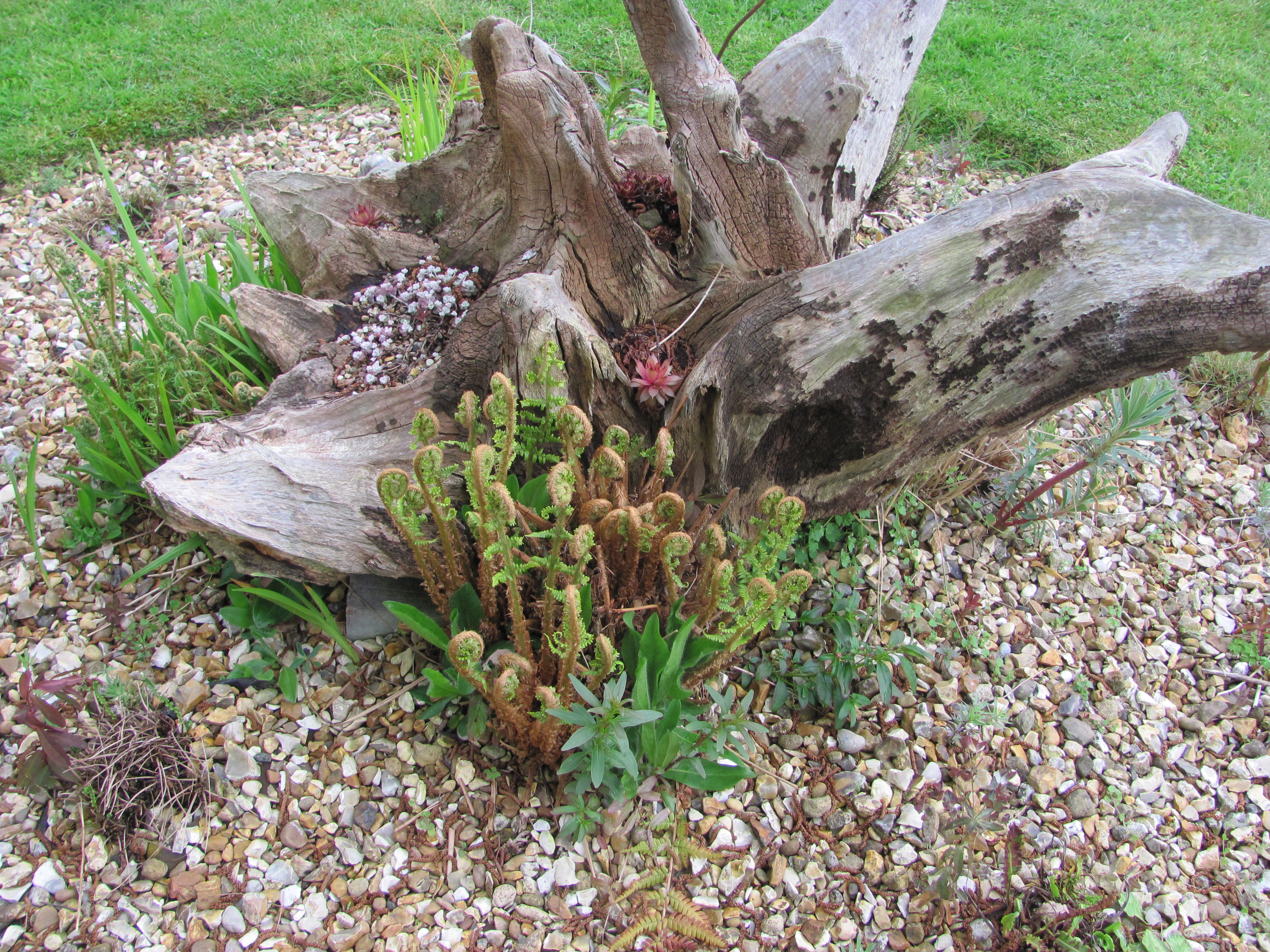
The beautifully coloured miner bee, the Tawny Lawn Bee.A mini-volcano on our gravel made by a bee.The old Oak stump as ferns and grasses are just beginning to grow in early May.
We have an old Oak stump around which we grow ferns and grasses. The Wrens, Robins, Warblers and Dunnock soon recognised this as a home for the insects they enjoy eating.
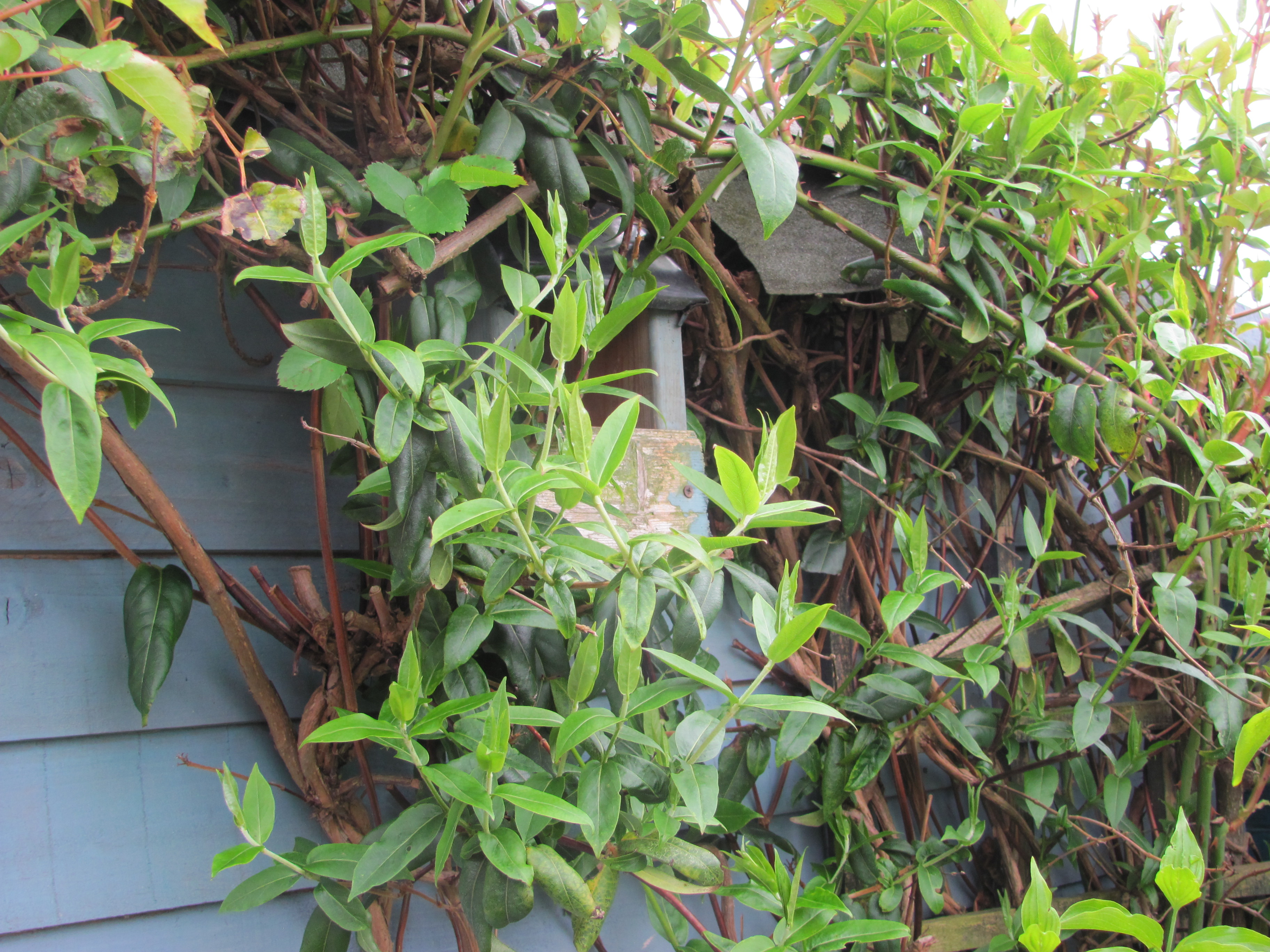
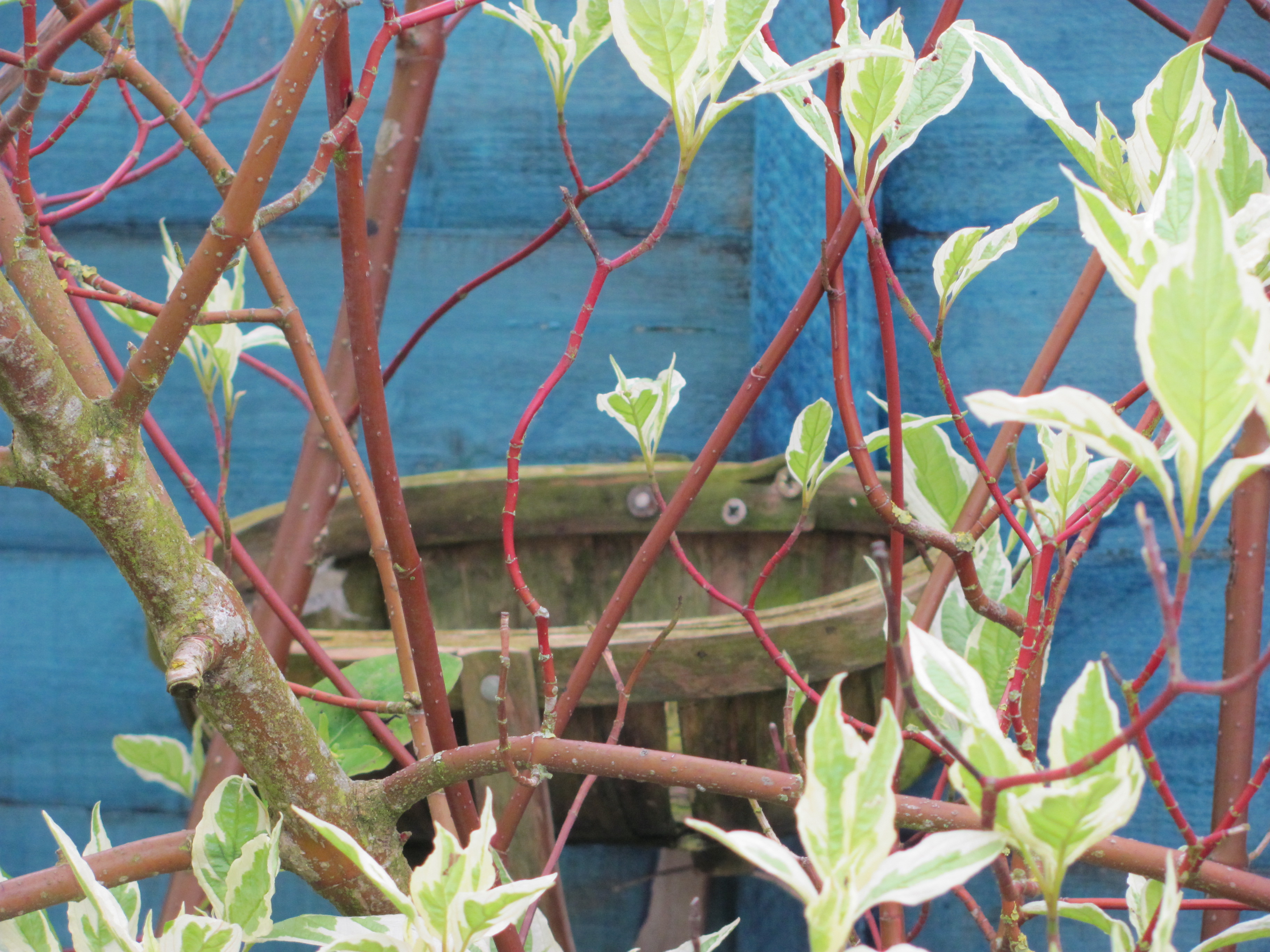
All of our outbuildings are clothed with climbers to provide shelter, food and nesting places for wildlife. You can just spot the robin box in amongst the honeysuckle and rose.The old trug hides behind climbers to attract blackbirds to nest
In our side garden opposite our main door are bird boxes for Robins, Tits and House Sparrows and an old trug was placed in a dogwood to provide a nest shelf for Blackbirds. On the shed there and the fence we grow Honeysuckles and Climbing Roses to provide shelter for wildlife and nest sites for Wrens and blackbirds. The Apple Trees growing in large terra-cotta pots are favourites of bees early in the spring, and in other large flower pots we have sown mini-meadows of wild flowers.
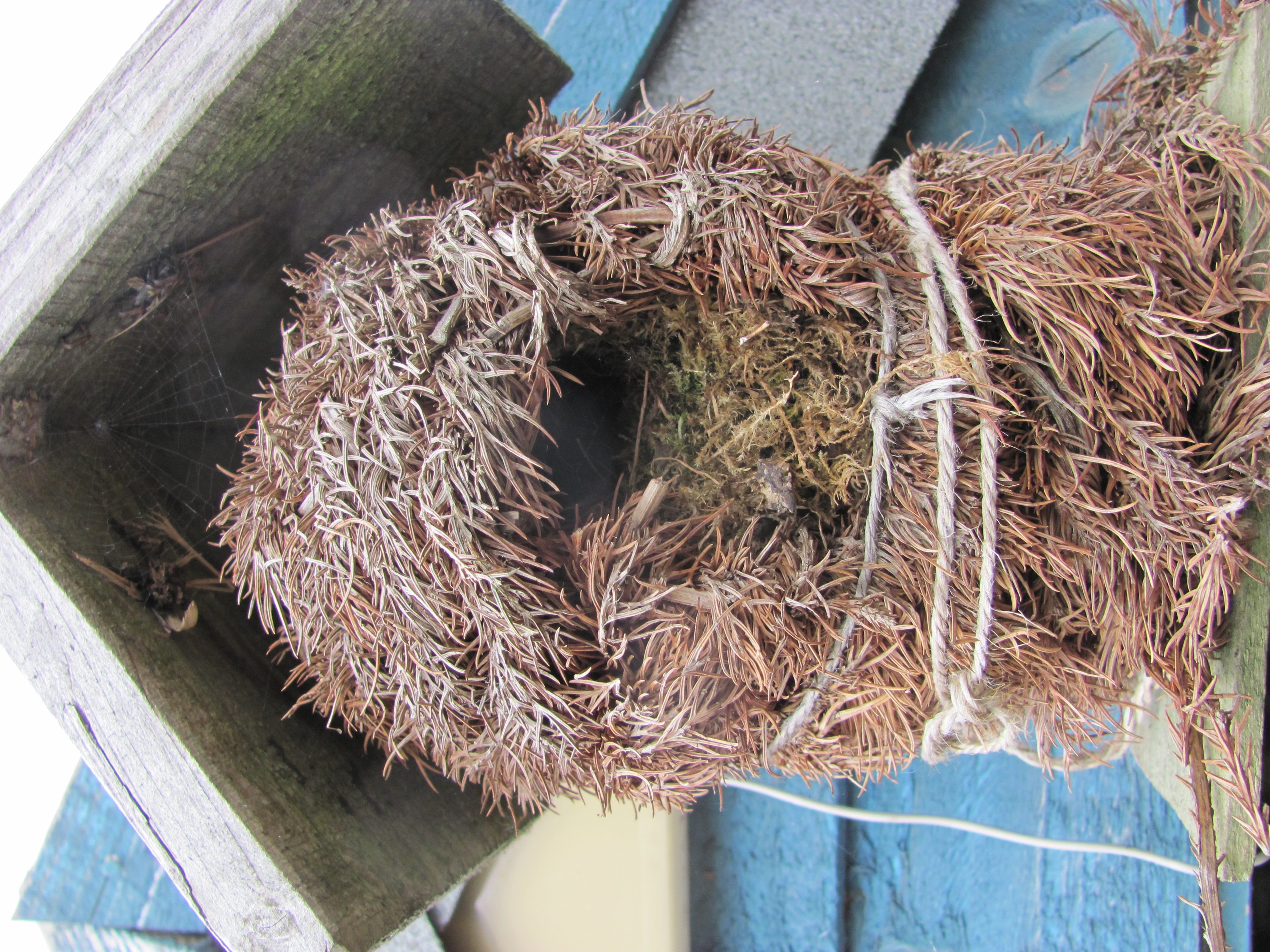
An assortment of insect shelters and nesting holes on the garden shed, attract droves of solitary bees who nest in the holes.Wrens nest in the roosting pouch every year even though it is right above the shed door.
Into the back garden and immediately we spot the insect hotel, which sits in amongst our comfrey bed. The leaves of the comfrey provide us with our organic plant food and their flowers are loved by bees and hoverflies.
Luxury accommodation for beneficial insects.
Nest boxes are scattered throughout the garden wherever we can find a suitable space. Most are used by members of the Titmice family or Robins. Our trained fruit trees and climbing roses are favourite nesting places. Last year a pair of Goldfinches nested in a climbing rose called Goldfinch – they must have read the label!
A favourite with our Robins.A Blue Tit nest box in the Cherry Arch.A pair of Collared Doves is nesting on top of one of our Apple Arches. We can see the eggs and sitting adult dove through the twiggy nest as we pass beneath.
Throughout the borders we select plants with simple flowers, rarely doubles, and grow several native plants such as Red Campion, Cowslip, Foxglove and Cow Parsley.
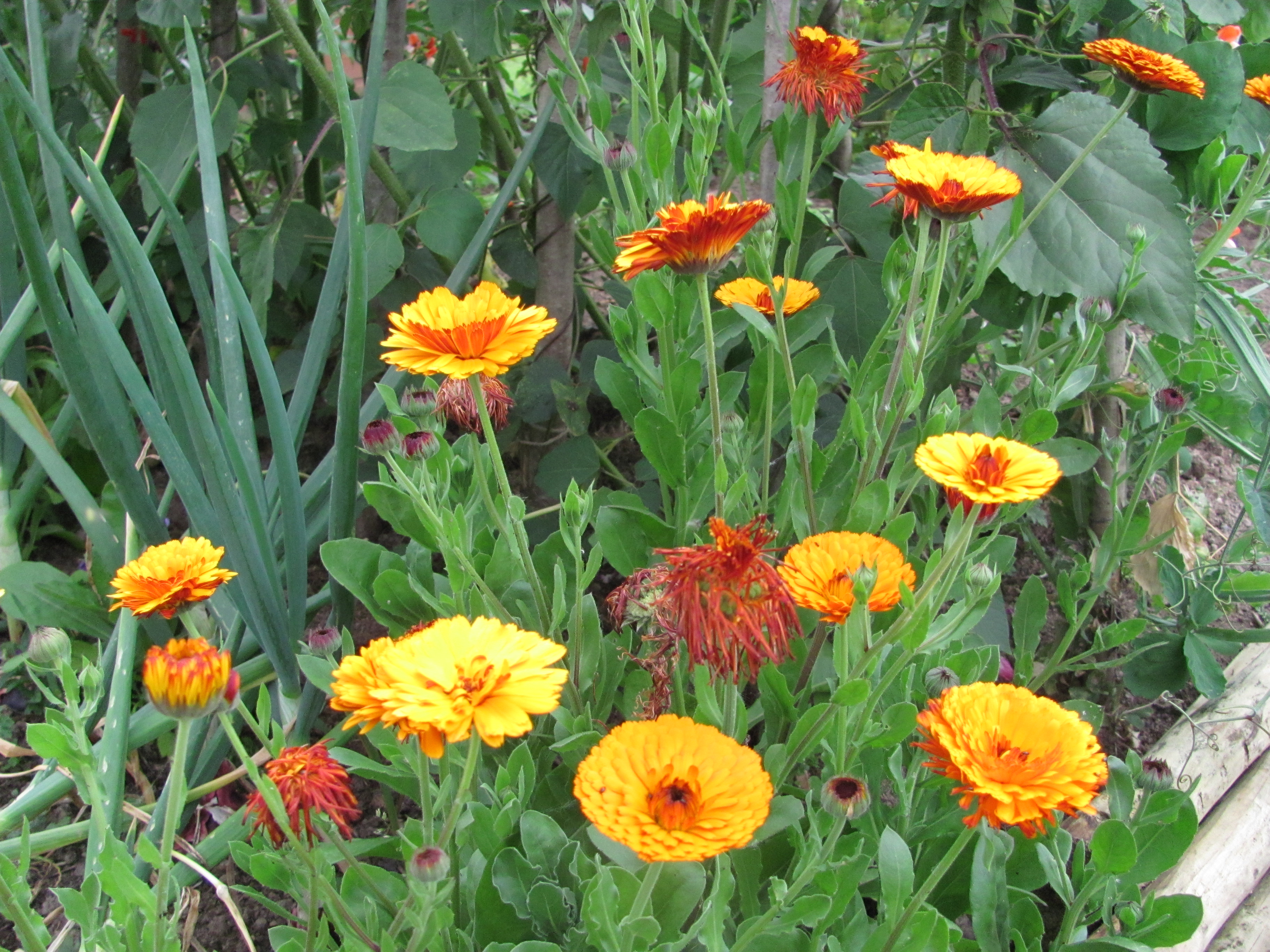
Calendulas are true insect magnets.The beautiful flowers of our native Red Campion.
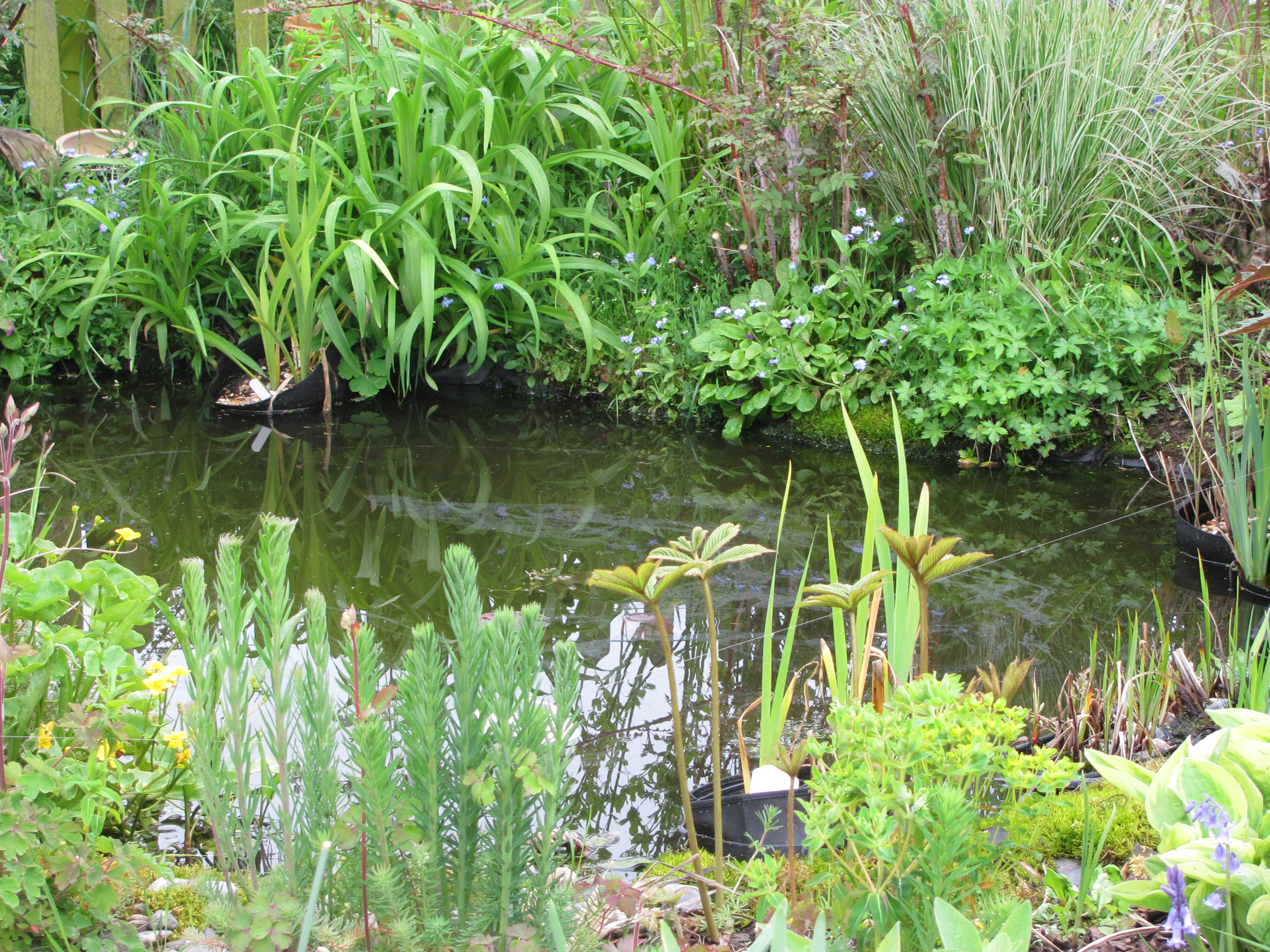
Towards the bottom of the garden is our wildlife pond all planted up with native plants, whereas the bog garden alongside is a mix of native and more exotic plants. The pool and bog are popular with our resident amphibians, toads, frogs ands newts as well as Dragonflies and Damsel Flies which breed in the pool. Birds use the shallow pebble beach area for bathing. Beneath the water live diving beetles and water boatmen, and on the surface Pond Skaters skim arouns on the surface film.
Our wildlife pool – a favourite place to watch wildlife.
Beyond the pool and chicken run is a strip of wild grass about 6 feet wide which gives us access to the surrounding countryside. We cut this grass to attract Green Woodpeckers who come down to feed here. We grow a pair of Hazel bushes here which gives safe place to approach one of our bird feeding stations in the winter, give nuts for Jays in the autumn and every few years gives us poles to use as bean poles and brash to use as pea sticks.
One of our Hazel bushes just prior to coppicing.
This quick wander around our garden shows some of the wildlife friendly features we enjoy. Our whole garden is a little reserve where we hope wildlife can feel welcomed and safe.
The key moment in April came when our allotments featured in a national gardening magazine, “Grow It”. A great article full of photos! And then towards the end of the month the lottie chairman, John and I were interviewed by Matt Biggs for an article in the “Edible Garden” magazine. (Please excuse the name dropping!)
So let’s take a wander around the site starting at our own plot, number 37, where the last of the leeks are still in the ground but the kale is beginning to go to seed. Seeds we sowed a few weeks ago are now germinating and popping their heads above the soil. The autumn sown broad beans are flowering as are our currants and gooseberries. So it is all systems go.
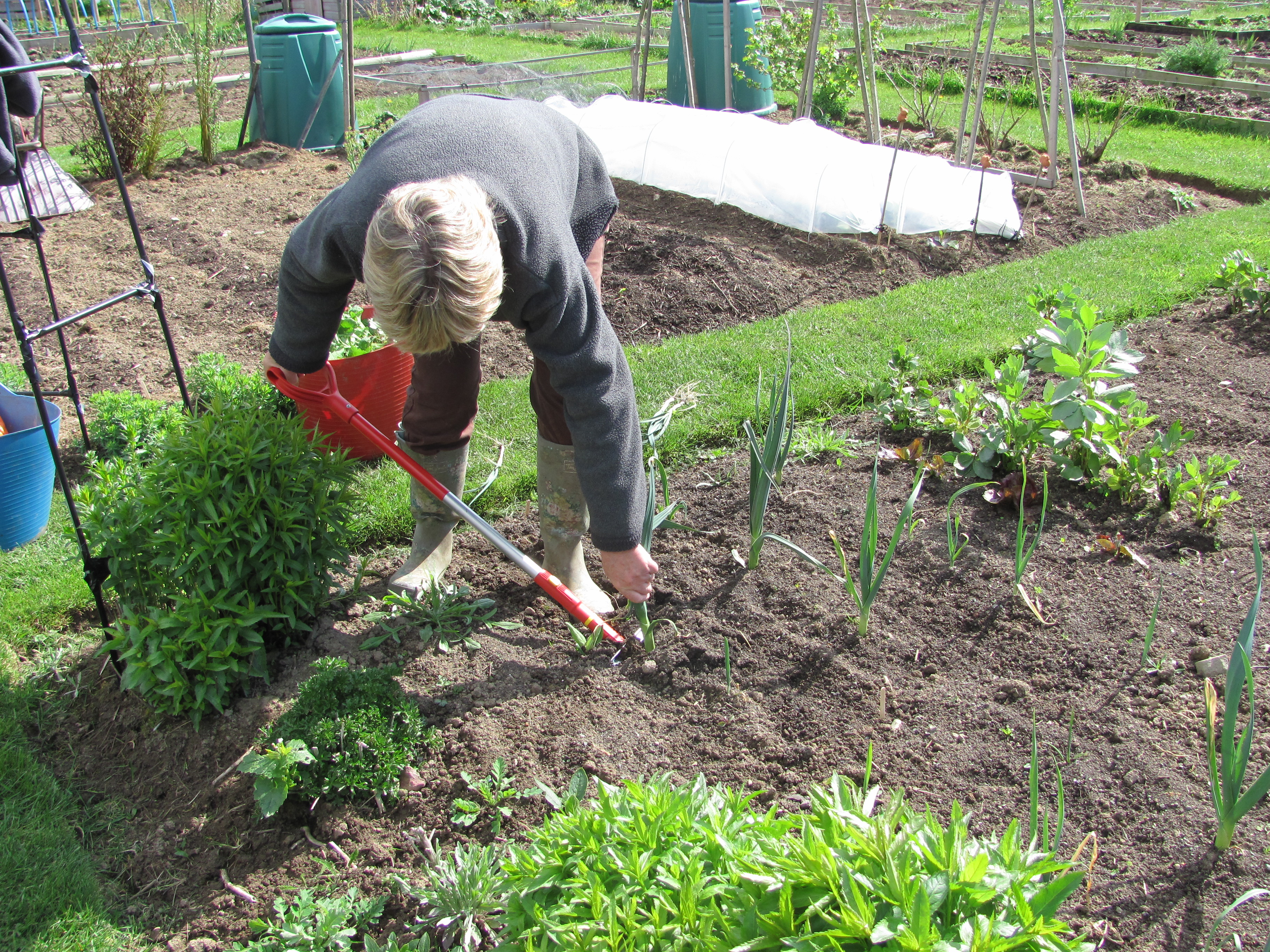
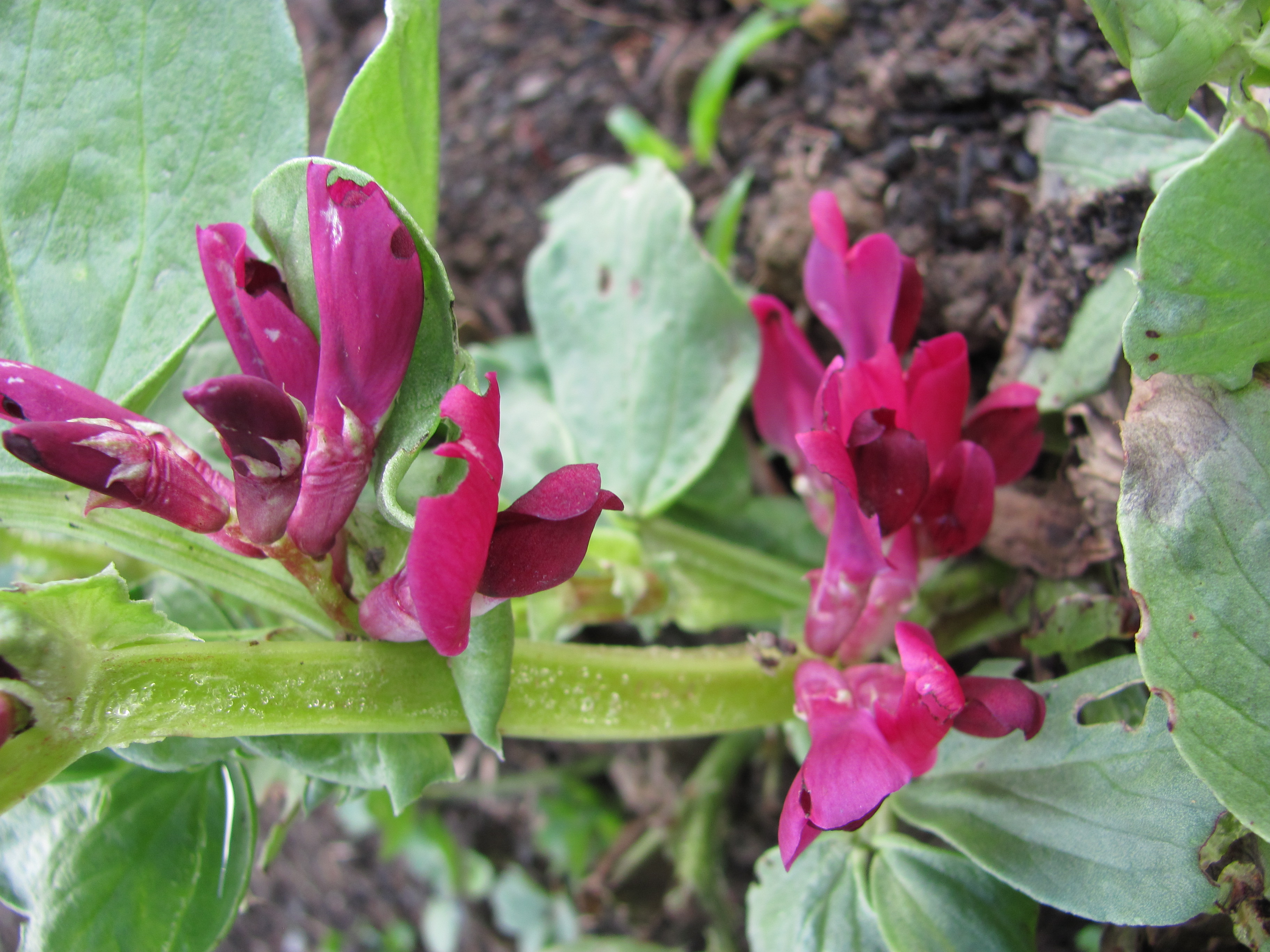
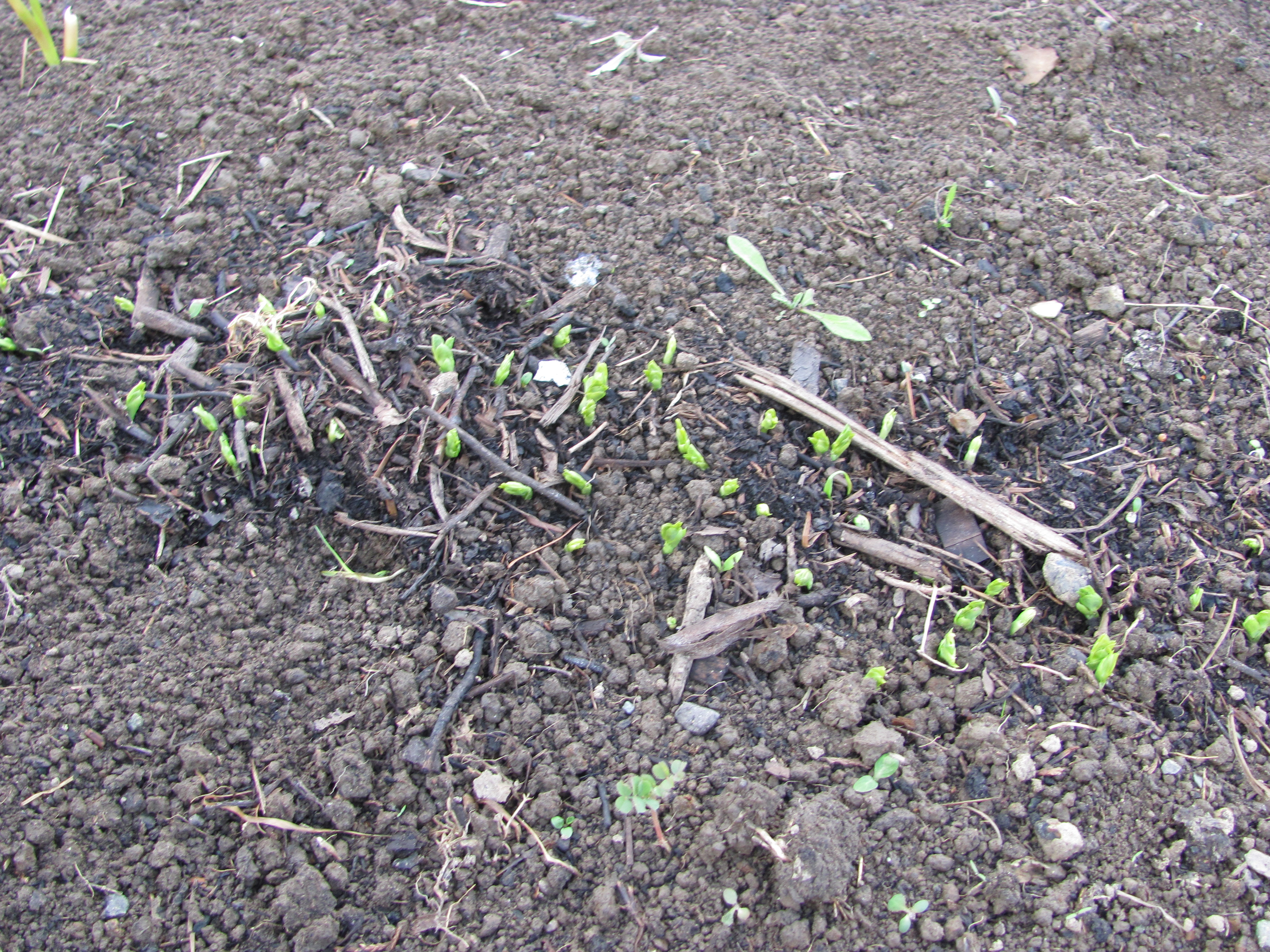
Jude harvesting the last of the leeks with our Wolf weeding tool.Shed painting - not our favourite job!The green roof of our insect hotel.The incredibly coloured flowers of Crimson-flowered Broad Bean.New seedlings of early peas.
As we began our wander we were pleased to see two families from the nearby estate wandering around our interest trail with their children. Later they were sat in the willow dome reading stories. This is what community allotments are all about! We shall start our wanderings at Hut 2, one of our communal huts and move on to the Autumn Garden, one of our “Gardens of the Seasons”.
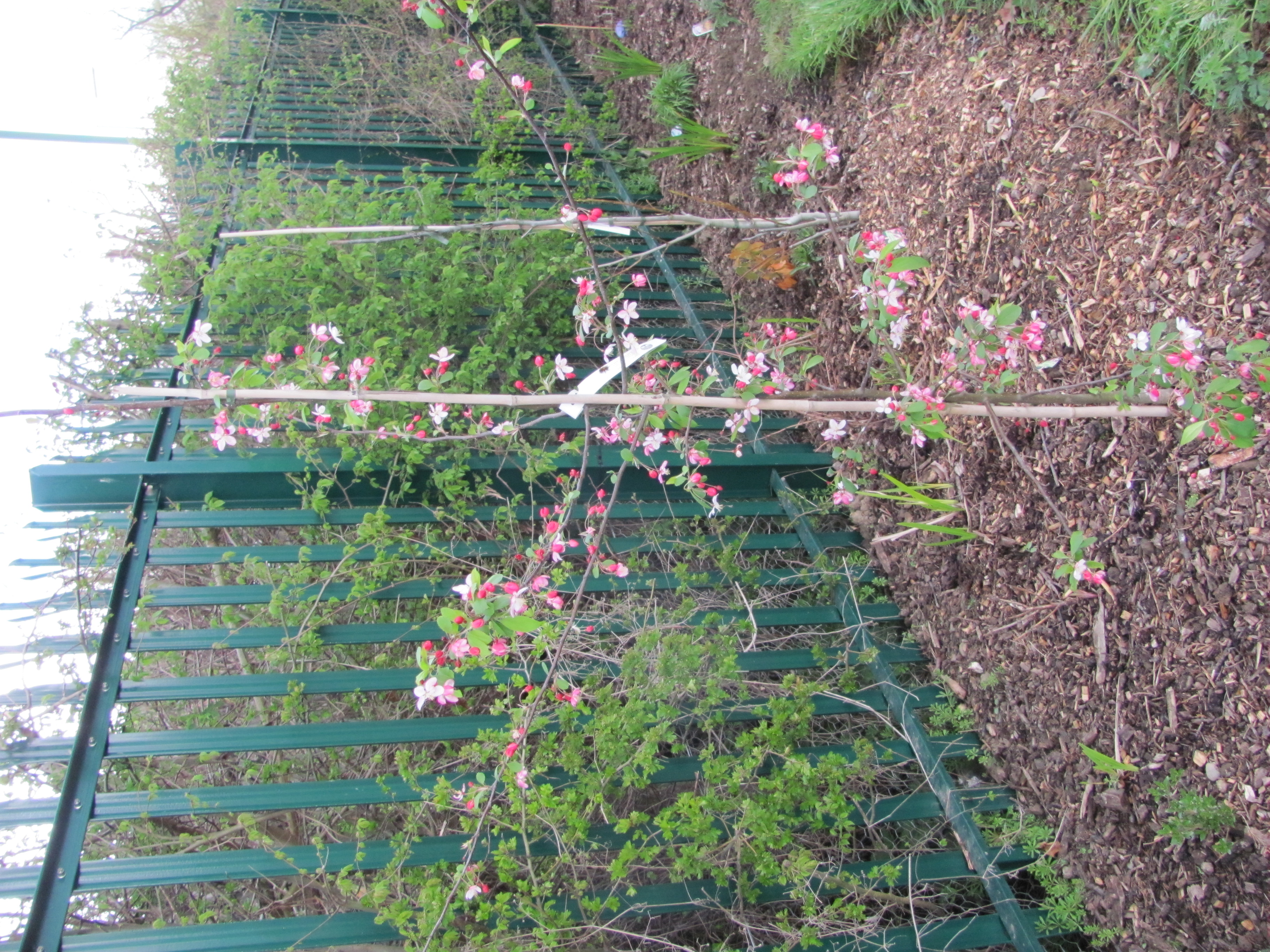
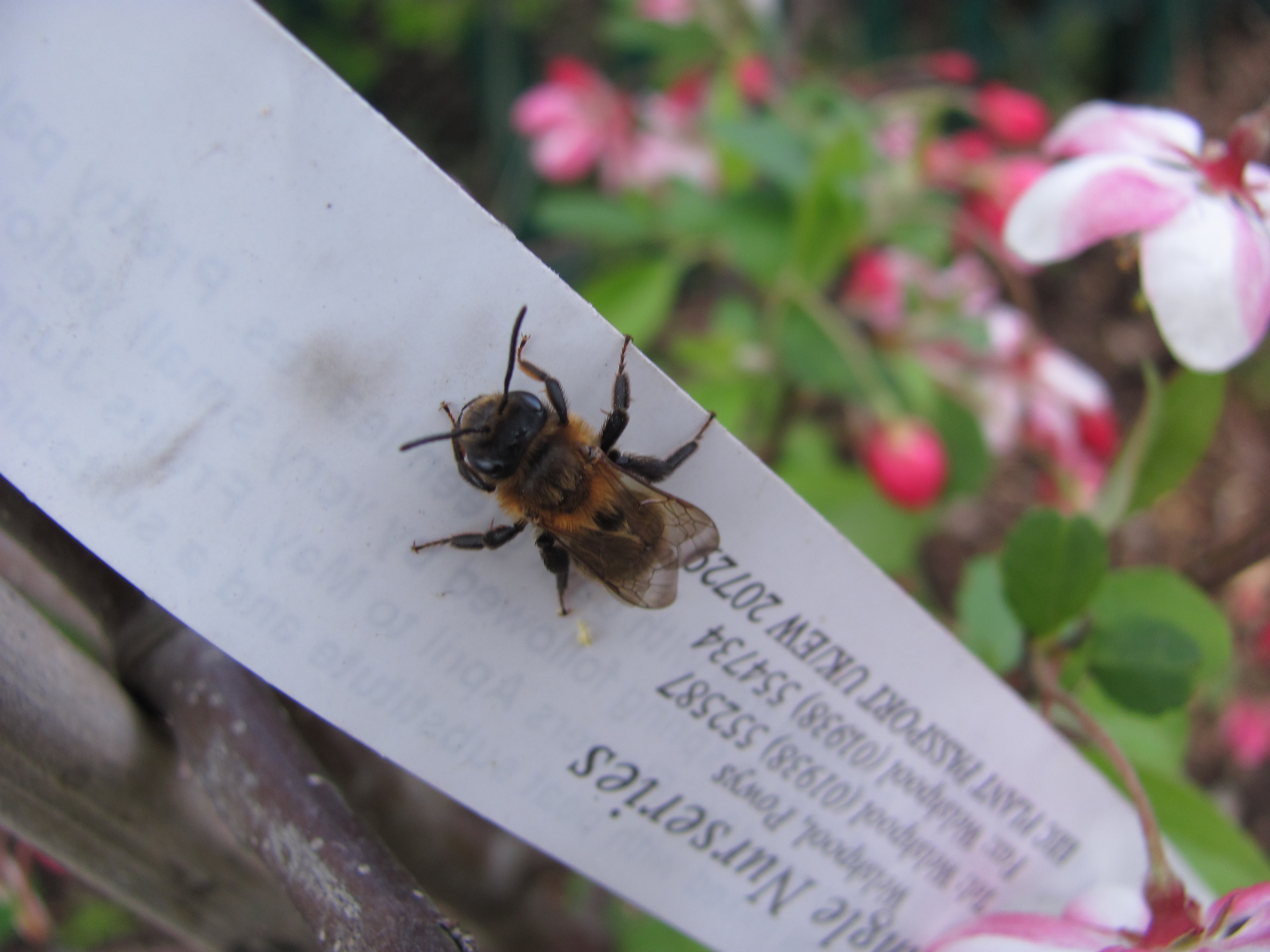
Colourful welcome to Hut 2, our information centre.A species crab apple, Malus floribunda, is a recent addition to the Autumn Garden.We planted the malus to attract bees - it works!Japanese maples grow in the dappled shade of the trees in the Autumn Garden
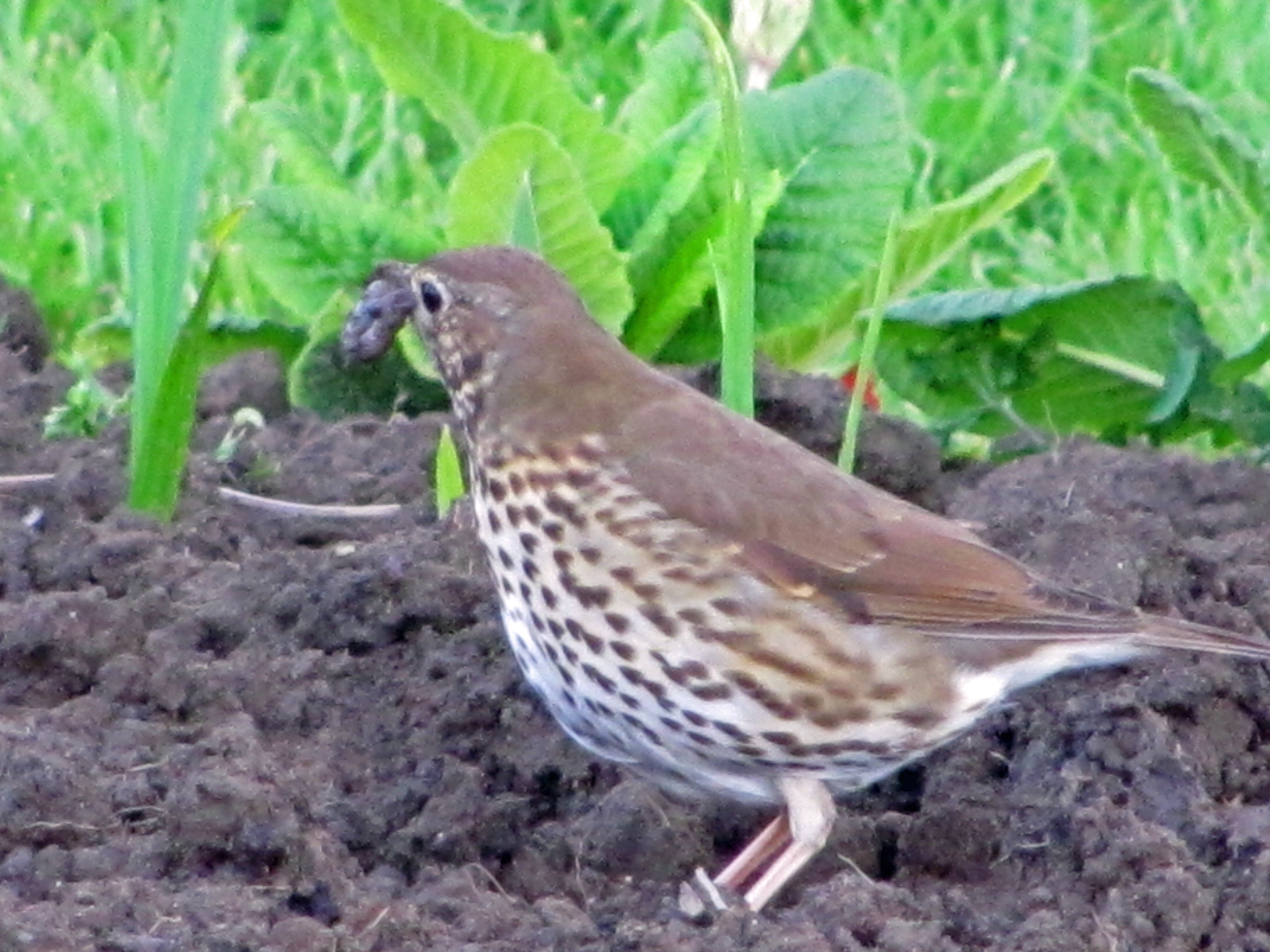
Moving on from the Autumn Garden towards the first communal orchard we follow a native hedge in which for the first time a Song Thrush has nested. the parents are busy feeding their young and collect worms and bugs from plots right under the noses of the gardeners.
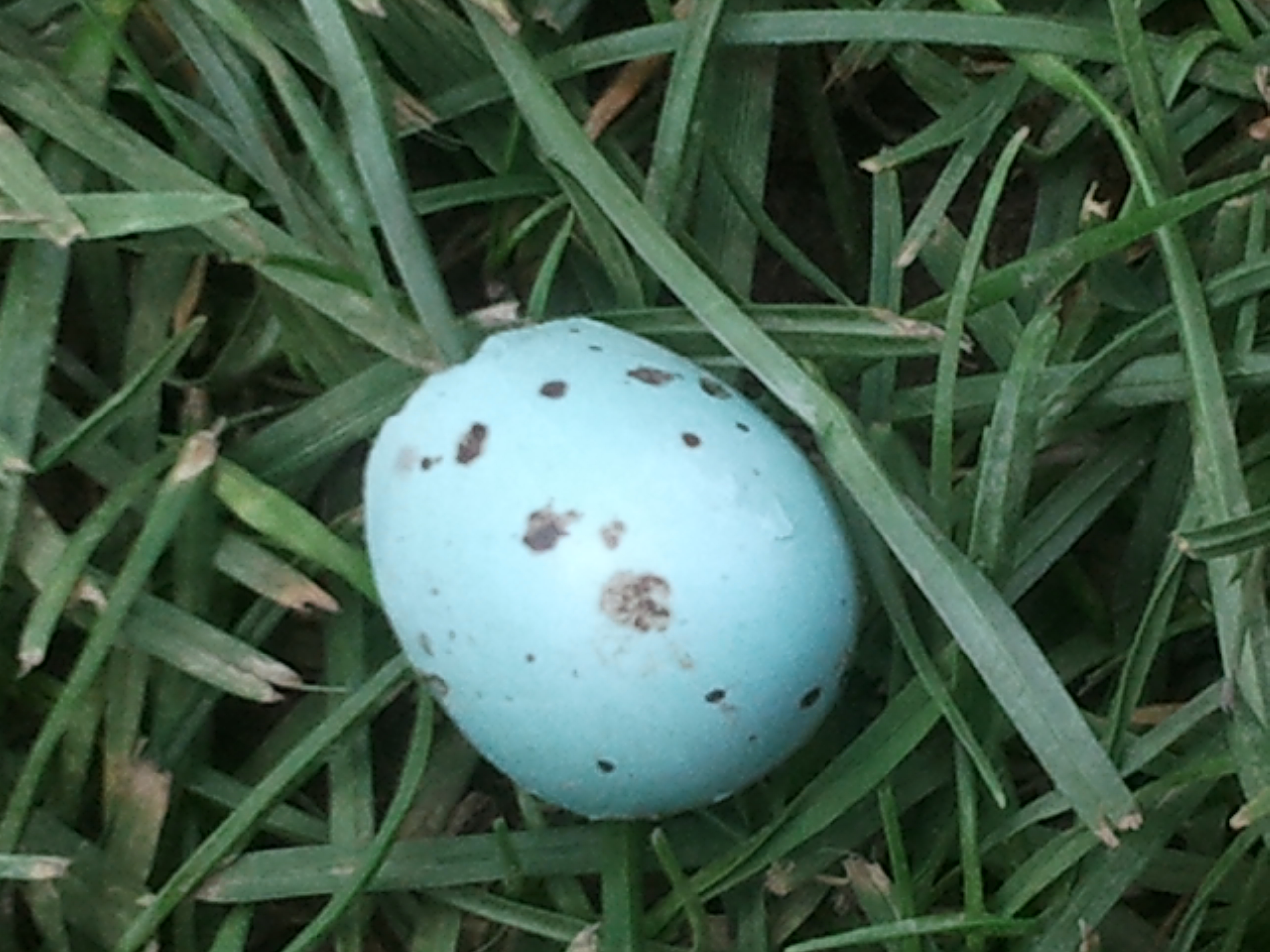
Thrush collecting food for its youngsters.The empty thrush egg we found a few weeks ago alongside the hedge.We are trying to encourage wise watering on the plots so lots of new guttering and butts are appearing.Ready for action.Have the crows got their own back?
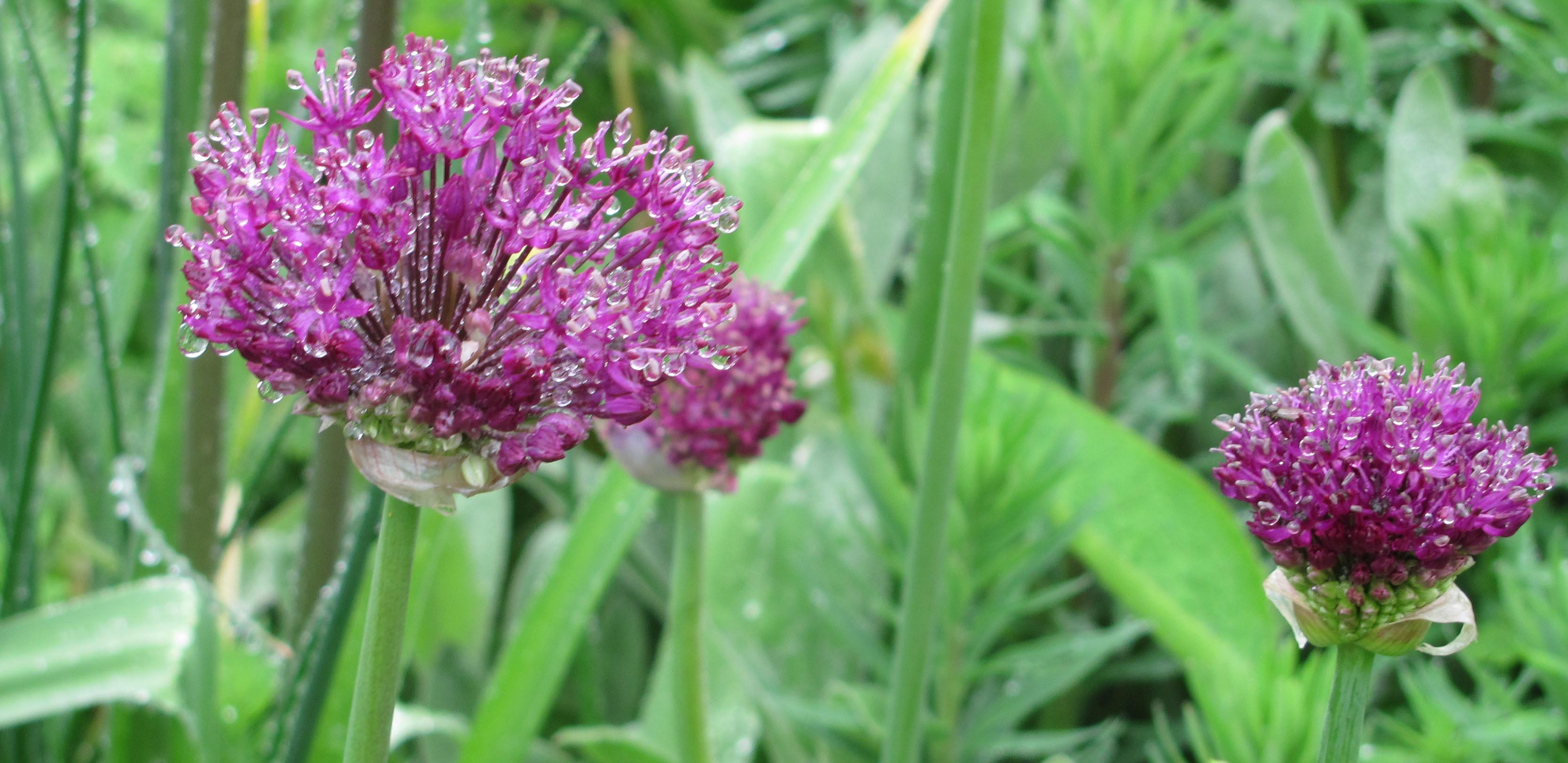
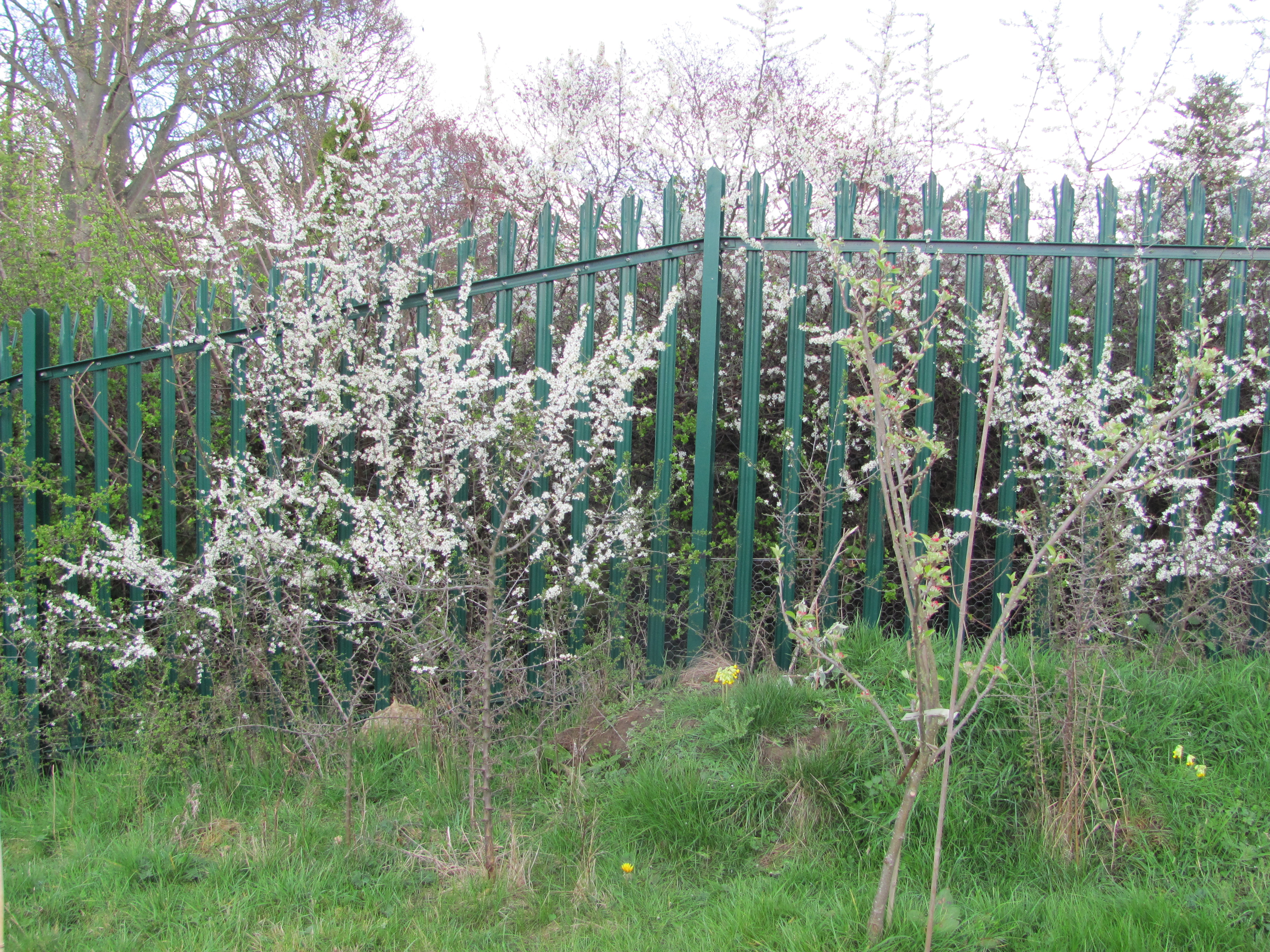
In Crowmeole Orchard flowering spring bulbs are coming to an end as Camassias and Allium push up their flowering buds. The apples, pears and plums are covered in pink or white blossom.
Blackthorn - bees love the blossom, birds love the fruit and allotment holders love to make sloe gin from them.Homes for beneficial insects who will help pollinate the fruit and predate on pests.The Fruit Avenue getting more colourful by the day.
As we wandered through this orchard a flock of Long Tailed tits in their pink and brown livery flew off in the bouncing flight pattern, having fed on the peanuts in the feeders. Their long trailing tails followed on. We moved on following paths between plots towards the Spring Garden and Sensory Garden near the old oak tree. Plots are full of ridged rows of sown potatoes and white plastic plant labels marking newly sown rows.
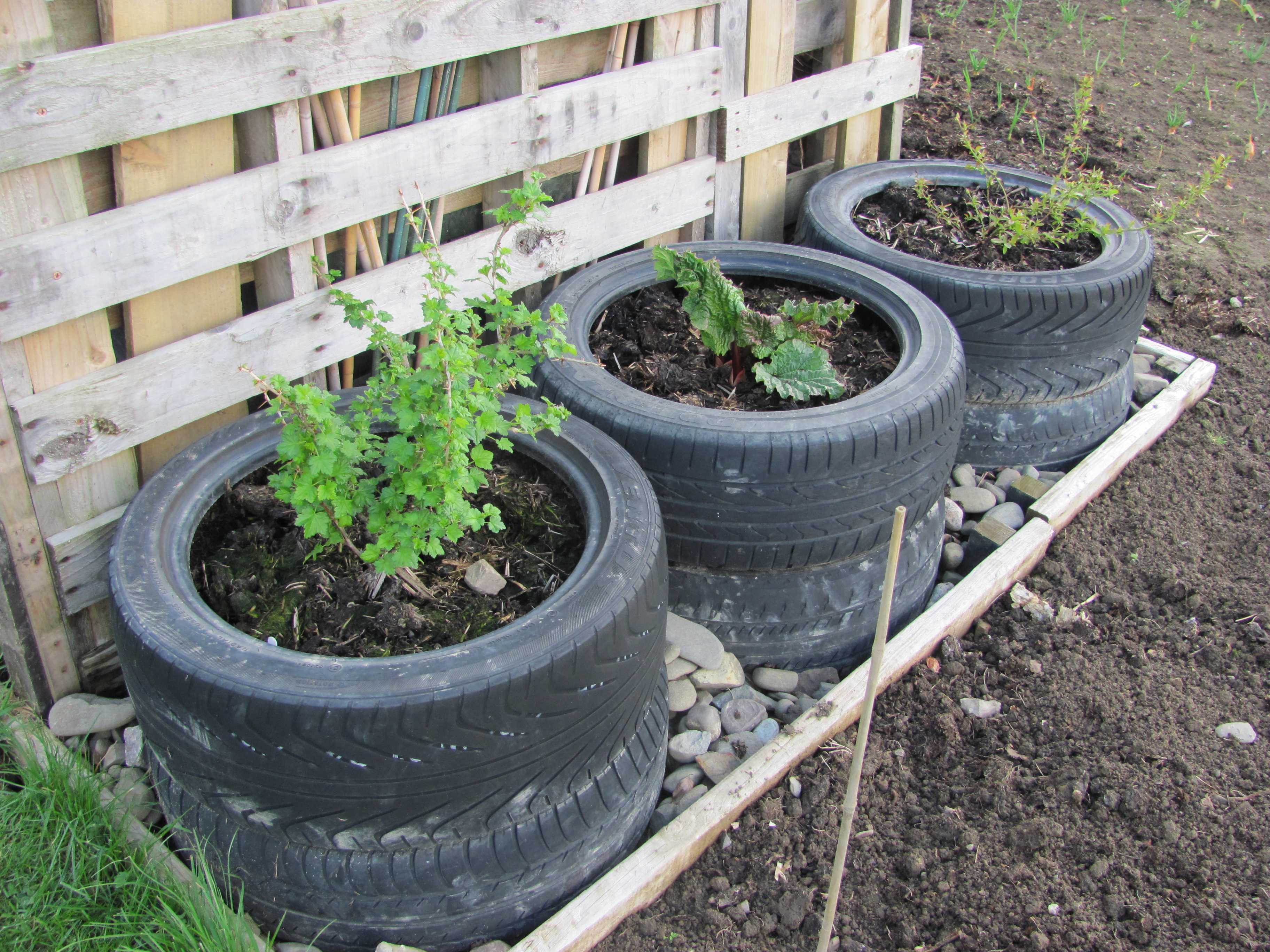
Phil and Doreen have planted up a border alongside their plot.Several plot holders are topping up their paths with wood chip.Alan's tyre beds.
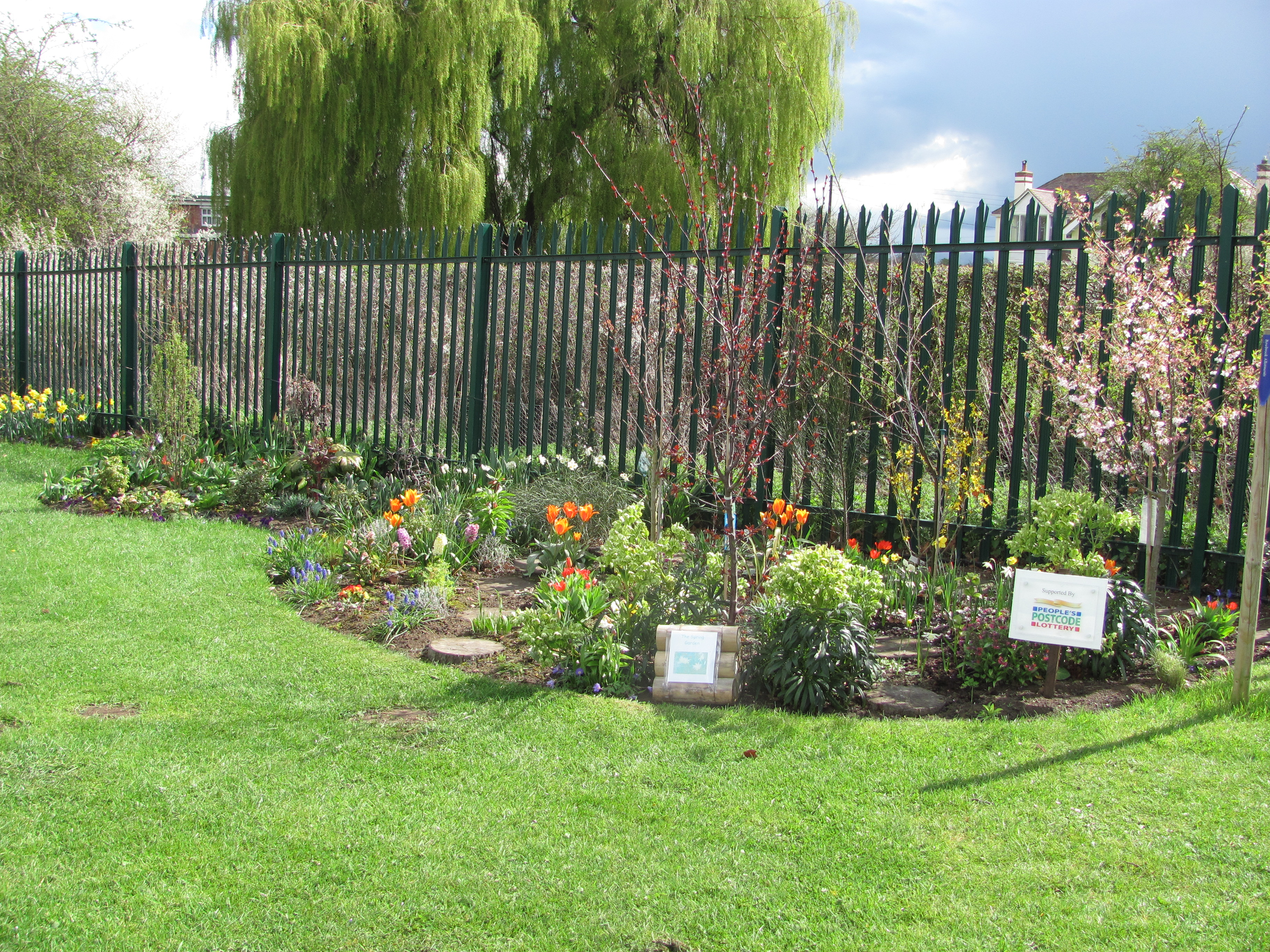
The Spring Garden in its second spring is looking so good and has become a popular place for allotment holders and visitors.
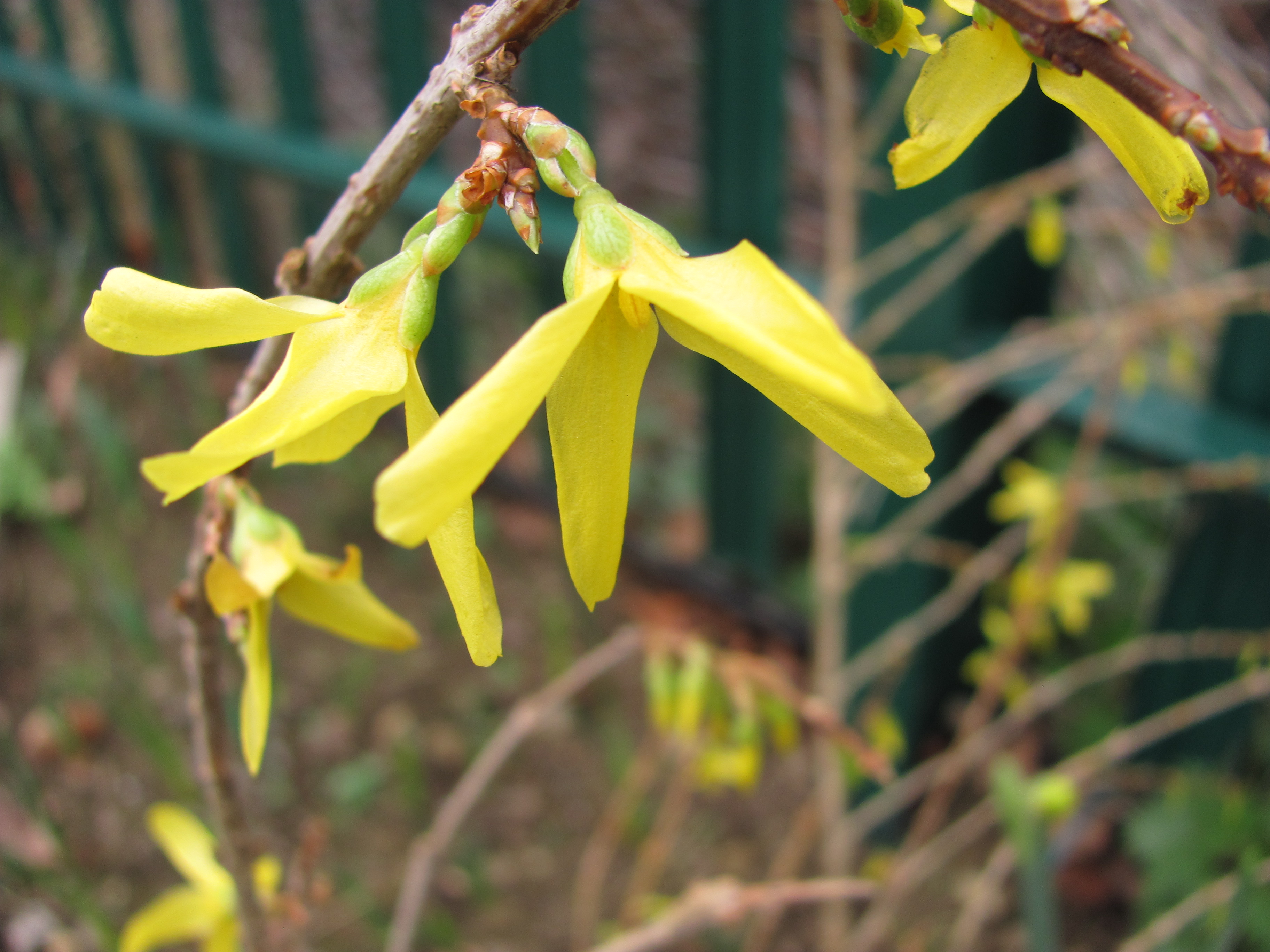
The most colourful spot on the site in April is the Spring Garden.Forsythia flowering in the Spring Garden.Spring Garden beauty.
Through the Willow Tunnel is one of our many picnic benches where we stop for coffee on our April wanderings. As we enjoyed our brew curlews called in nearby fields with their mournful song and the Great Spotted Woodpeckers flew busily overhead.
We have just started to shape the willows into a tunnel.The Sensory Garden is growing well now the weather is warming up.
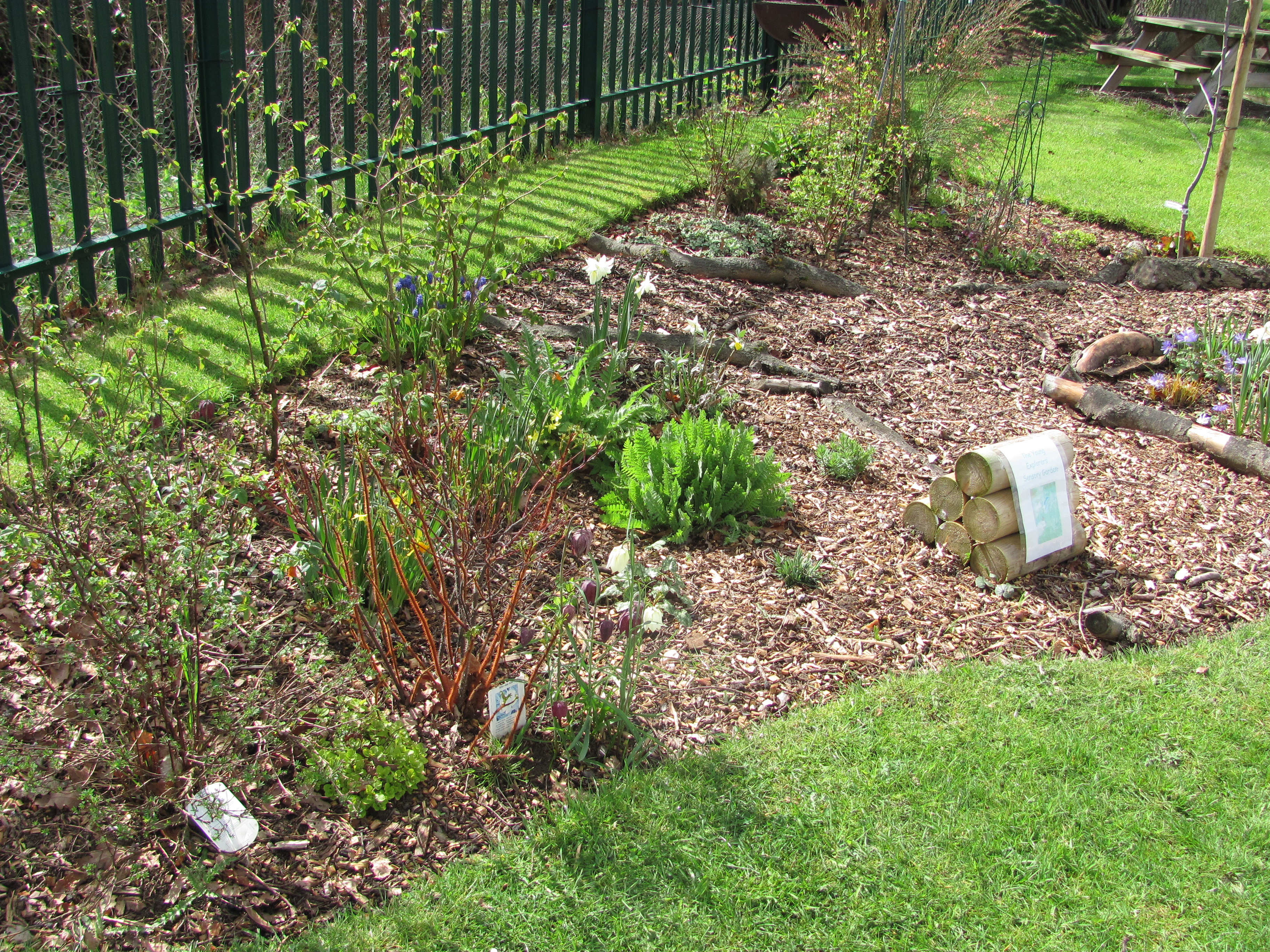
The Winter Garden has passed its peak after being so popular for months. We have been busy giving it a sort out.
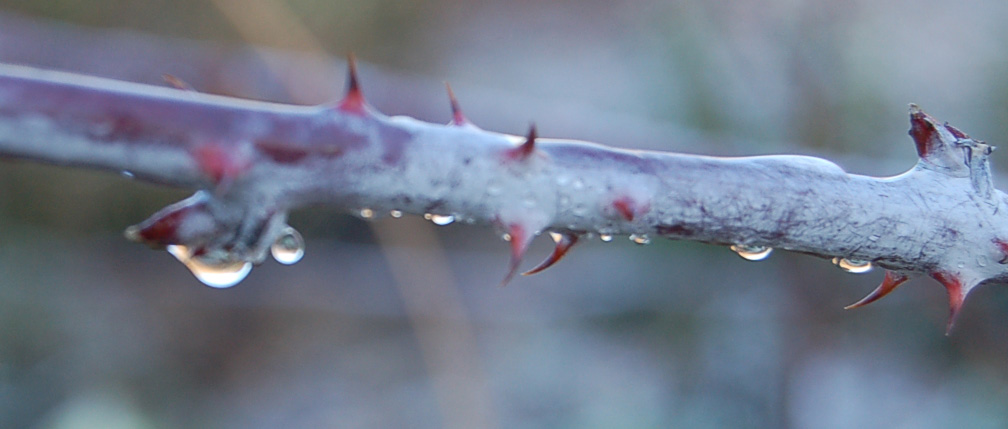
The stems of the White Stemmed Rubus look magical in the spring sunshine.The dogwoods and willows grown for their coloured stems have been pruned hard to encourage fresh wands of growth.Fresh Fennel foliage in front of a Euphorbia.
We wandered next through the Woodcote Orchard where the paths are cut short and neatly through the long grass, and looked at the Turf Spiral, a favourite of the children.
Follow the trail post down the neat path.We have been adding another layer of turf to the spiral to create somewhere to sit.
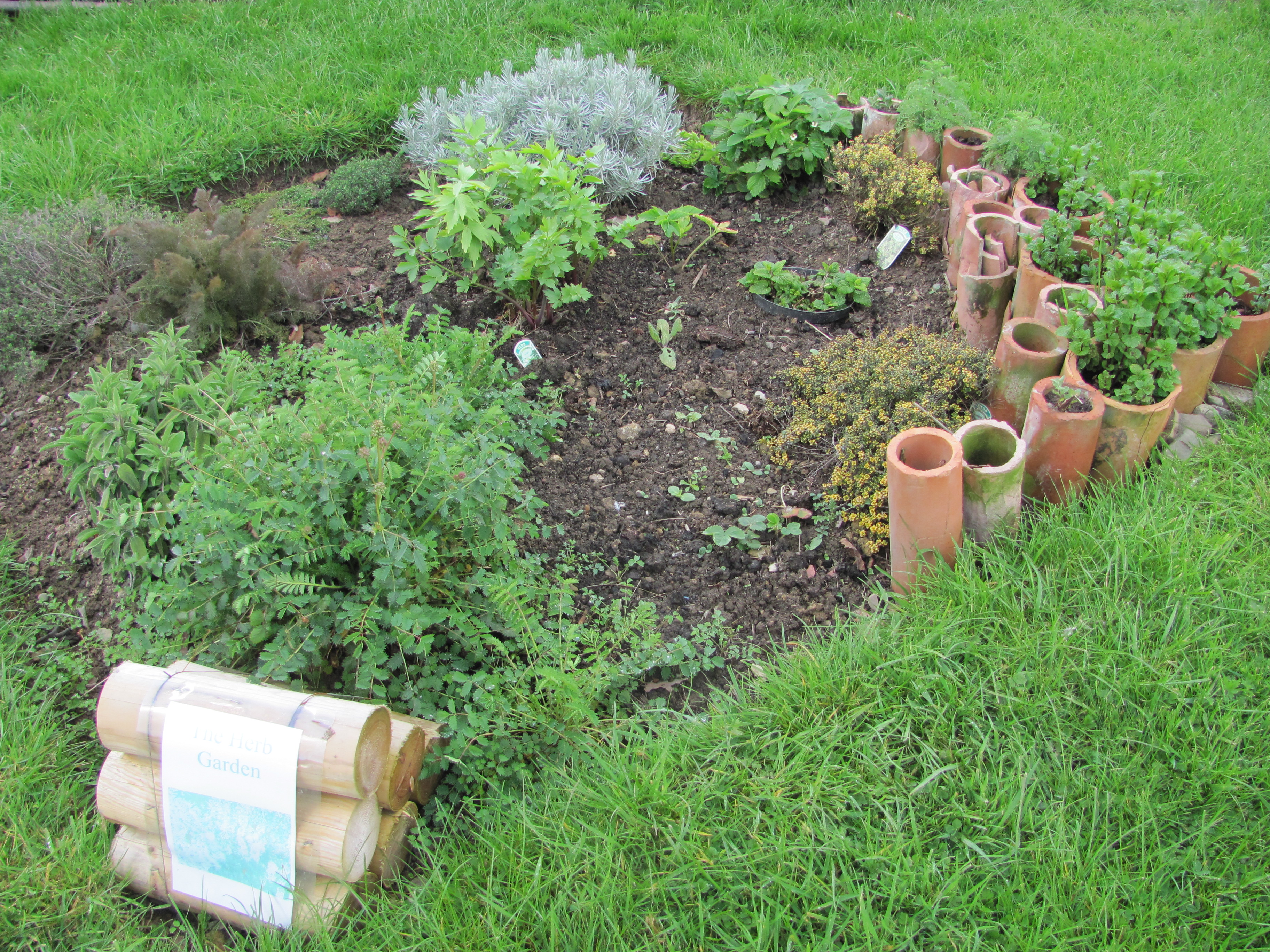
Our final stop on the way back to the car park was the Herb Garden where herbs are now well established. This last section of our lottie wander took a lot longer than the others as we enjoyed a good chat with Dave and Jean. We put the world to rights and shared details of how all our crops were getting on.
Yesterday we spent the day up at our allotment, with the aim of sowing mini-meadows and planting out Brassica plants. But firstly the grass paths separating the plot into its four beds needed a good cut. That done we prepared two narrow borders along one edge of the plot, raking the soil finely but adding no fertilisers or organic matter, for this is where we were creating our mini-meadows.
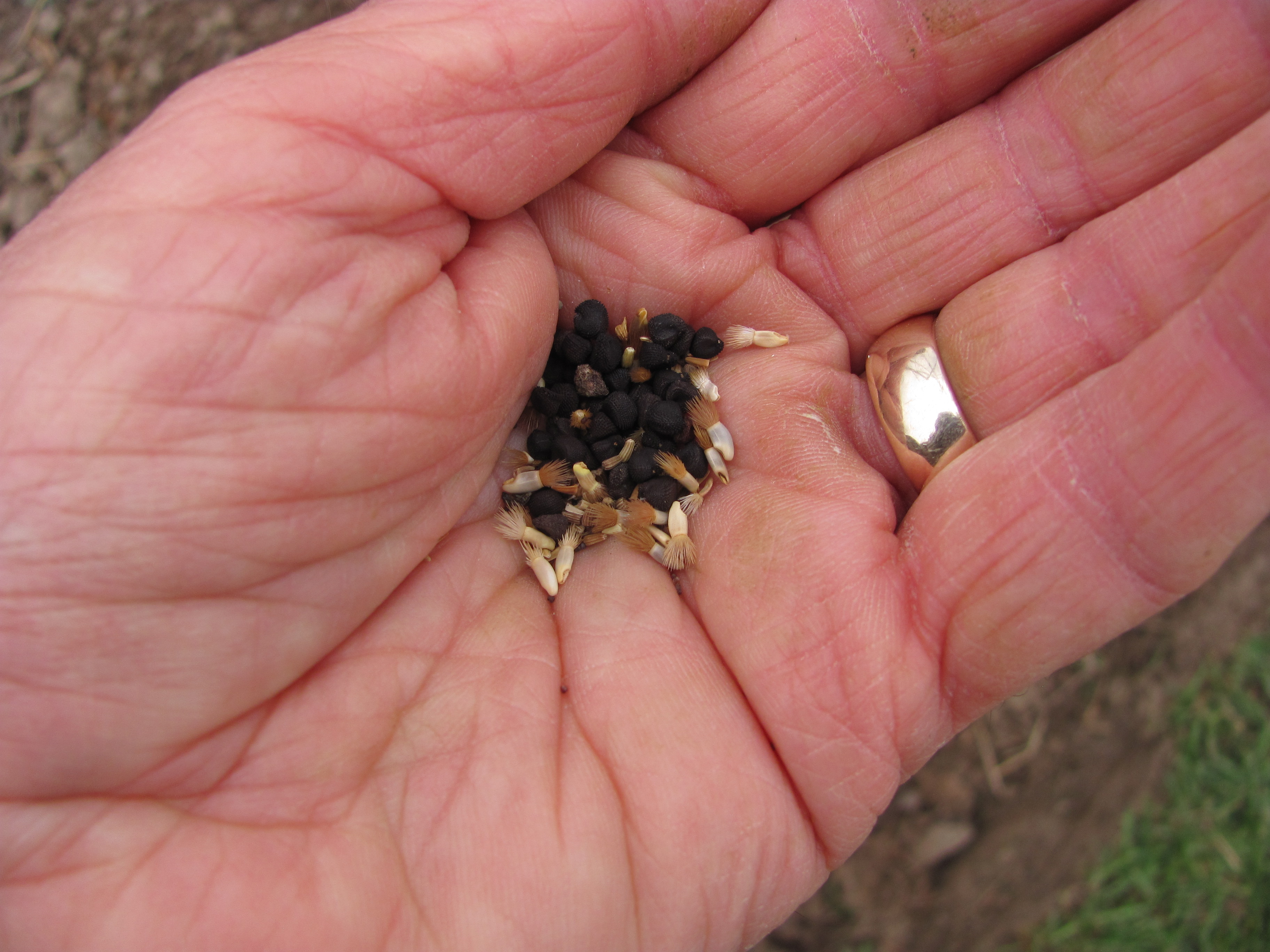
We sowed a mixture of 3 packets, a white cornflower called “Snowman” a native cornfield mixture and a Californian wildflower mixture. It seemed so strange to feel how light the seeds felt in my hand – a meadow in the palm of my hand.
We hope that our little strips of meadow will look good for us and fellow plotholders to enjoy, attract beneficial insects and bring in attractive butterflies. We particularly want bees to arrive to help with crop pollination. And of course they all entertain us while we are gardening.
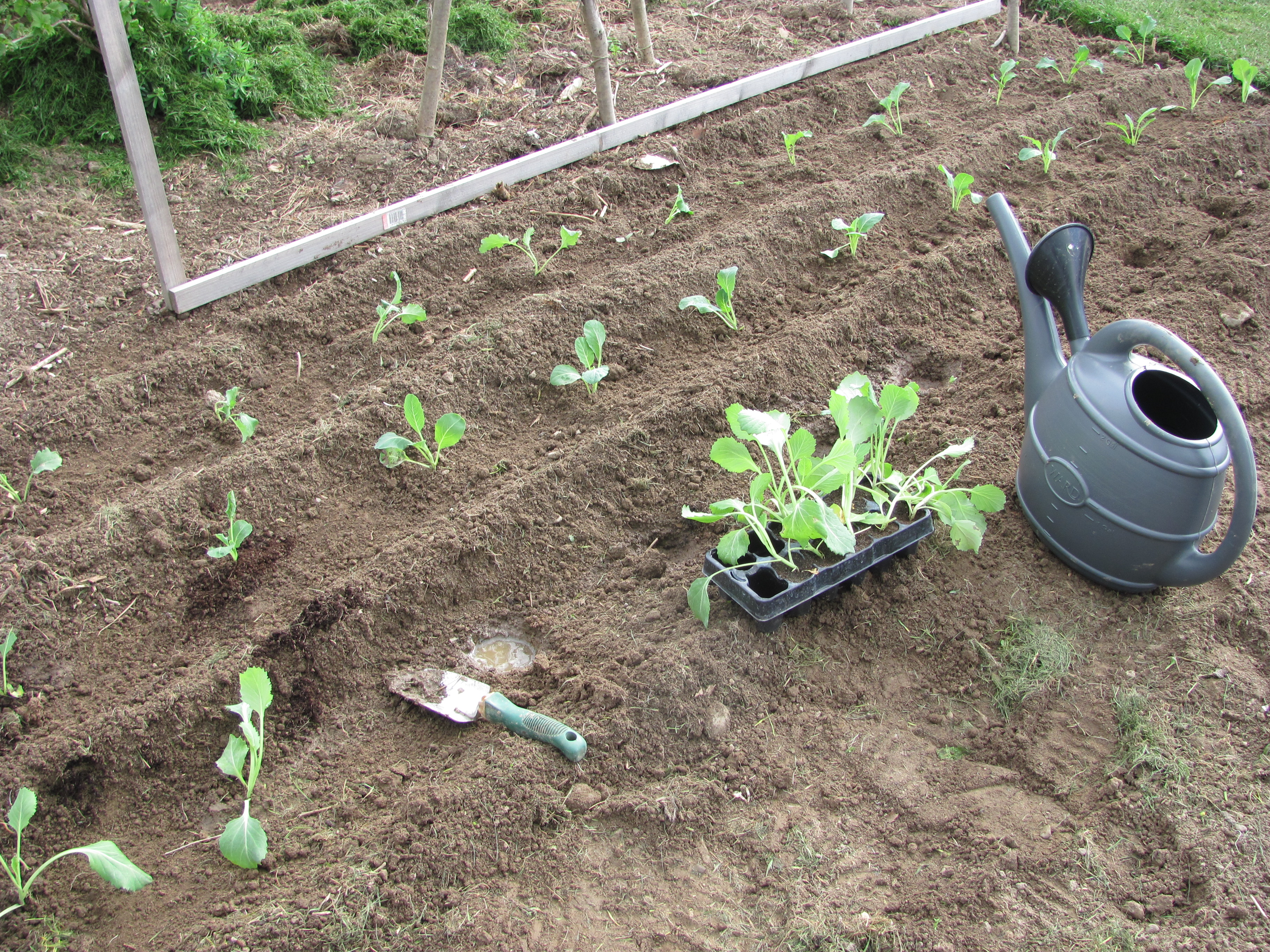
After a quick coffee we scattered chicken muck pellets and fish, blood and bone fertiliser onto our brassica bed and raked them in well. I then trod over the area to firm the ground and raked again. Brassicas enjoy firm soil and they are less likely to bolt and help them fill out better.
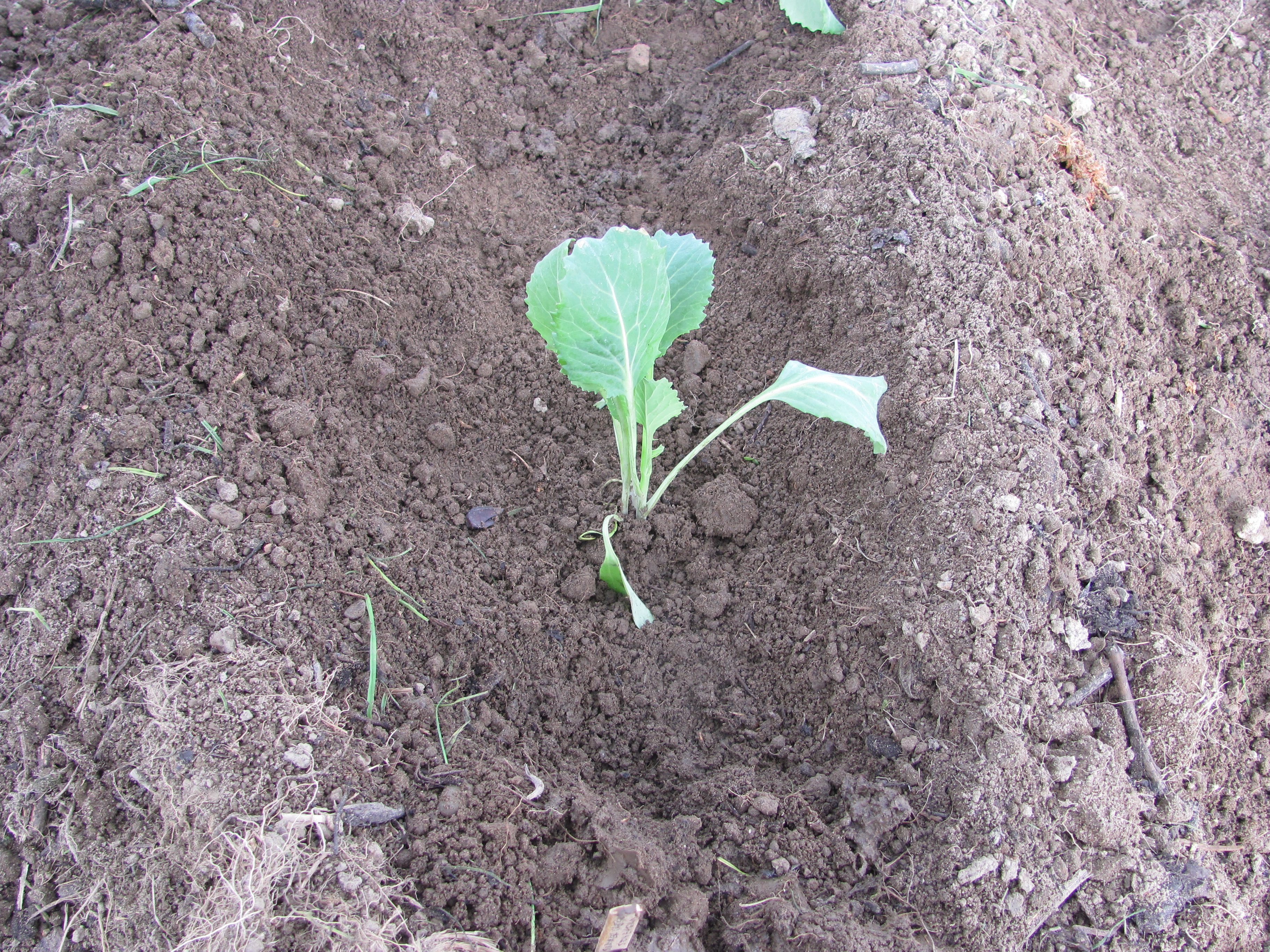
We decided to plant the Brassica plants in trenches with raised sides to act as min-dikes. With all the talk of drought and possible hose pipe bans we are trying out ways of watering wisely. These trenches should ensure that any rain is directed towards the plants.
We packed away our tools and locked up the shed after a busy, productive couple of hours. Back to the community hut to collect one of the site mowers and the grass strimmer, and we were off to mow the grass around the community meadow area and the turf spiral. But we wandered around the site first and found three real little gems.
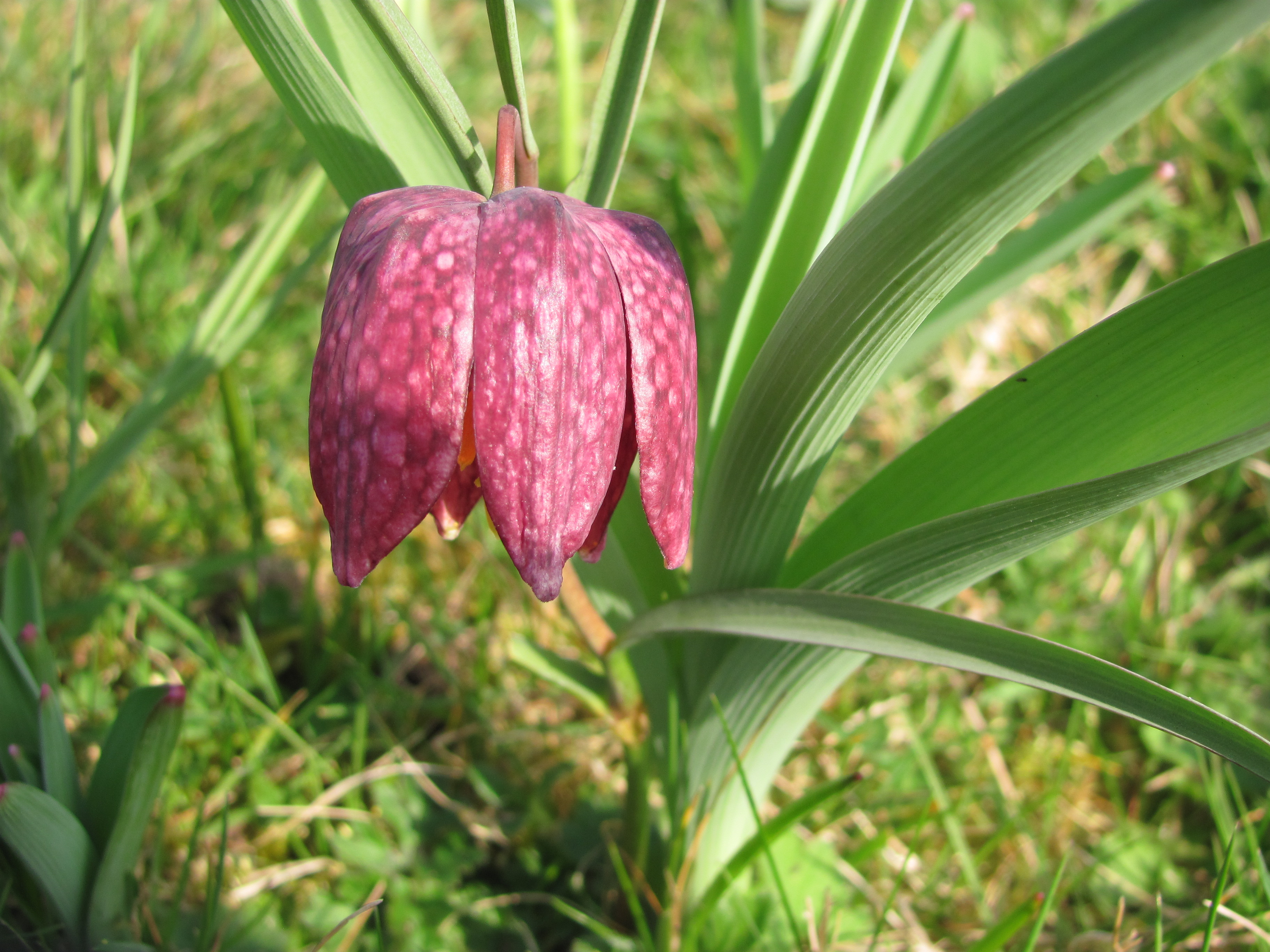
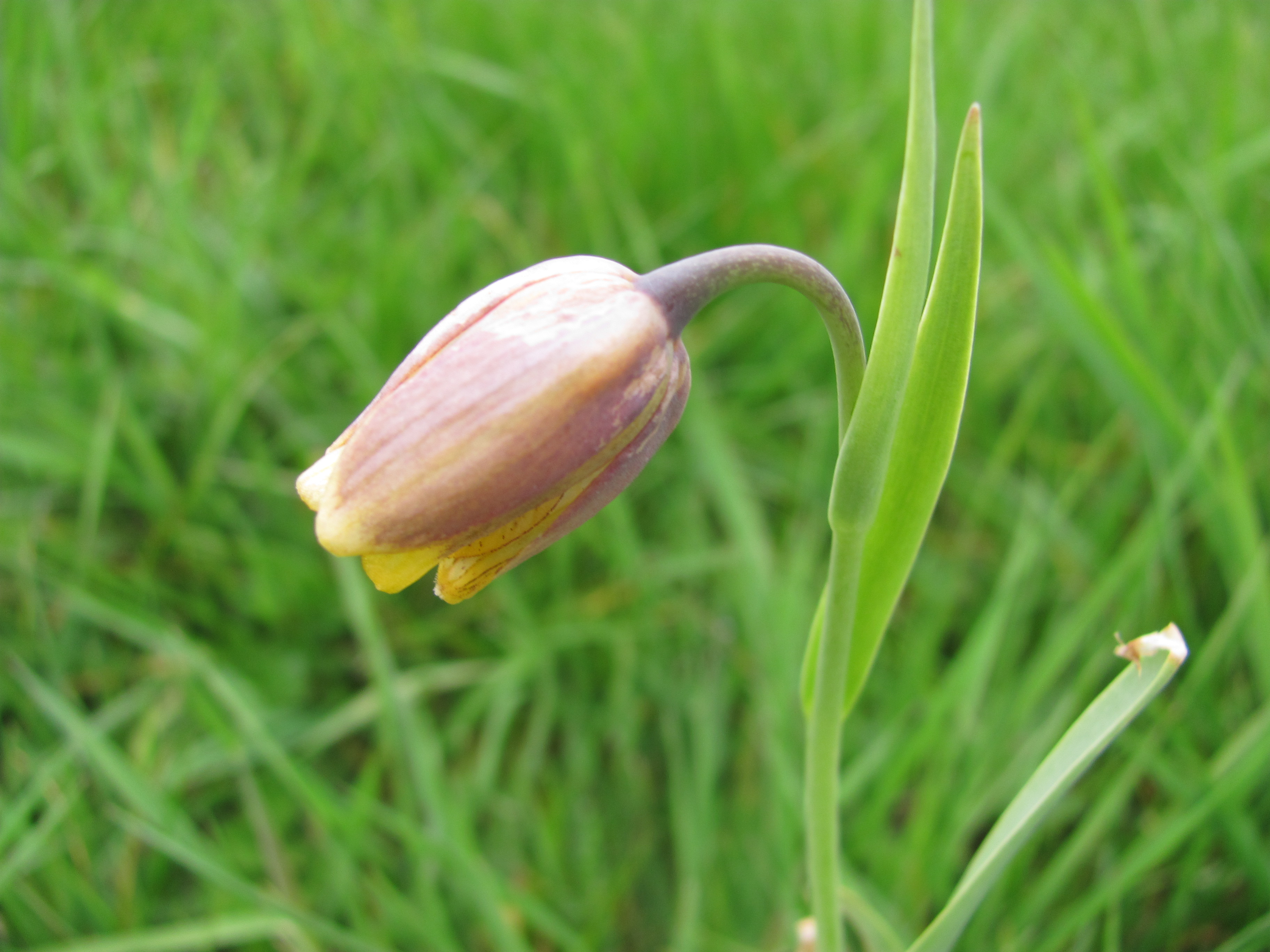
This first gem we found was a native fritillary growing in a batch in the first of the community orchards and the second, a more unusual fritillary, in a small patch in the Hazel Grove.
The third gem was a hatched shell near one of the native hedgerows. This little sky blue beauty is the egg of a Song Thrush, so we were delighted to find it. Thrushes are becoming more frequent on the site as our community wildlife areas are becoming more established. We often see them feeding under the feeding stations or rummaging in the leaf litter beneath the hedges.
We mowed and trimmed for a couple of hours before our backs shouted “Enough! Enough!”
The long-awaited and eagerly anticipated day arrives. First outdoor sowings on the lottie. A big flask of coffee, a bunch of bananas and half a dozen apples in the trug and we arrive at our plot with blue sky above and warmth of the sun making us feel good.
We began by tidying our paths, I mowed and Jude, “The Undergardener” trimmed the edges. Instantly the plot looked the business. We removed the cloches that had been warming the soil for a fortnight and discovered warm, moist soil below all raked to a fine tilth.
Cloches in place warming the soil ready for sowing.
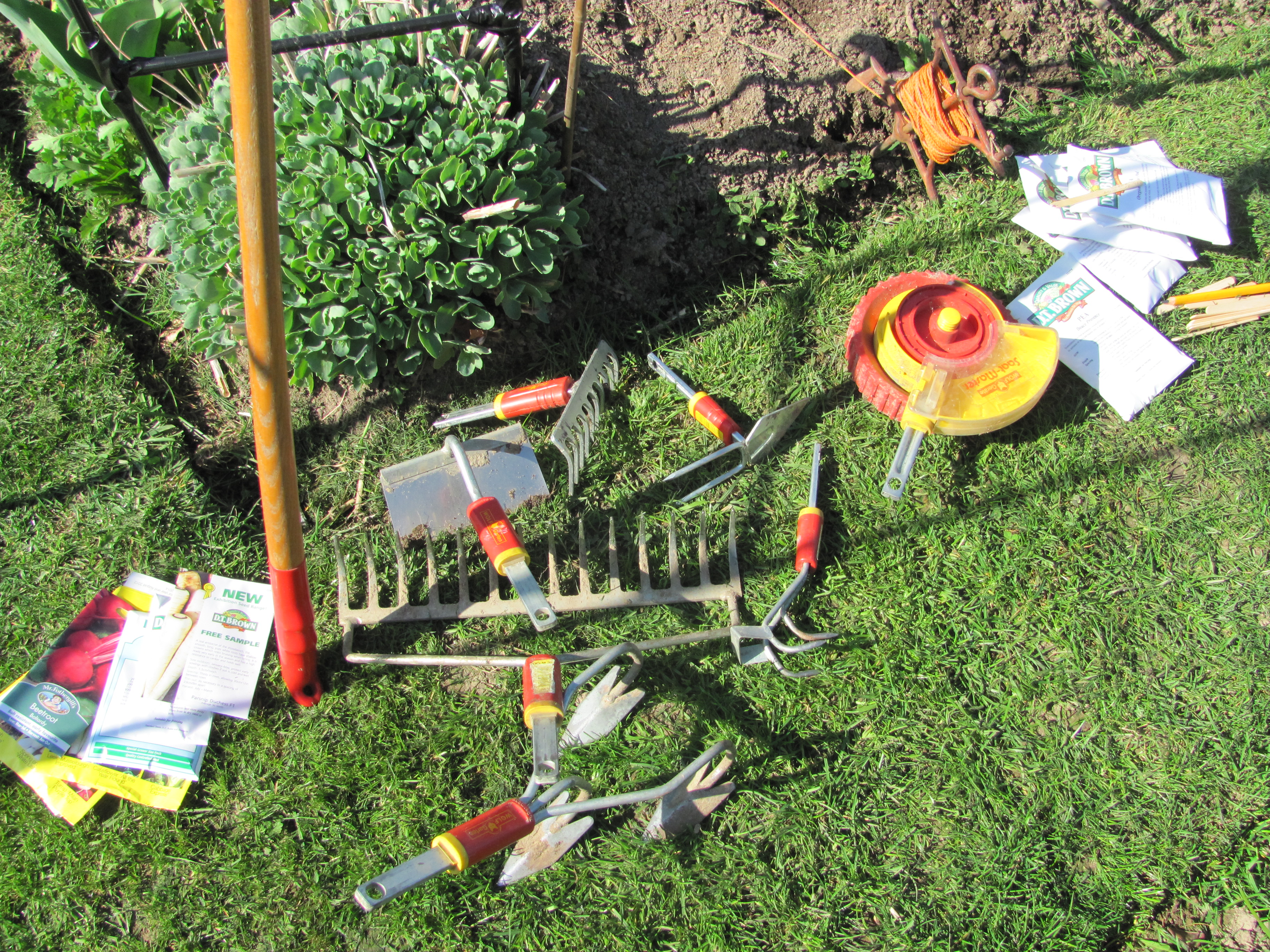
The tools for the job collected from the shed, seed packets at the ready and the sun on our backs – ready for off! I use a range of tools by Wolf – three handles, short medium and long, and a range of inter-changeable heads. For today’s sowing I got ready a wide rake, narrow rake, cultivator, drill-maker, seed-sower and hoe.
Tools at the ready.
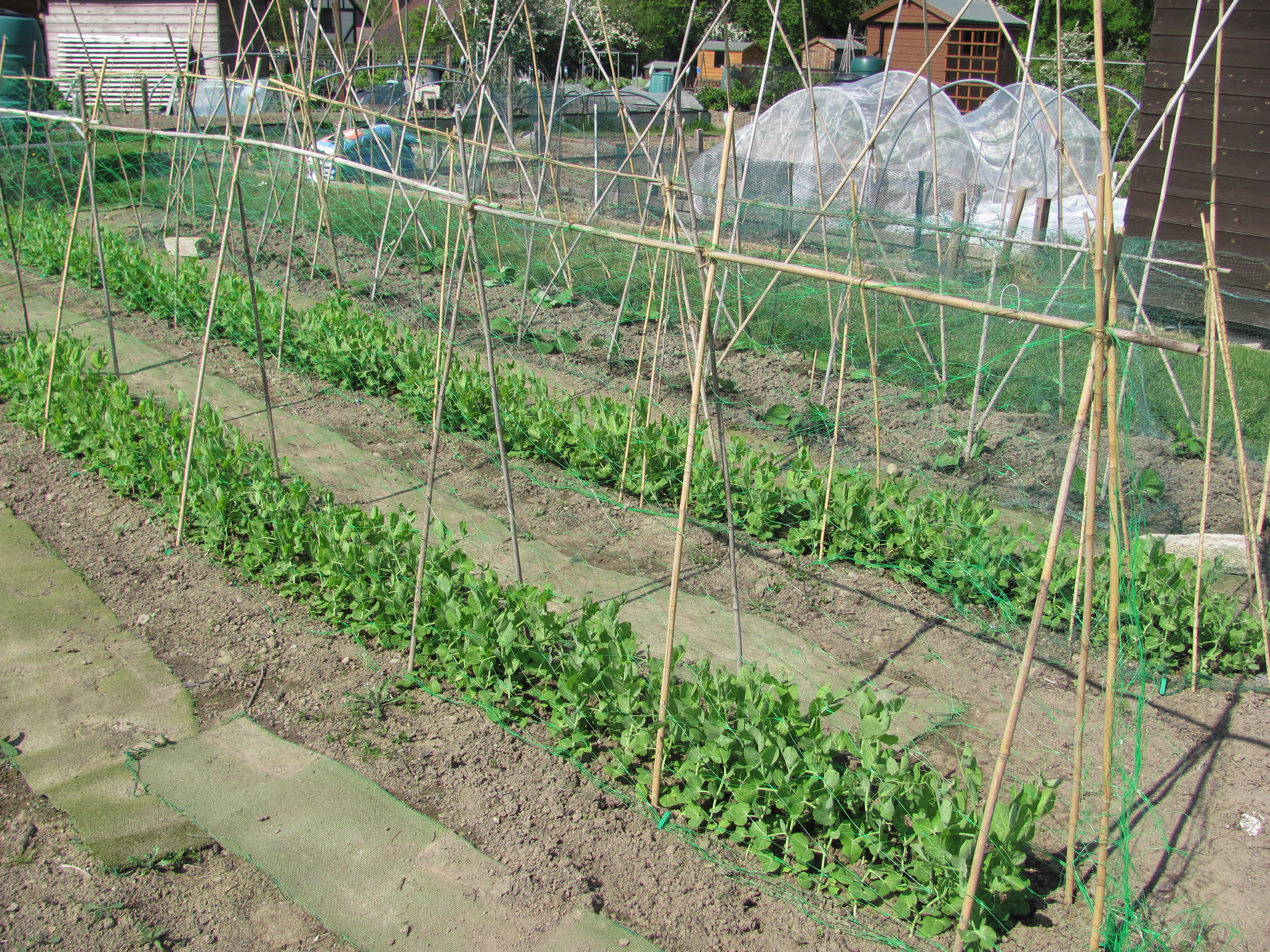
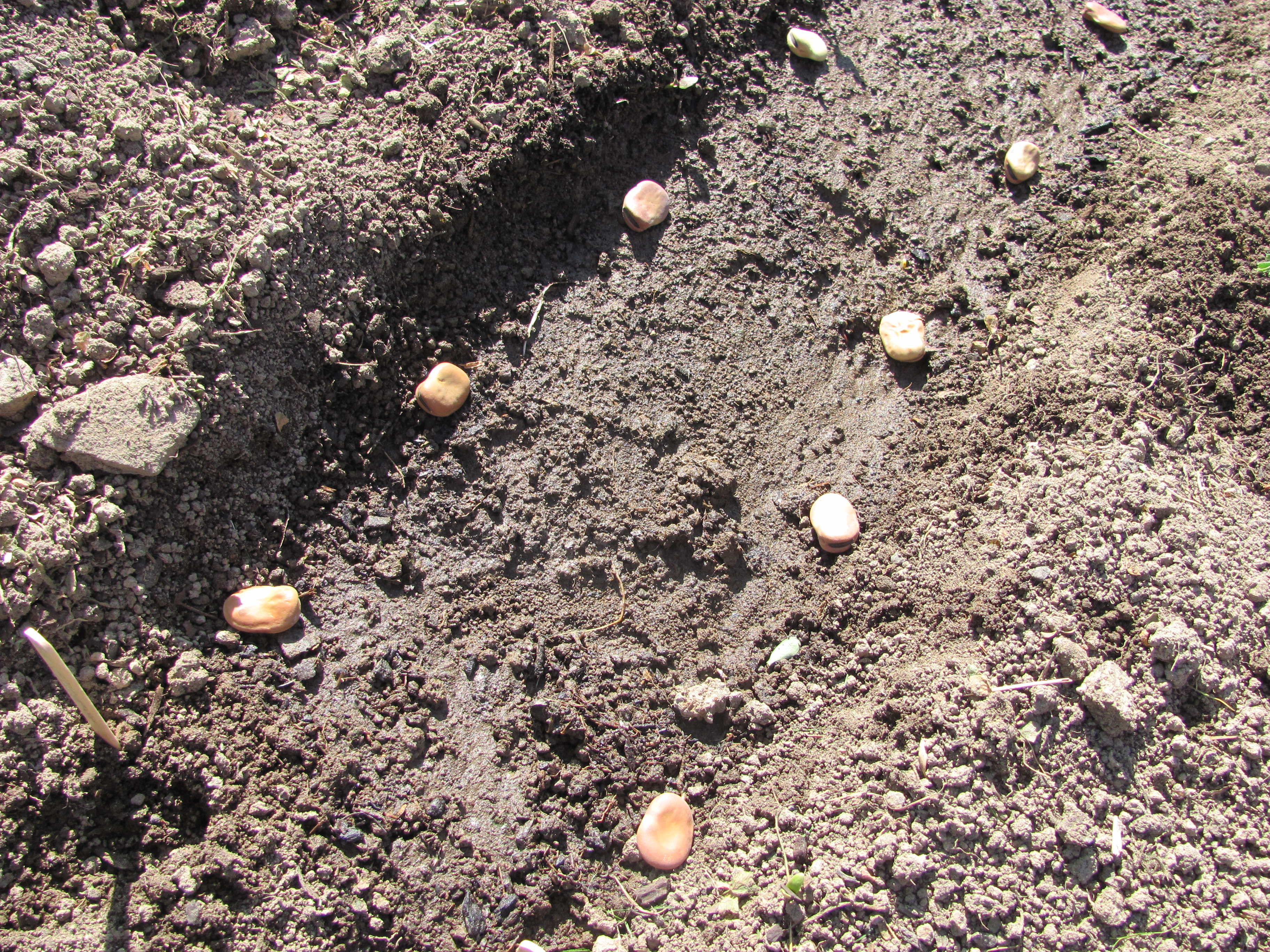
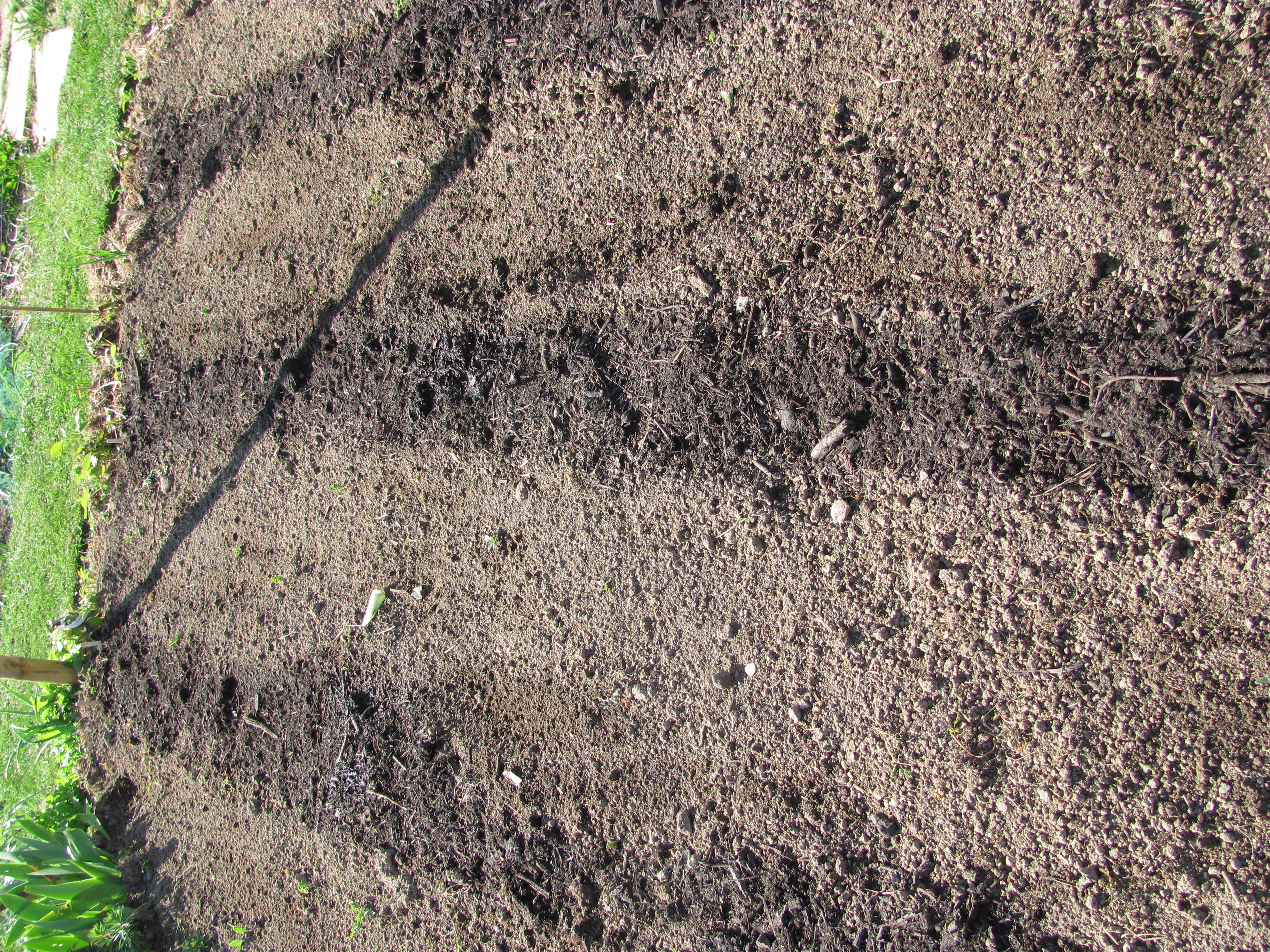
Where the soil had been warmed with a covering of cloches we sowed legumes, Broad Bean “Super Aqualdulce”, Pea “Sugar Ann” which we enjoy by eating the young pods whole, Pea “Oregon Sugarpod” a mange tout type. First job is to take out a 2 inch deep drill six inches wide with a draw hoe and then keep watering along it until the water stops draining away quickly. The seeds are then placed in the drills and covered with dry soil to keep in the moisture and a final topping of compost to act as mulch and to clearly mark where we have sown. Although we label our seeds as they are sown we take this second precaution against the Blackbirds who enjoy pulling our labels up and throwing them on the paths.
Waiting for the heavily watered drill to drain.Two rows of Broad Bean seeds neatly set out.The darker compost mulch marks the rows of peas and broad beans.
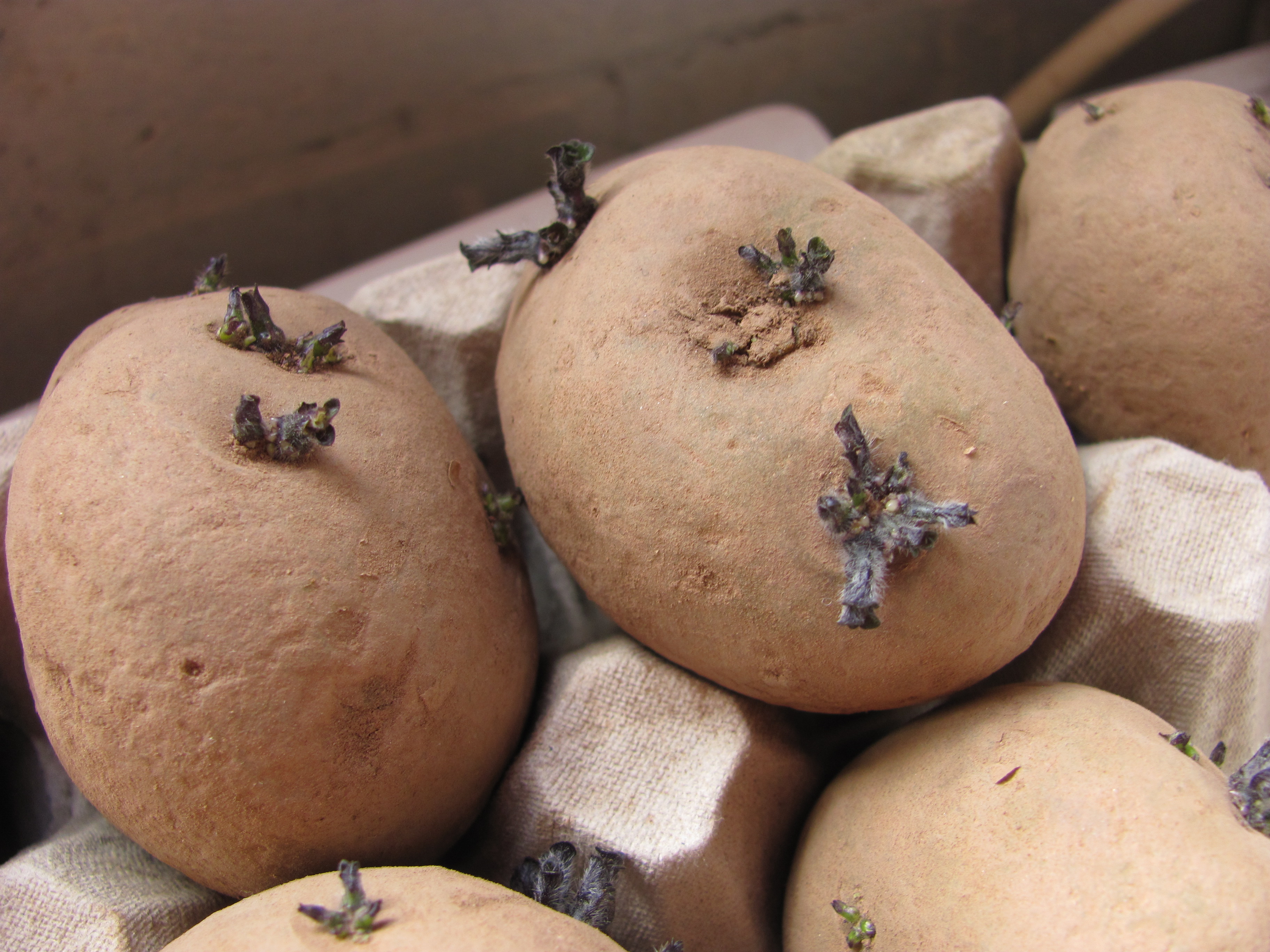
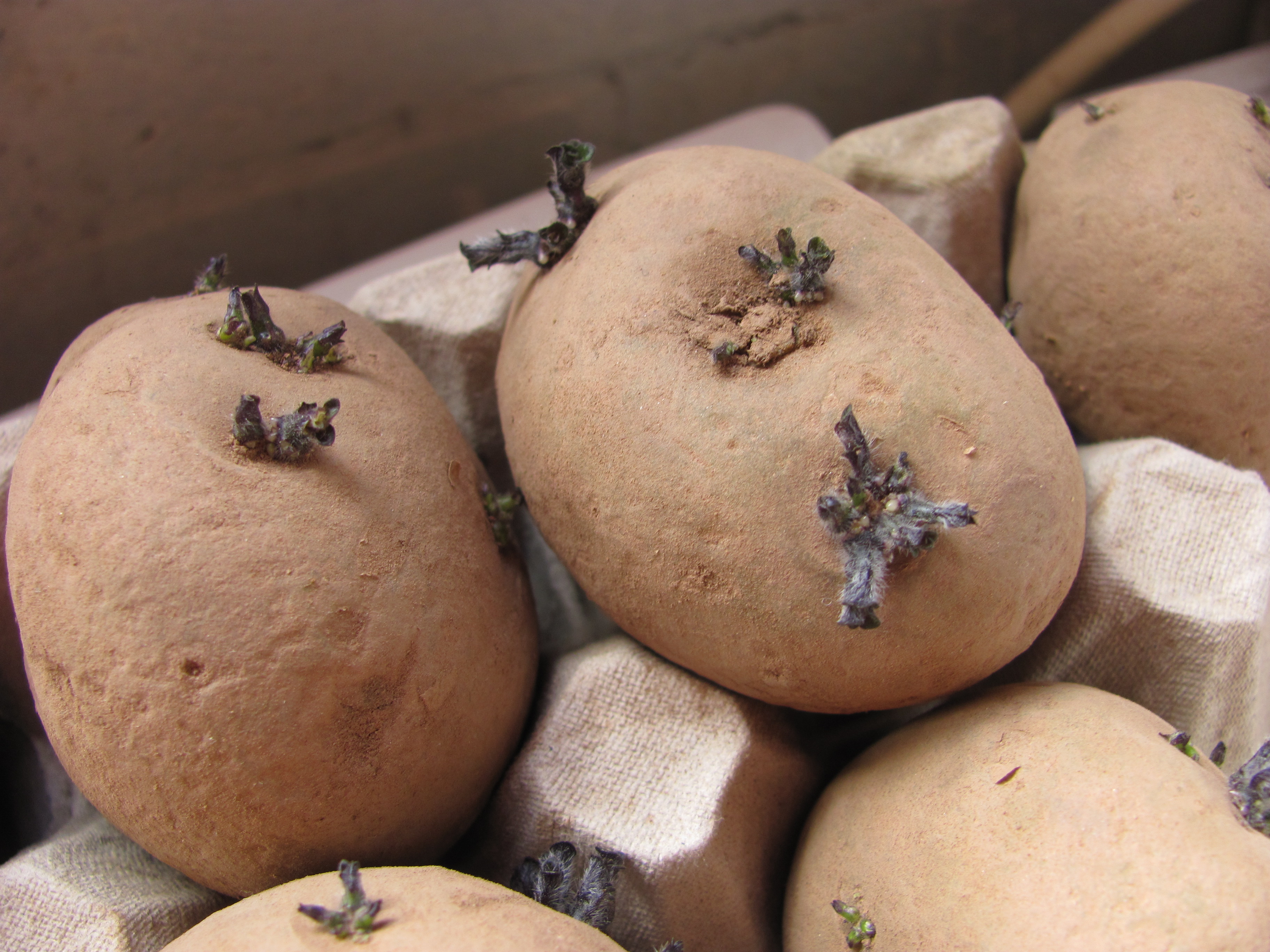
When we returned home we planted up our first batch of seed potatoes, Rocket and Kestrel. The Rocket will be ready first, hopefully within 11 weeks and the Kestrel a few weeks later. Kestrel looks good with its purple eyes and tastes good too.
Potatoes chitted ready to plant.We grow our potatoes in potato bags, using old compost as the growing medium.
Late Saturday night we were digging jazz at our jazz club. Early Sunday morning we were digging soil on an allotment. Double digging at its best! At Shrewsbury Jazz Network we enjoyed a brilliant young band called the JJ Wheeler Quintet. JJ the young drummer leads the band and composes and arranges their music. We had a great night.
Sunday morning we, the Undergardener and I, woke early anticipating a mild sunny day, just right for helping out our Daughter, Jo and Son-in-Law, Rob on their allotment. After a short drive we arrived and Rob opened up the gate. Jo was elsewhere enjoying learning more about jewelry. The three of us aimed to finish preparing the plot for sowing and planting. Their plot is divided up into small beds divided by grass paths and we were determined to dig, rotovate, feed with poultry manure pellets and rake them all level.
Unfortunately I forgot that essential blogging gardener’s tool, my camera so I had to use my phone.
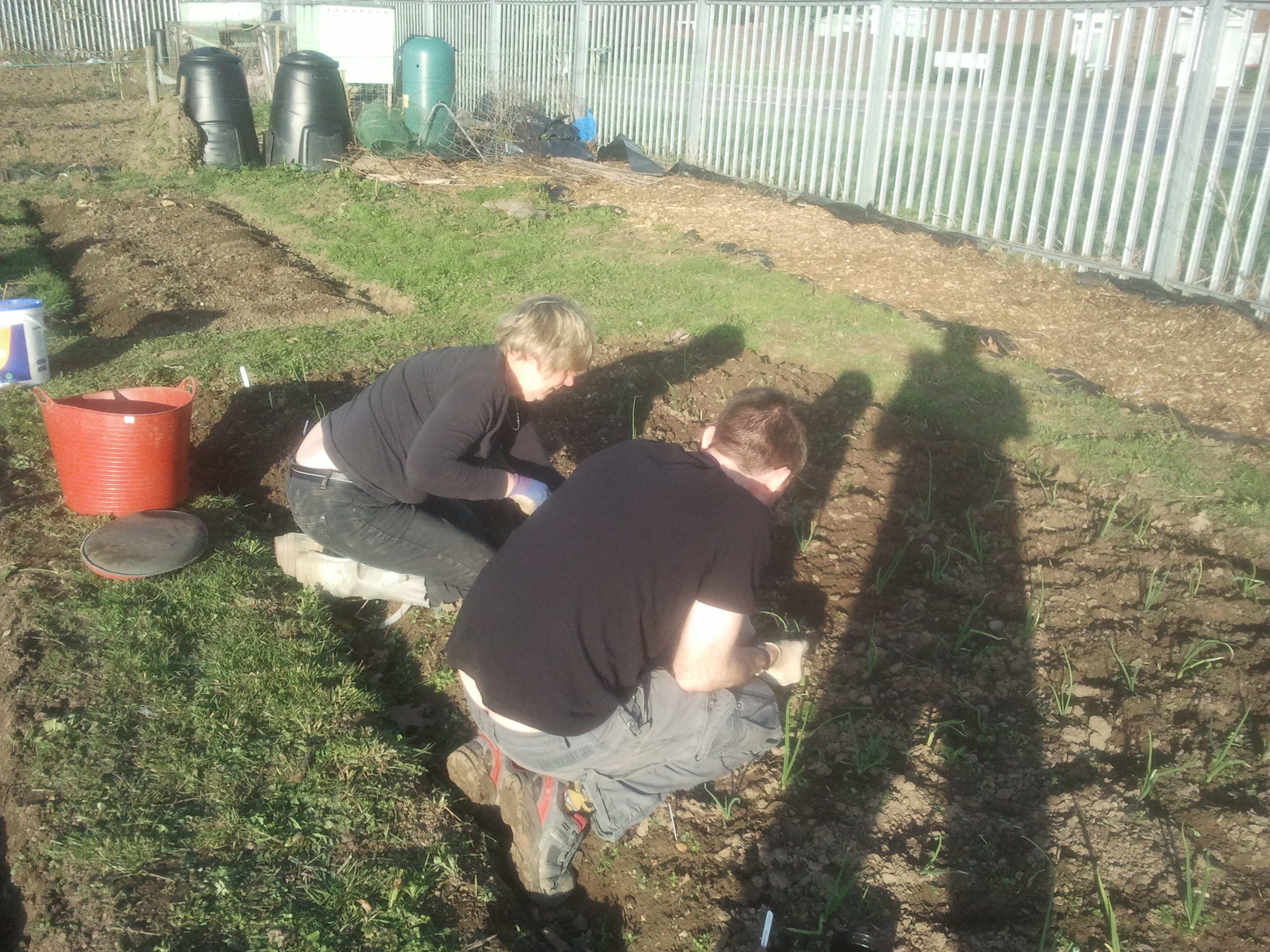
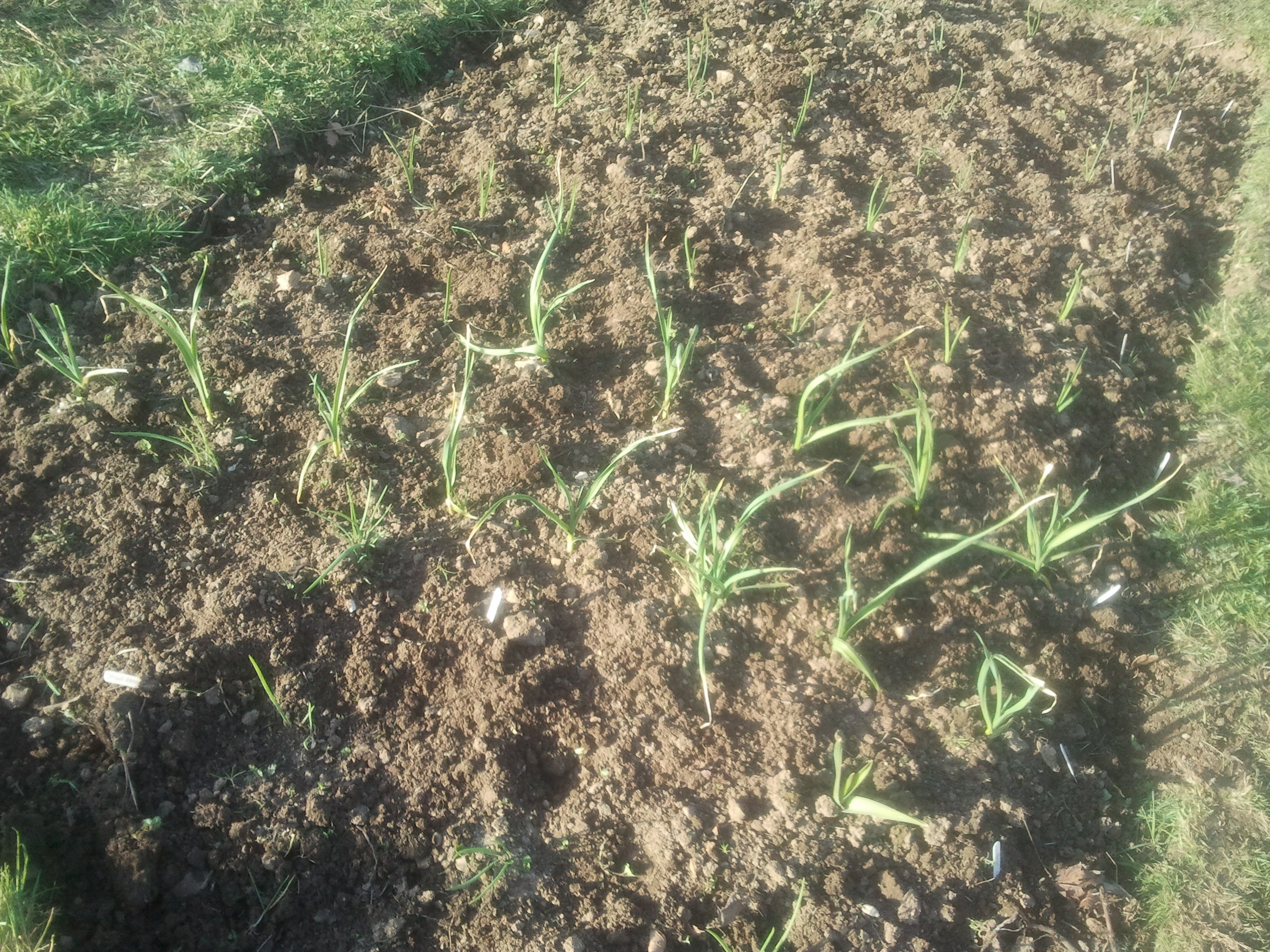
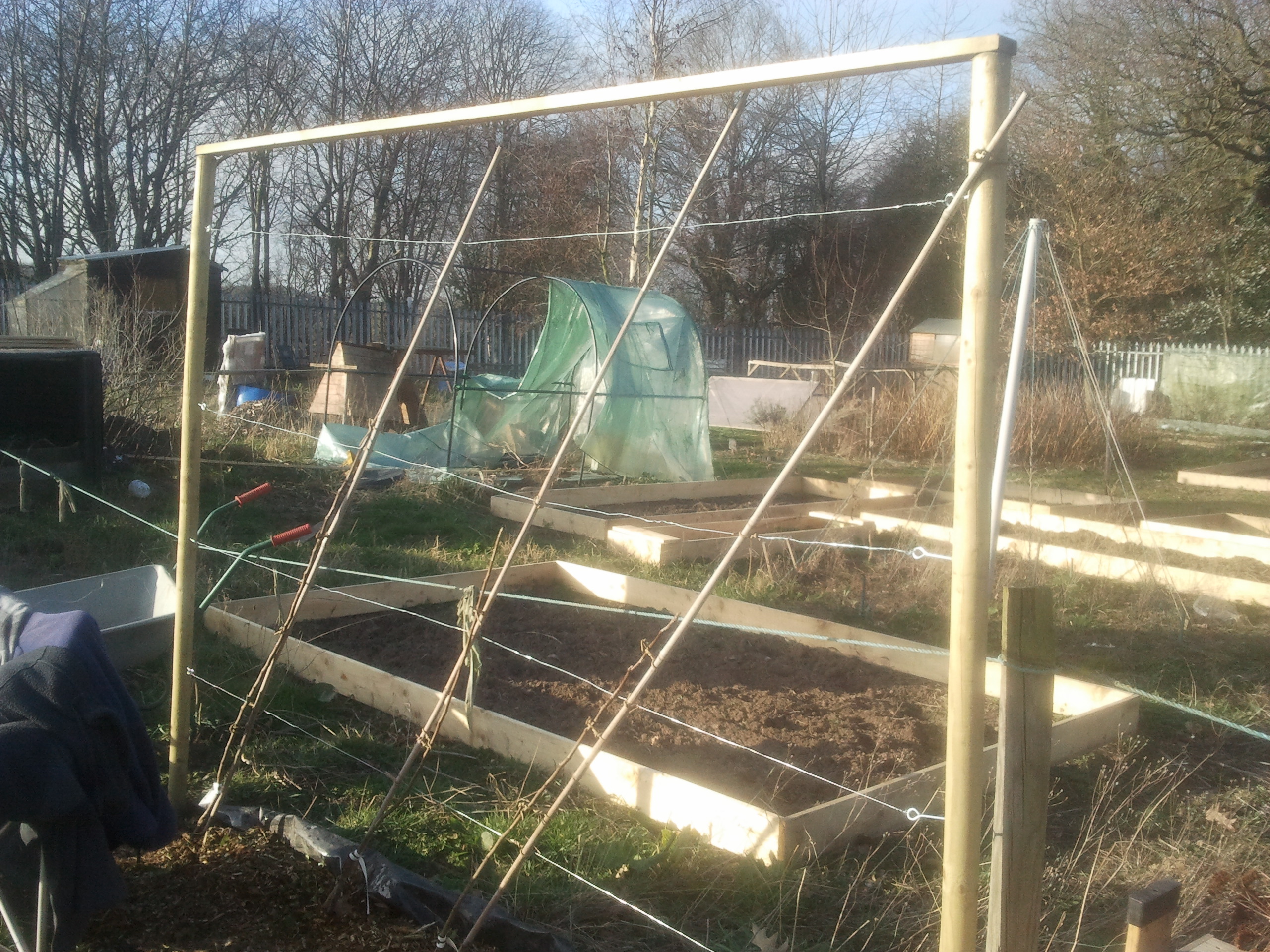
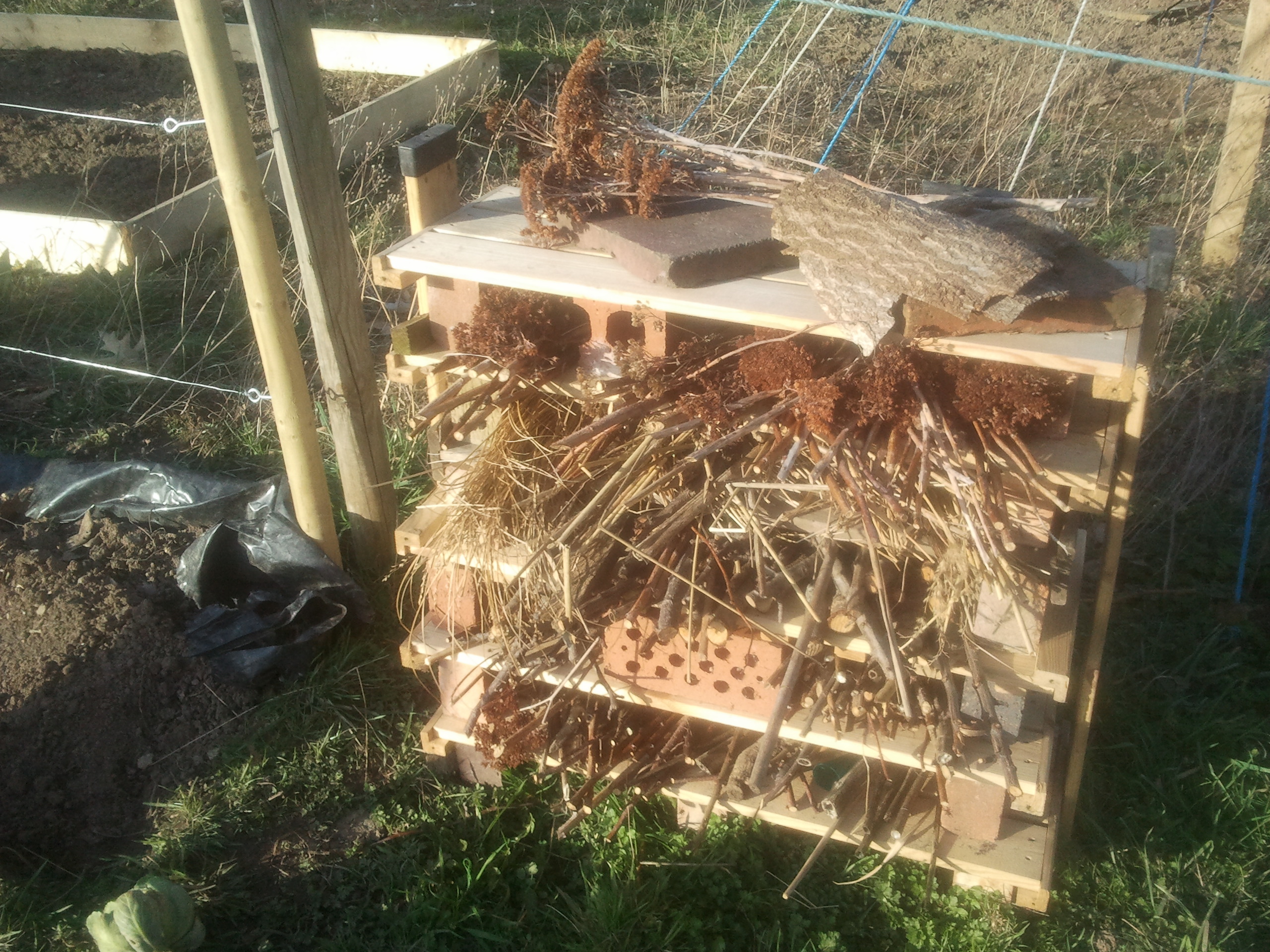
Jude, the Undergardener, and Rob weeding the onion bed (plus my shadow)Jude, the Undergardener helping sort the onions, without my shadow.Onions weeded and fed.We finished planting and putting up supports for the new cordon apples.We finished off the luxury insect hotel.Success! Paths cut, edges trimmed and all beds ready for the sowing and planting season.
This is the third of the garden wandering posts already. Why is this year going so quickly? Could it be that we have had so many days when the weather has been amenable to gardening? So what is happening here in our garden? The bulbs are at last flowering well after such a slow start but in contrast the birds are responding quickly to warmer periods of weather. Robins are nesting in the box on my fishing tackle shed, House Sparrows are using three boxes around the garden, Great Tits are using the box on the summer-house and Blue Tits have started building in the box opposite the front door. They are so busy! Blackbirds are collecting moss from the lawns and dried grass stems from the borders so are nesting somewhere close by. The early morning bird song gets louder and more birds join in the chorus each day.
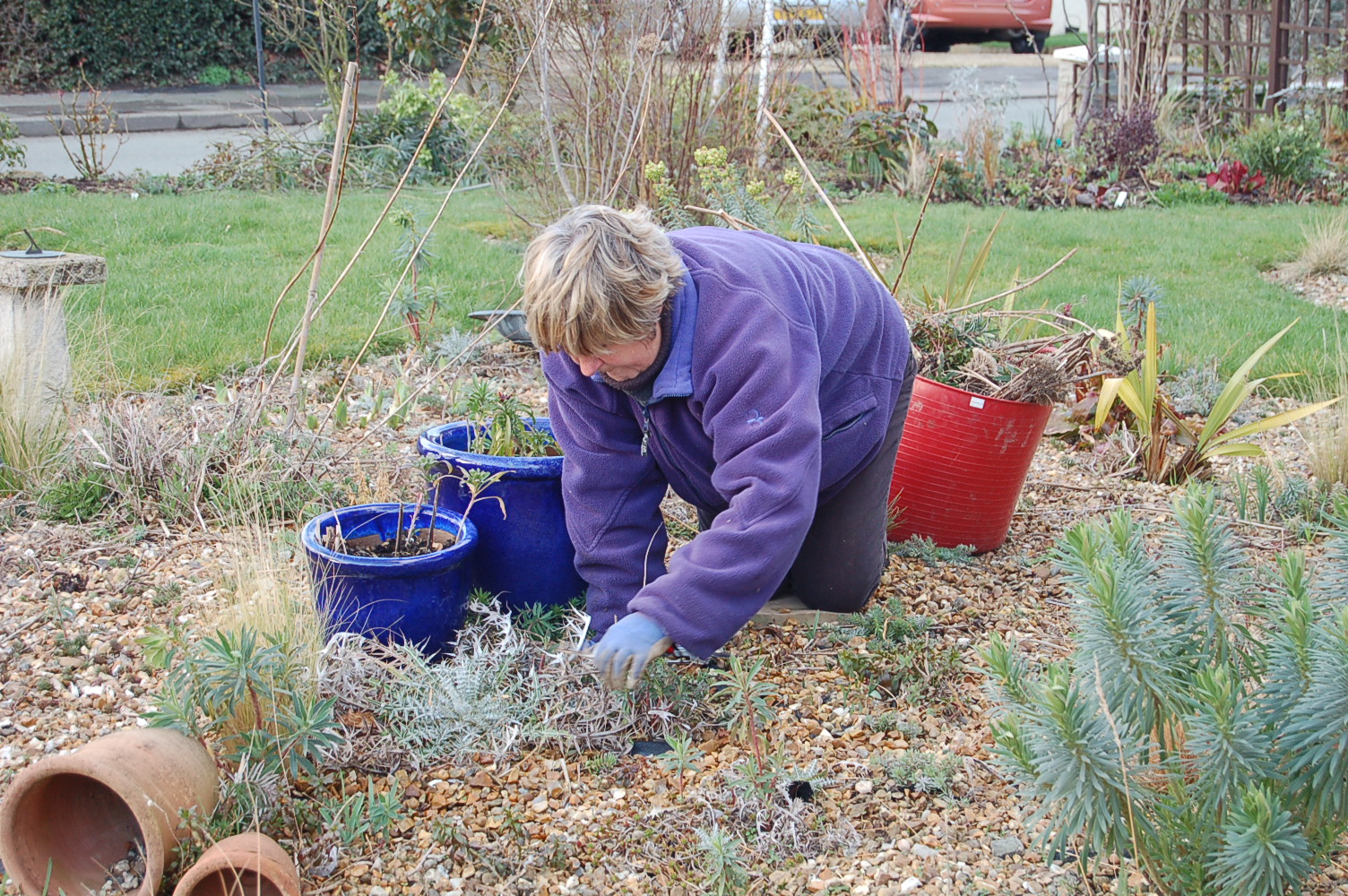
We have spent most sunny days continuing to clear borders, cutting down and adding new mulch. Clearing the “Beth Chatto Garden” is a hands and knees job. Jude the “Undergardener” pulls up weed seedlings by hand. Very tedious but made more enjoyable by the constant song of Blackbirds, Song Thrushes and Robins. Calls of Buzzards high above us provide a good excuse to stop occasionally.
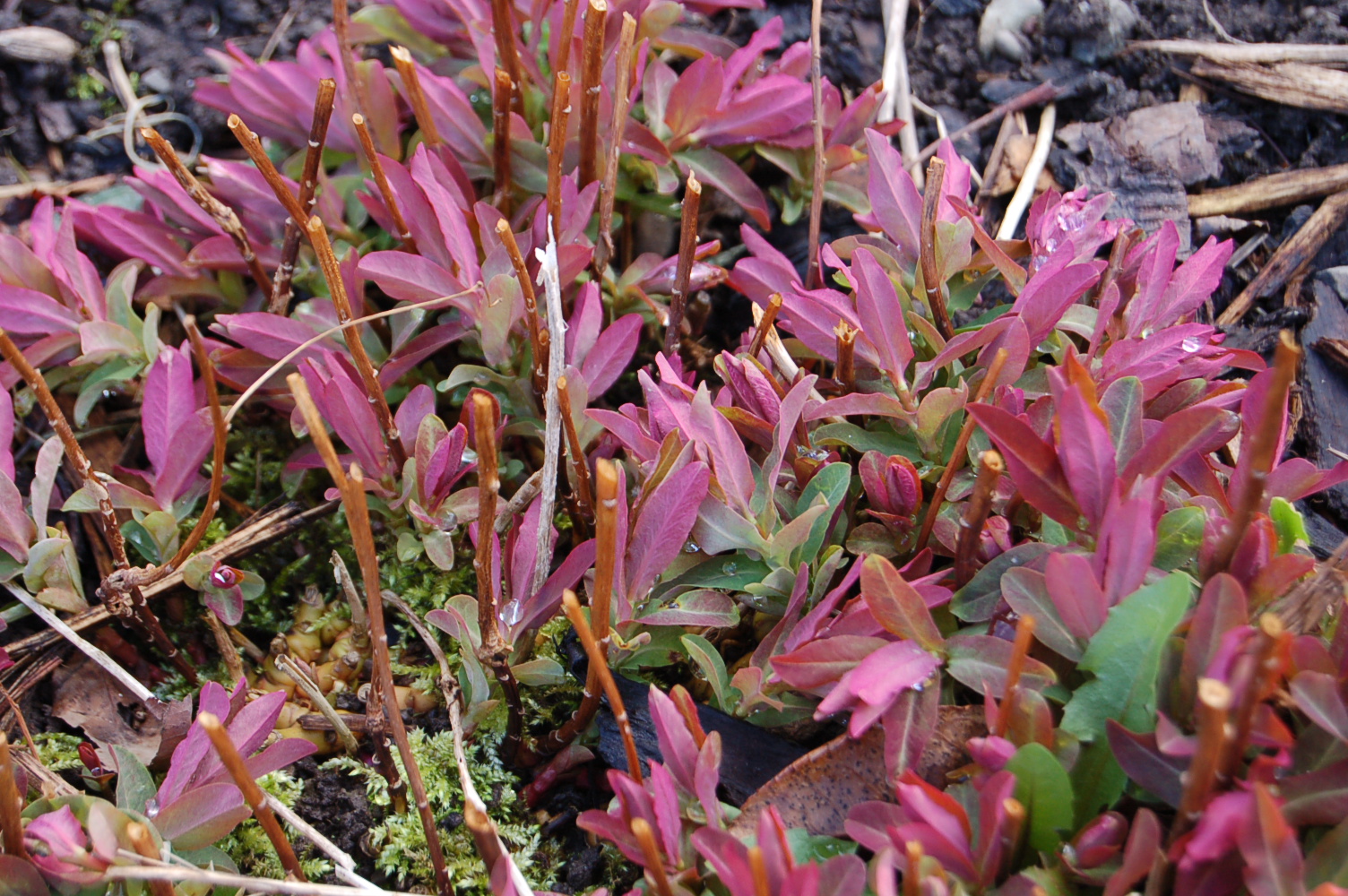
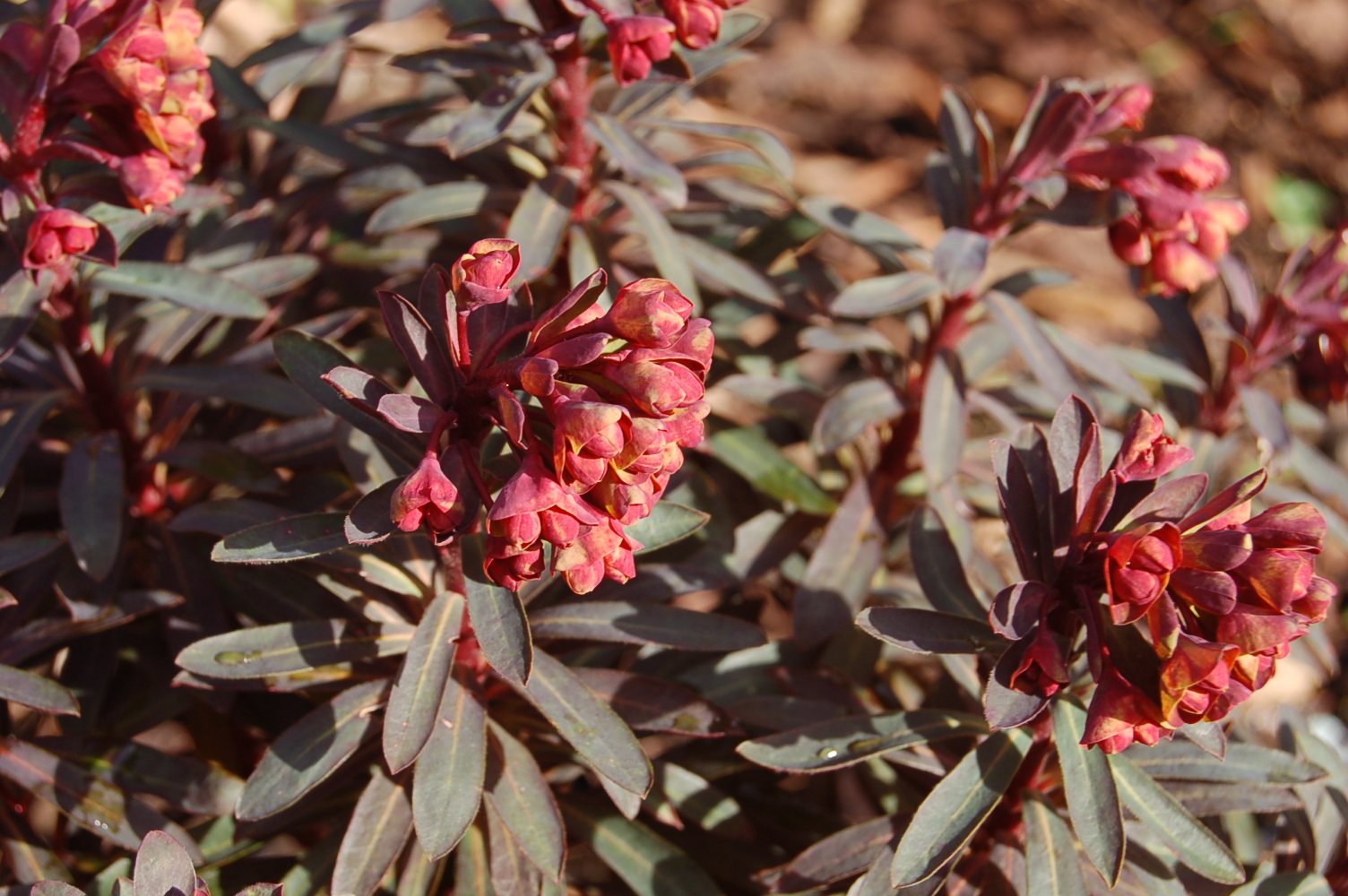
In the front garden Euphorbias are bursting into growth and some have already sent up their flower stalks curling over like shepherds’ crooks. New growth on the later ones is showing bright colours as they emerge from the bark mulch.
The flowering quince at the end of the drive is covered in bright red blooms scattered amongst its thorny angular network of stems – it will flower for months giving a warm welcome to visitors.
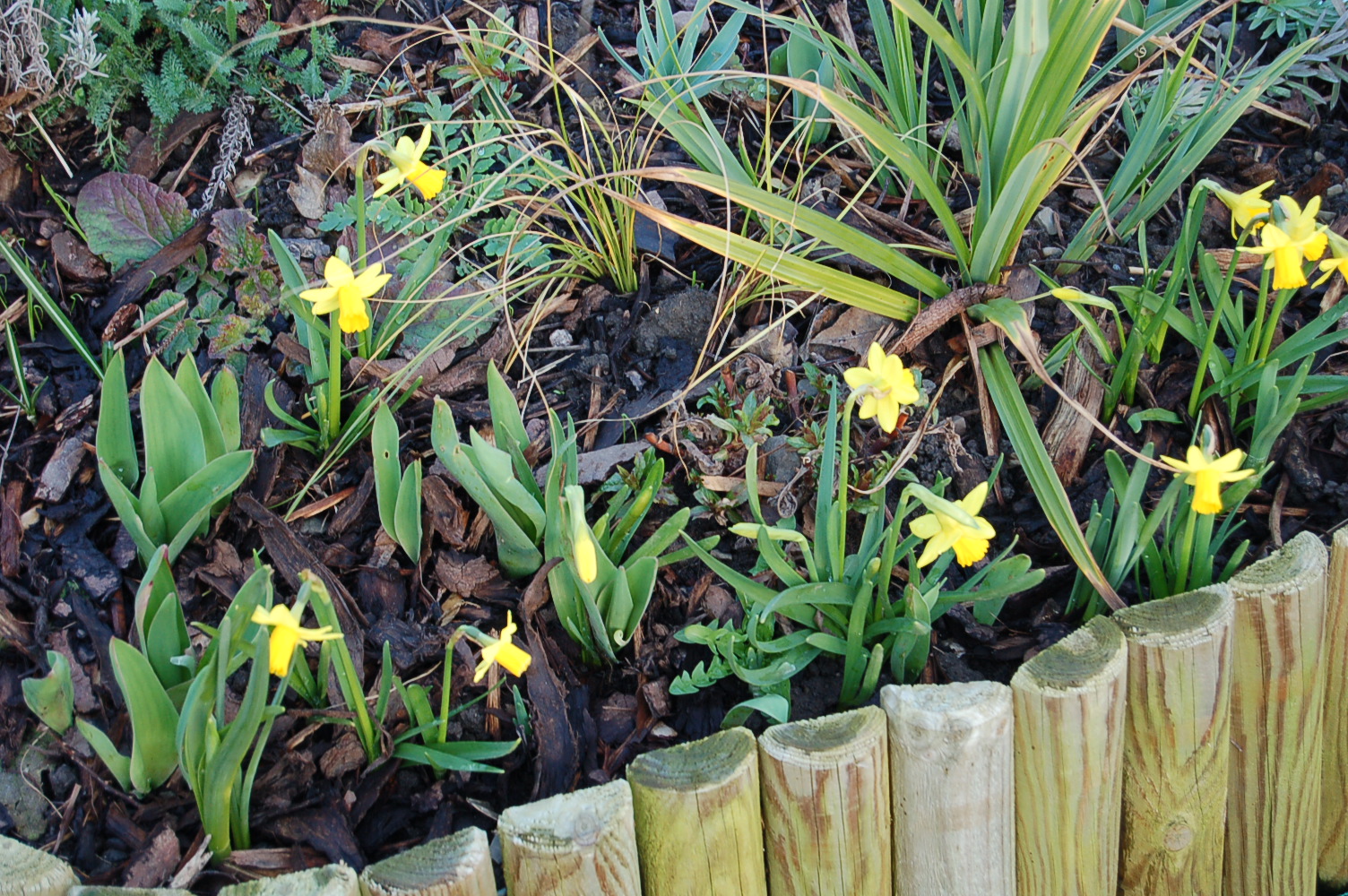
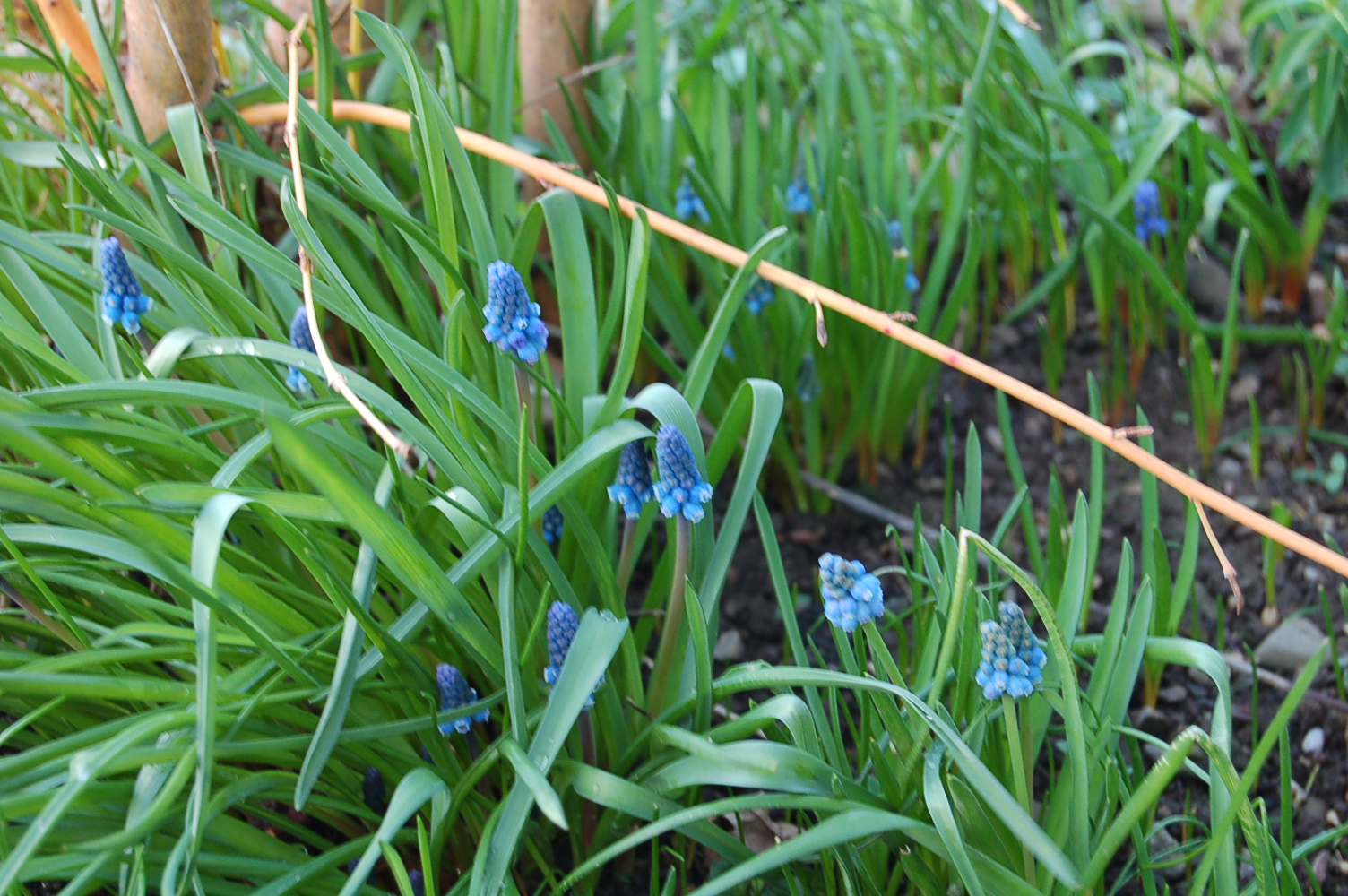
At last our first daffodils are fully in flower! We have waited so long. Muscari are also now bursting into bloom adding their own shade of blue all around the garden.
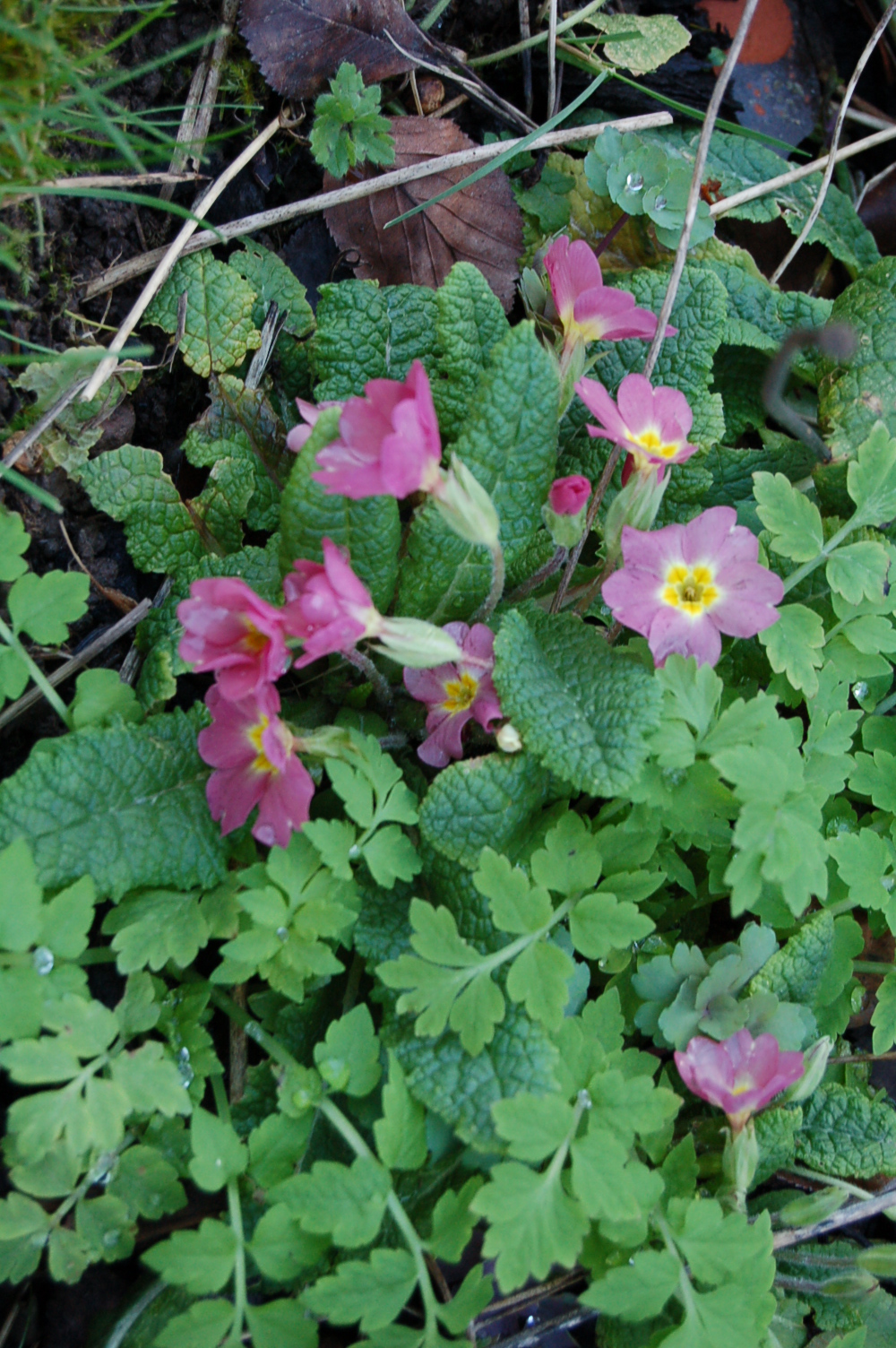
The Primroses we grew from seed a few years ago now give us big clumps of flower in their own special shade of yellow. They are self seeding and spreading around the garden, with an occasional plant producing flowers of an extraordinary shade of greyish pinky. Not sure I like them!
One of the delights of this time of year are the Pulmonarias with their flowers coloured pink and blue on the same plant and their beautifully marked hairy leaves.
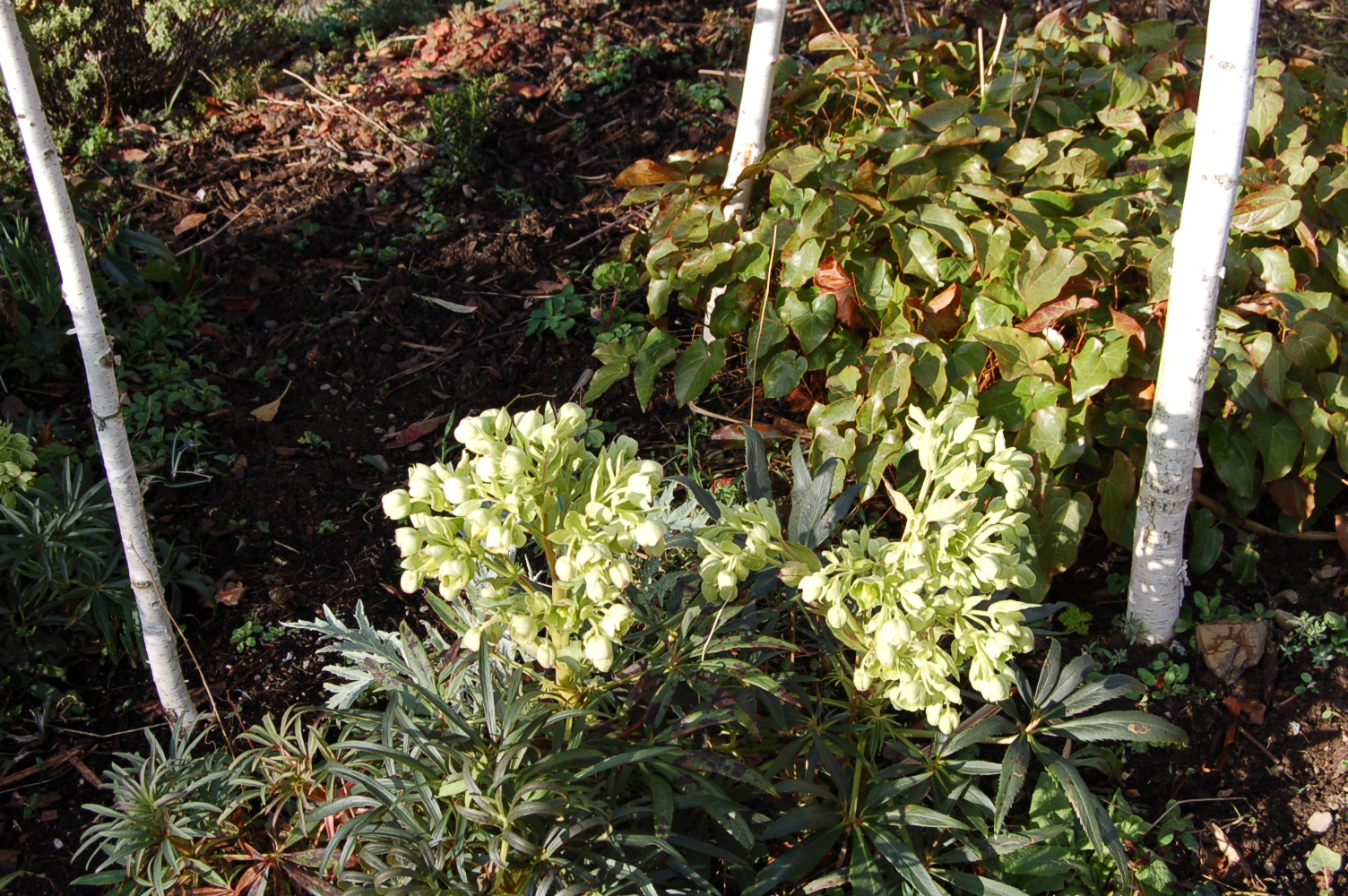
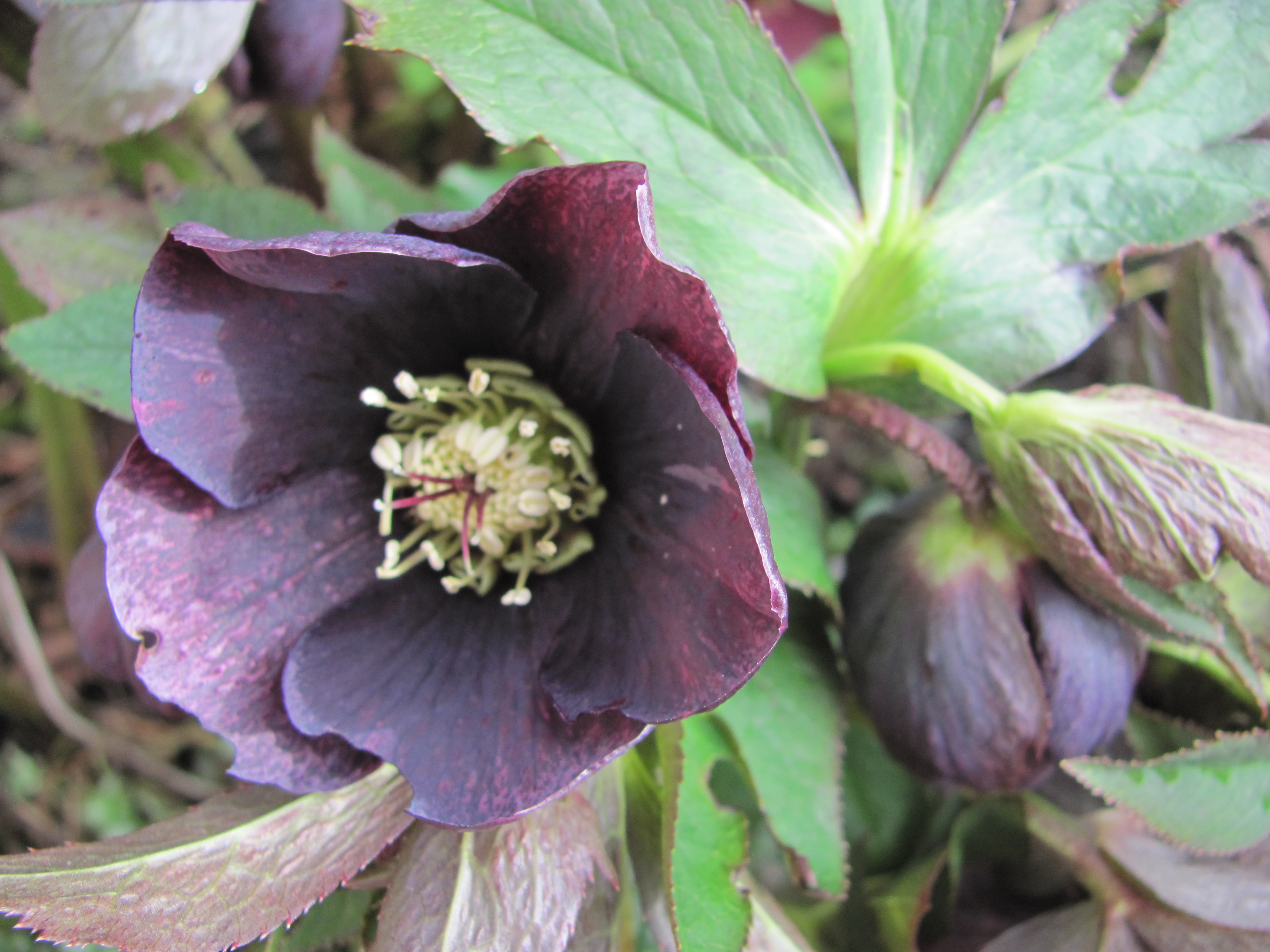
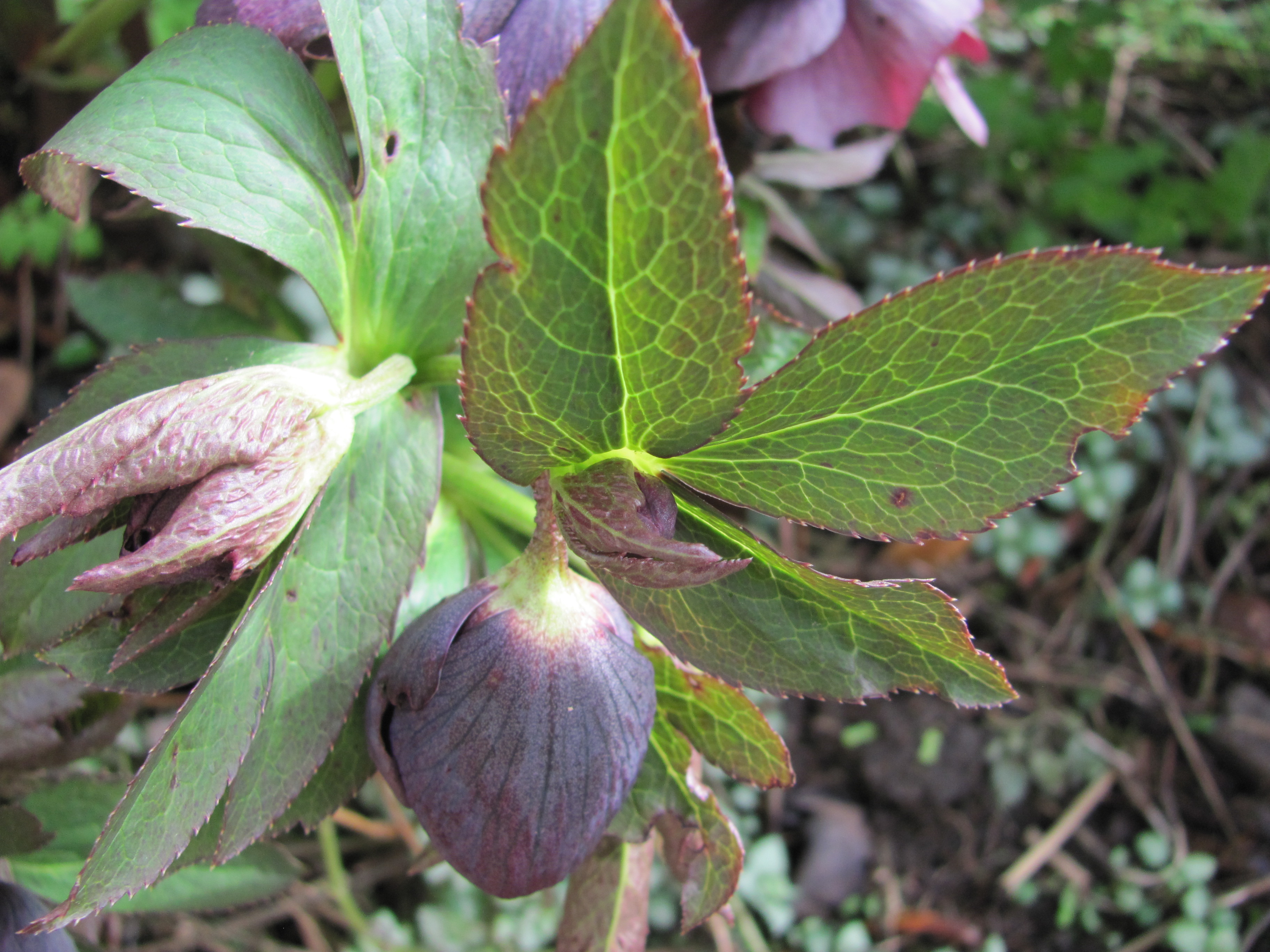
Helleborus have featured in both the January and February garden wanderings and they are still going strong. Two of the last ones to come into flower are this red hybrid and the magnificent near black variety. It looks good in bud and full flower and has the added attraction of interesting foliage. The clump of mixed Hellebores in the “Chicken Garden” give us plenty to look at on coffee breaks when the March sun bursts through and its warmth feels so good on our backs.
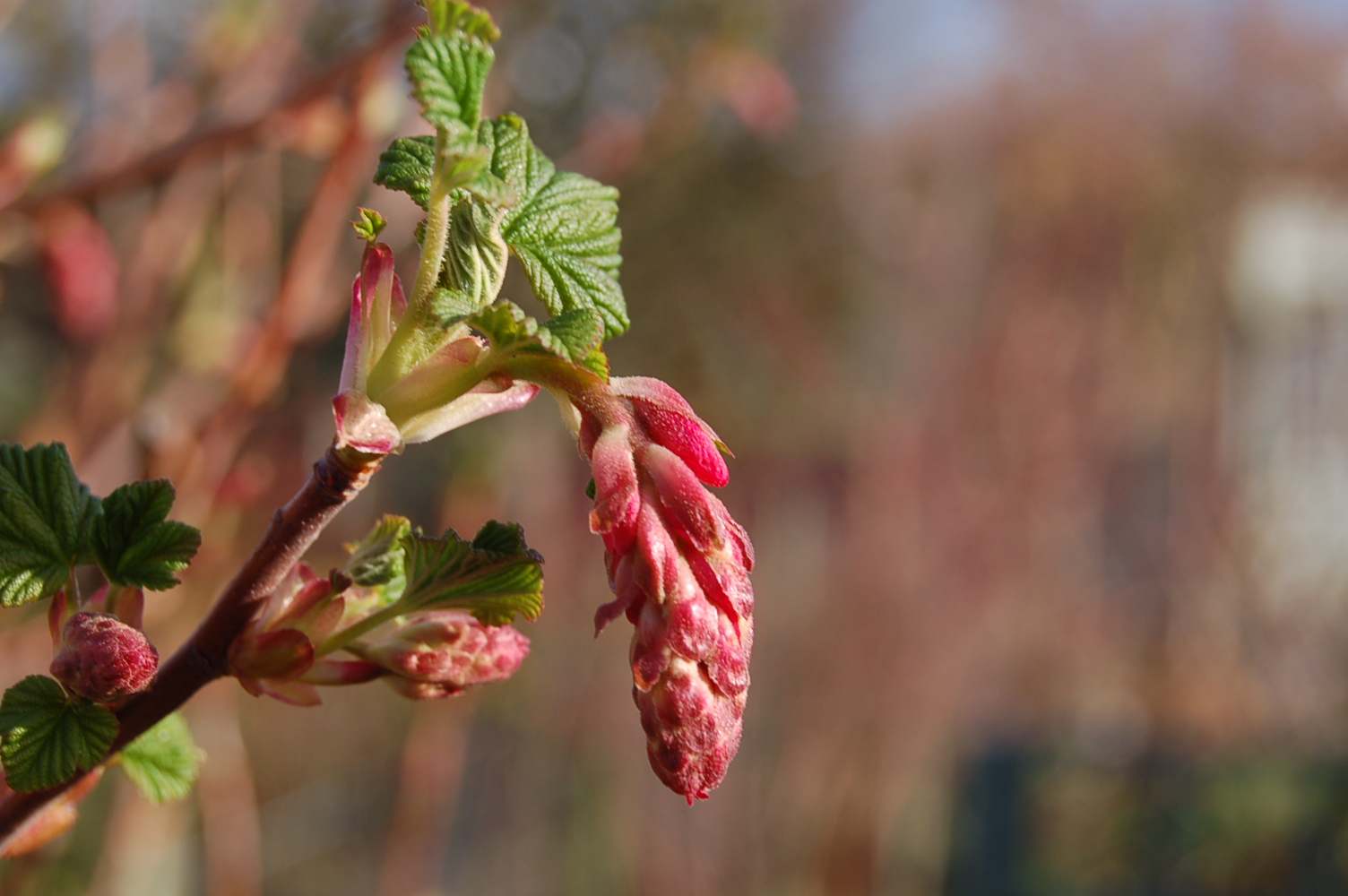
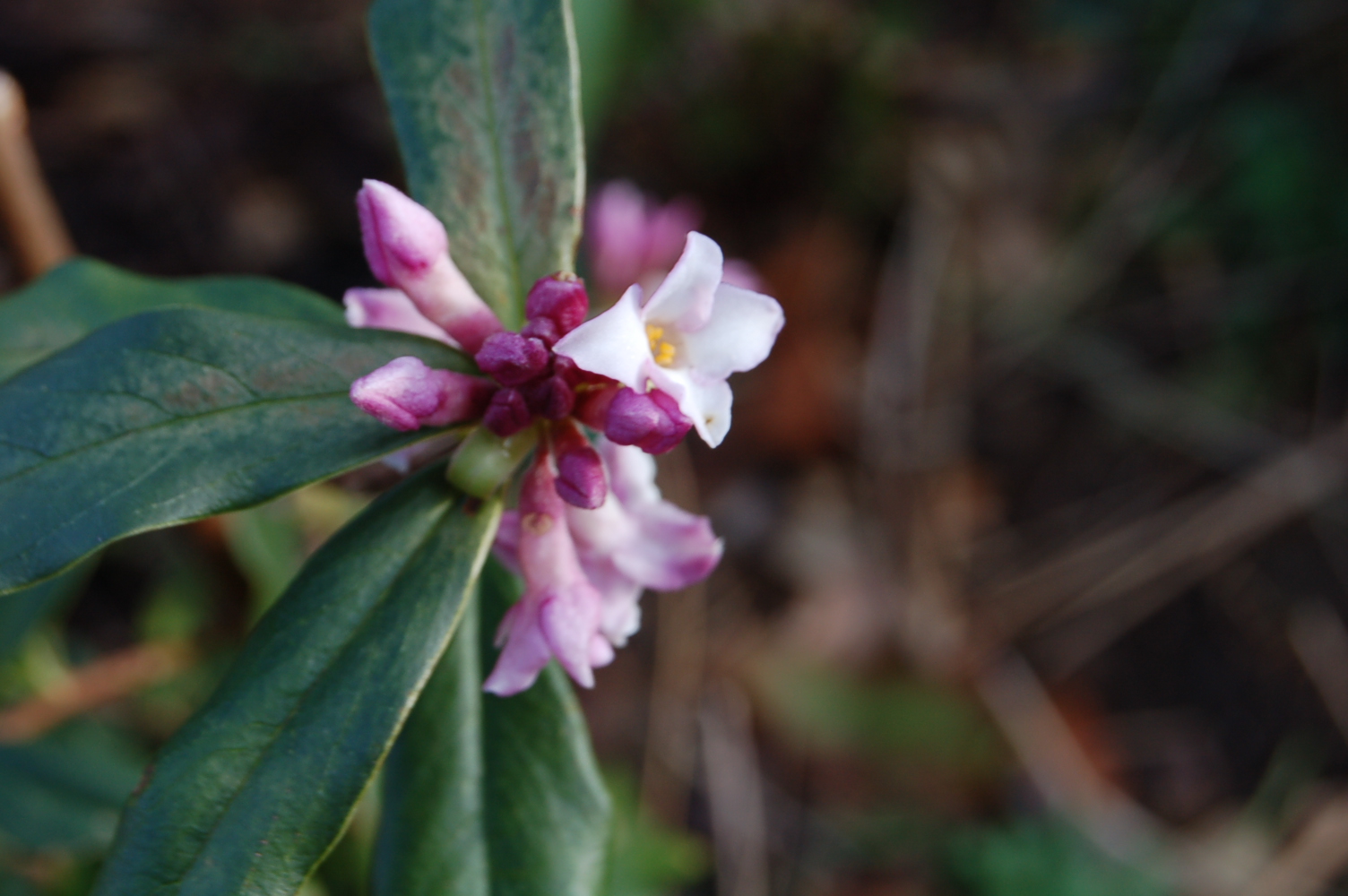
The bees appreciate the early flowering bulbs especially purple crocuses but soon they will be flocking to feed on the Flowering Currant, the exceptionally large flowered variety Ribes sanguineum King Edward VII, which is on the point of bud burst. The buds on the Daphne bhulua “Jacqueline Postill” have opened to reveal highly scented flowers in several shades of pink.
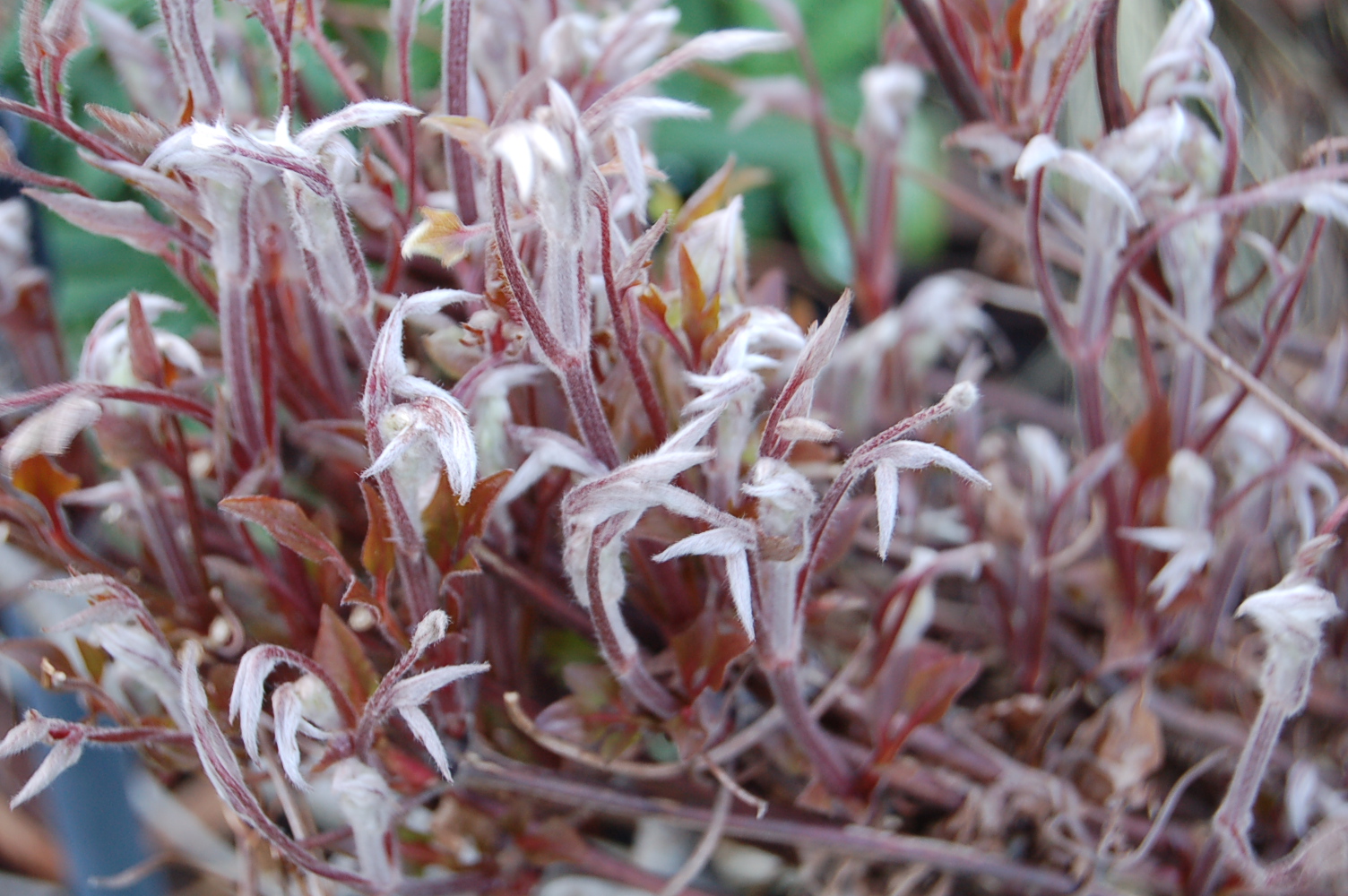
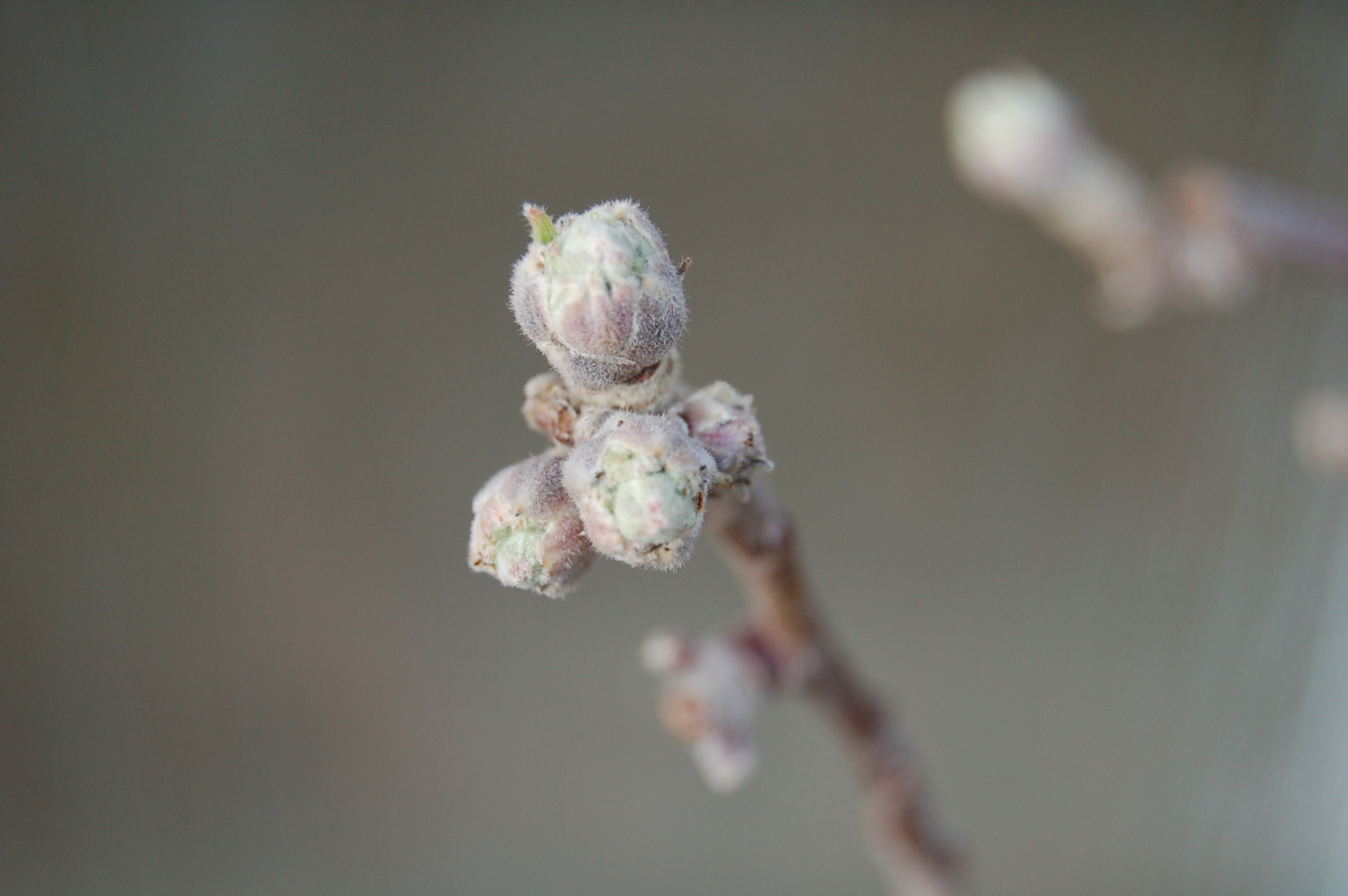
March in the garden is full of promises with buds developing and preparations underway for the productive garden. The photos show buds of Clematis, both climbing and herbaceous, and Apples and Pears.
The Sempervivum in the alpine troughs and on the slate scree bed are all budding up nicely but one pure white-flowered one is out and glowing in the March sunlight. They are such precious little jewels of plants.
Our two newest areas of the garden, the Chicken Garden and the Secret Garden, are turning glaucous green with Allium leaves. One area is like a lawn of Allium. They seem to enjoy our soil too much and are spreading and self seeding madly!
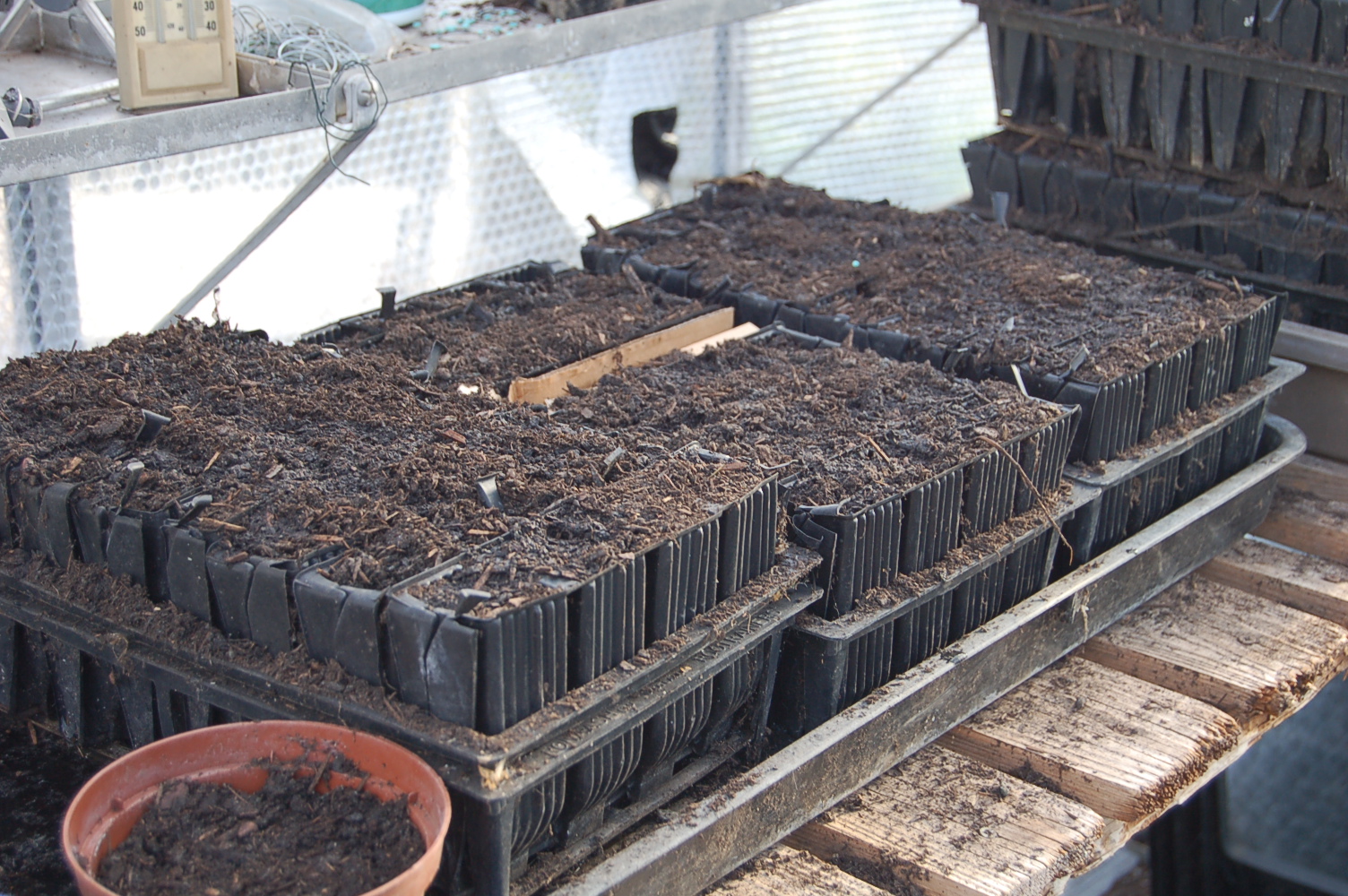
The productive side of our gardening mostly happens on our allotment but we have a big greenhouse in the back garden where we start off many of the veggie plants. Some seedlings have germinated in the propagator and lots cells and 5 inch pots are full of compost ready for us to sow peas, broad beans and sweet peas.
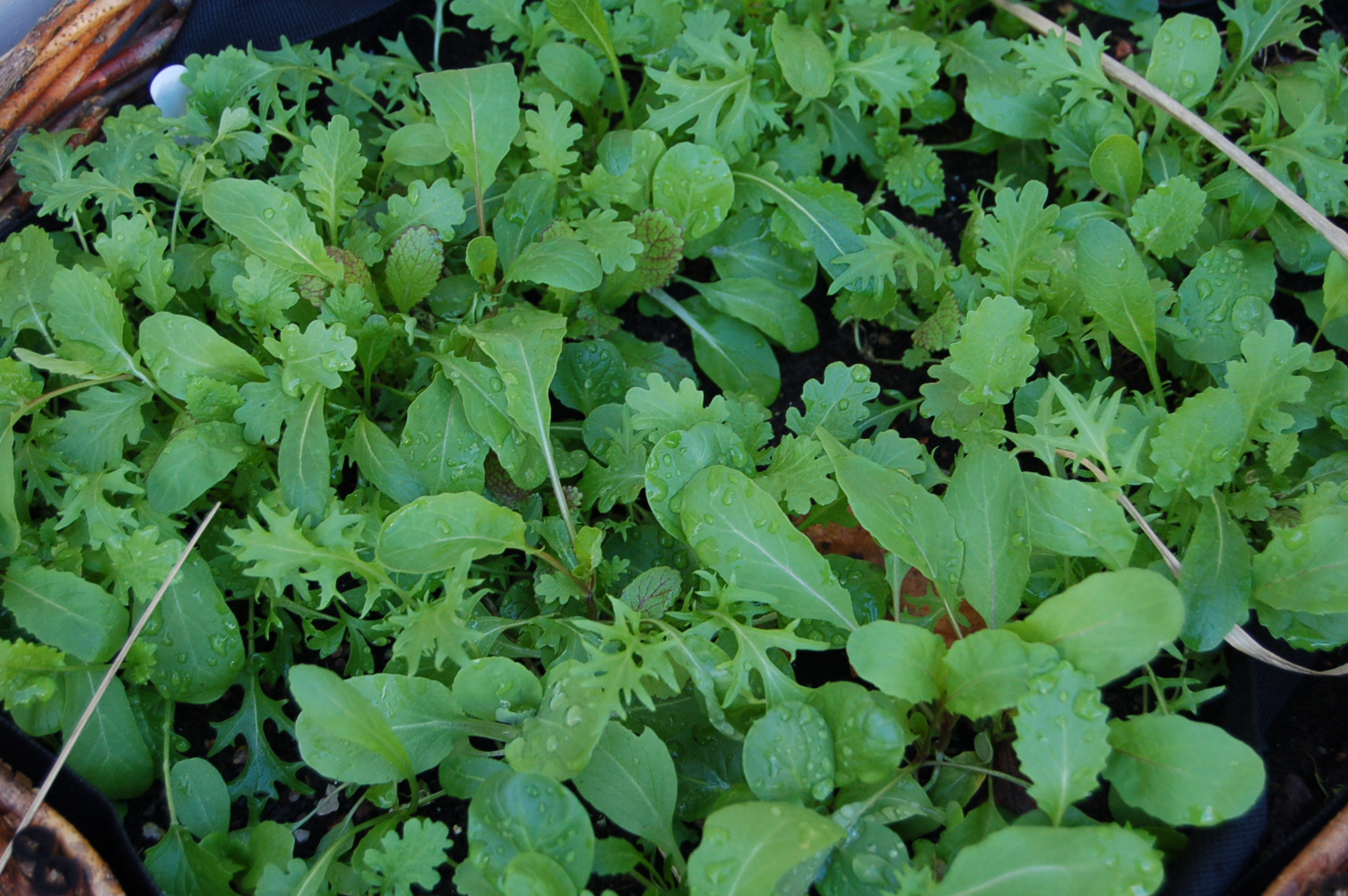
In our raised wicker beds just outside the back door the cut-and-come-again salad leaves are almost ready for the first cutting – and of course the first eating. So many different textures, colours and tastes! Delicious! Much is still to happen in March and on into April.
Our Comfrey patch is showing strong growth. This is one of the most important areas of the garden for in this 2ft by 10ft bed we grow a comfrey variety called Bocking 14, which we can cut 4 or 5 times a year. The leaves can be put in the bottom of potato trenches before we plant the potatoes to feed them and prevent the disease “Scab”. We also put them as a mulch under fruit trees and bushes as a feed and as a weed suppressant, and use them to make a liquid feed mixed with nettles.
So much is still to happen in the March garden. It is a busy and exciting month. So much to look forward to.
As part of the development of the shared community spaces at Bowbrook Allotment Community we have created “Gardens of the Four Seasons”. We did this with the support of “The Peoples Postcode Trust” who awarded us a generous grant for the purchase of plants. In early 2011 we began work on the Winter Garden and now we are beginning to see some results of our labours. The work was carried out by allotment holders who attend regular working parties (look out for future blog about our working parties) and the gardens are maintained by members. Much work is also done outside working parties by individuals or small groups.
I designed the garden and presented the plan to the management committee and informed other members by e-mail, asking for comments, further suggestions and ideas. The basic idea was to create a garden full of trees, shrubs, grasses, bulbs and perennials that looked good in the winter, for their stem colour, bark colour and texture, their flowers, their scents. Movement and sound was also considered so we included many grasses and some trees with rustling stems.
It is now a year since we began the groundwork. The preparation was completed by the end of February 2011 and the main framework of planting by the end of March.
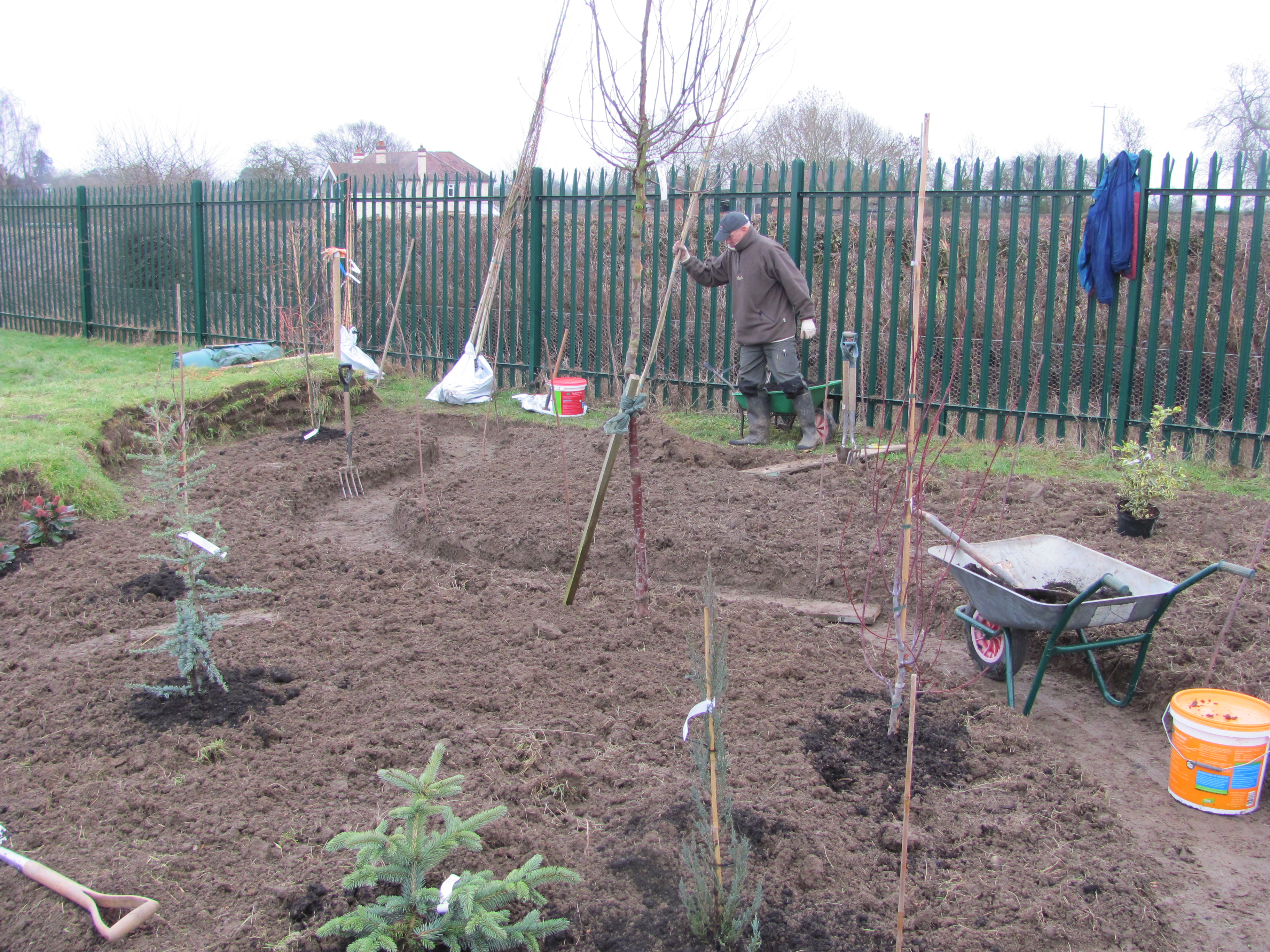
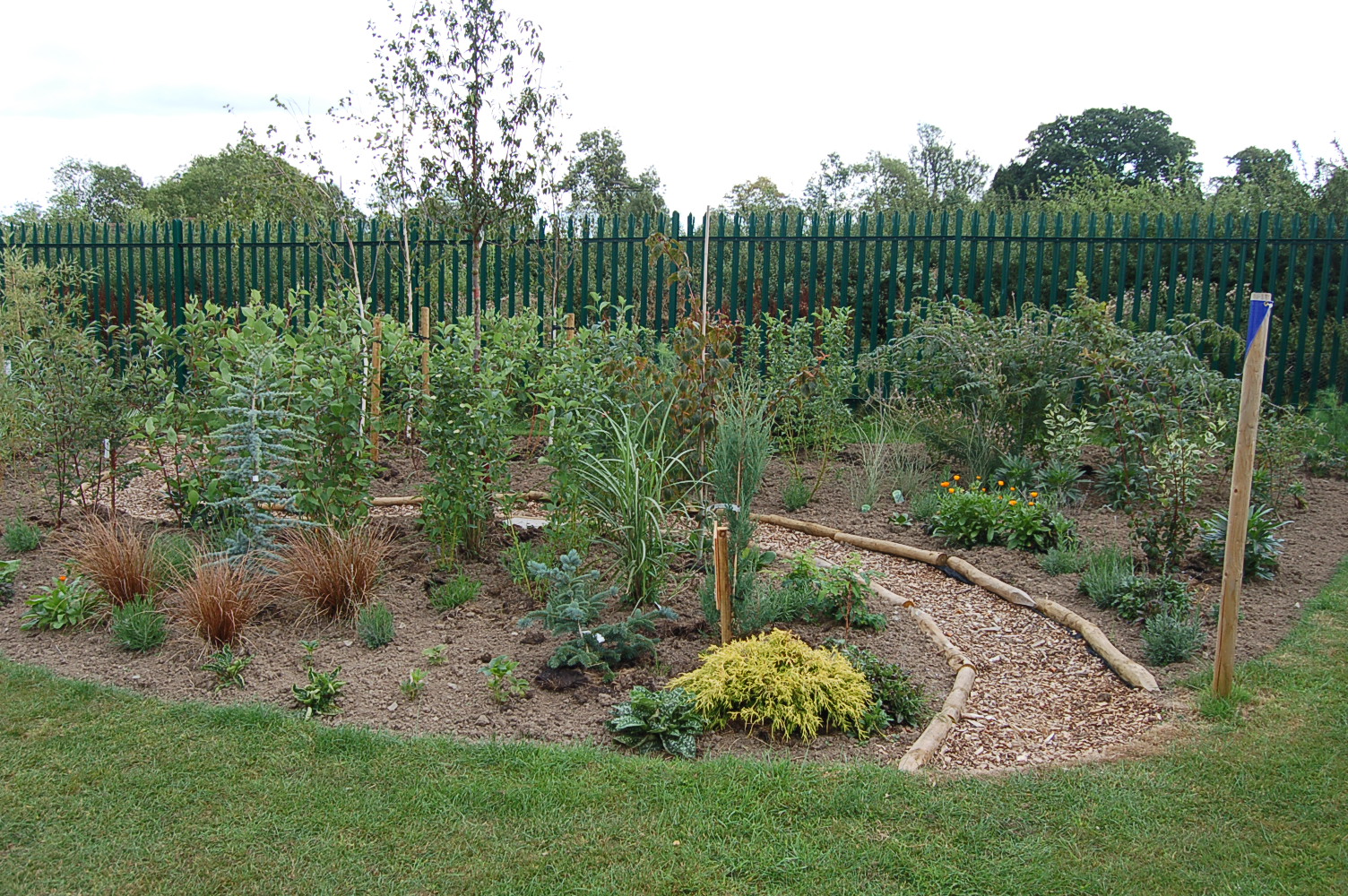
The first step was to rotovate the land, almost triangular in shape, in the corner of the site furthest from the huts, about 10 x 20 metres. We then added manure and rotovated once more. We dug out a path shaped as a serpentine curve, which cut the border in two, edged it with logs and gave it a deep layer of bark. It proved soft and comfortable to walk on. A thick layer of compost was added to the planting areas and raked level and we were prepared for planting.
Our Winter Garden is situated in a corner of the site. A water-butt is ready to be placed conveniently for watering in dry periods. In front is one of our wildlife banks.
Trees and shrubs were delivered by The Dingle Nursery from Welshpool, who had proved so helpful in helping us to select the best when we visited them to place our order. Unloading the truck and unpacking the plants was an exciting time, full of anticipation. Transporting them across the site took longer than expected involving three plot-holders with wheelbarrows. Some of the trees were just too long to stay put. After an hour of laughter and regular rescuing of dropped goods, we finally began planting. It was to take a few days.
Trees in place.
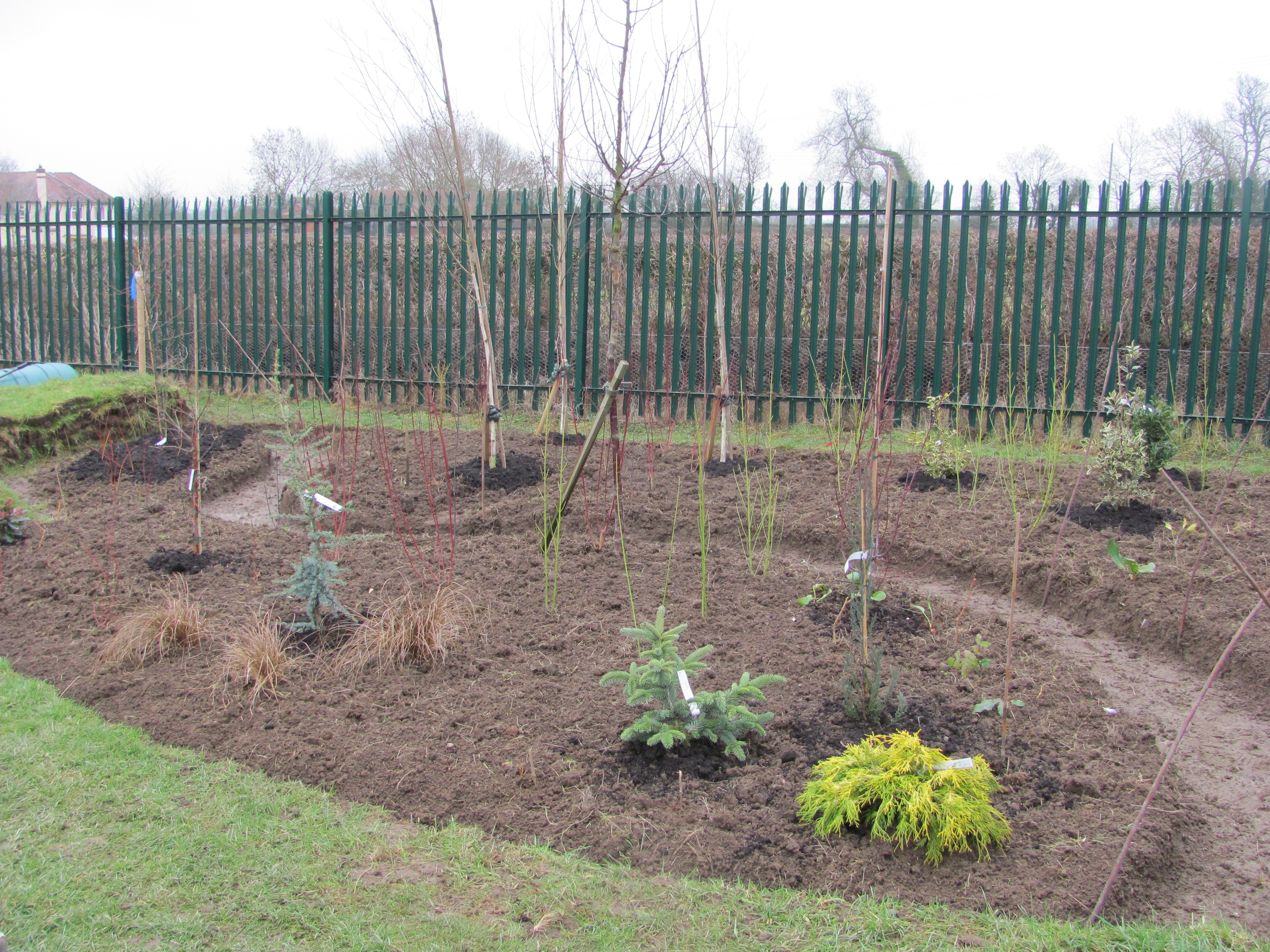
Bulbs and herbaceous plants arrived by post and were added to our structural planting of trees and shrubs. a selection of grasses was added later. We now had trees with coloured bark, shrubs with coloured stems and a winter flowering time, perennials such as Hellebores and Pulmonaria and grasses to give movement and beautiful seed heads.
Plot holder Pete busy planting.
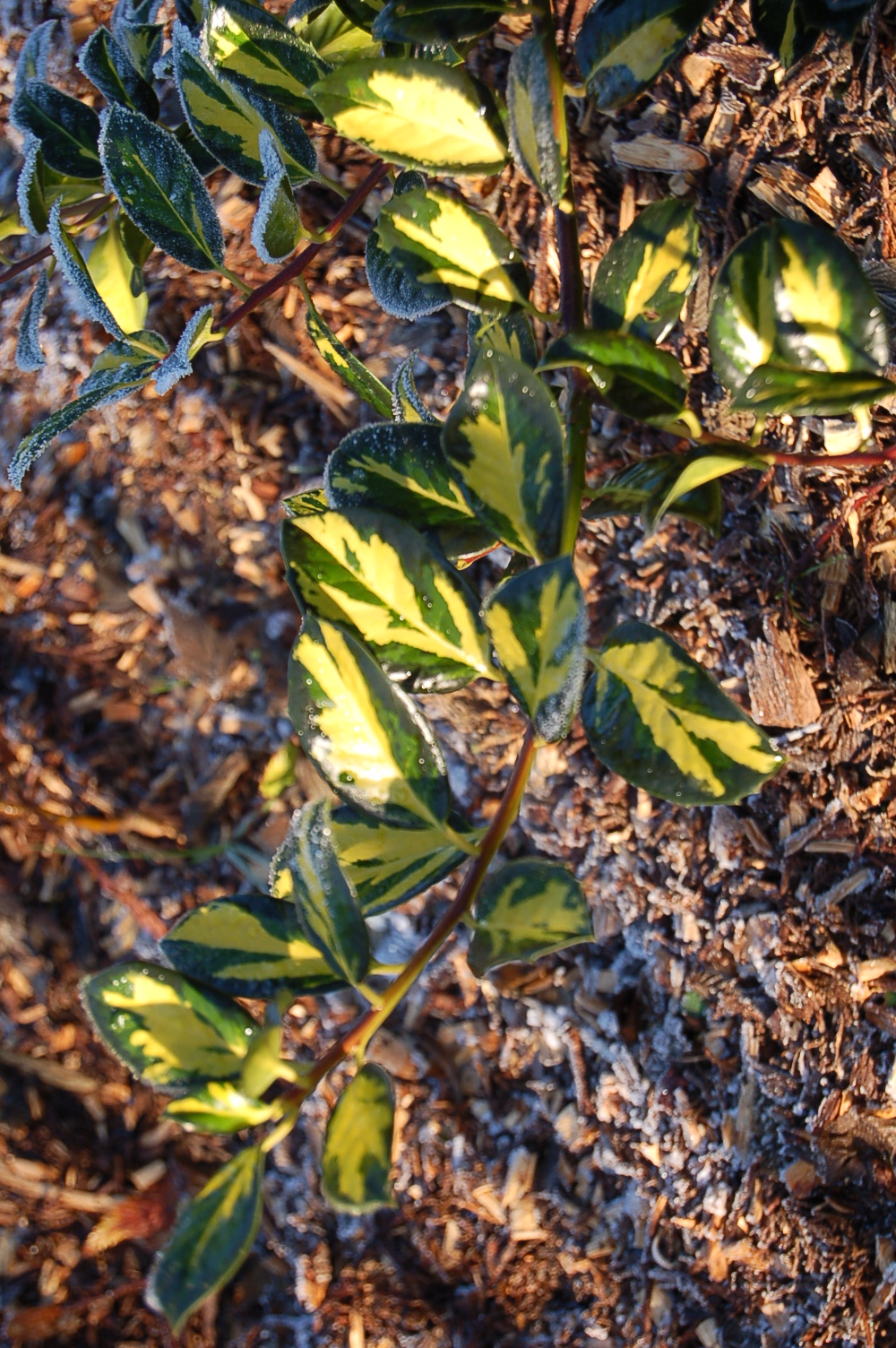
In pride of place are our three silver-barked Birches, Betula utilis “Jacquemontii” planted as 3 metre tall specimens, along with similarly sized Prunus serrula with its shining gingery-bronze bark. Smaller specimens of Acer davidii (a snake bark maple), Acer griseum appreciated for its peeling red bark and a selection of variegated Hollies completed the structural planting.
Key plants in place.
For bark colour we planted dozens of Cornus, Salix and Rubus tibeticanus to give an airy network of colour all winter and early spring. We interplanted these with patches of Lavender to give some summer interest, to attract butterflies, bees and hoverflies and to provide gentle bluish foliage colour all year. For winter flowering interest and scent we planted Cornus mas and Viburnum bodnantense “Dawn”.
In order to maintain all year interest with greatest emphasis of interest we added evergreens. As well as the Hollies we included Viburnum tinus and several conifers chosen for the variety of foliage colour, texture and habit of growth – Picea pungens Procumbens, Pinus sylvestris, Chamaecyparis “Boulevard” and to top it off John, our committee’s chairman donated a lovely specimen of Cedrus atlantica glauca. As a contrast we also planted a Larix decidua a conifer that is deciduous.
When we planted the trees and shrubs, following the allotment site’s organic policy, we gave them a sprinkling of bonemeal in the planting holes and top-dressed with blood fish and bone fertiliser before mulching with manure. We plan to give the bed regular mulching of compost and manure to give a slow-release nutrient regime.
Working parties and individual volunteers worked throughout the year to keep weeds at bay.
Volunteers at work tidying and weeding.
By late summer the garden was showing lots of healthy growth and we could see much promise for the future.
Full of promise.
In the autumn we gave the garden a mulch of chipped bark to protect it from the ravages of winter and to slowly break down releasing nutrients and improving humus levels ans soil texture.
This week three of us weeded the bed over, tidied, pruned and loosened up the soil. It was amazing to look at progress and realise how the garden had developed in less than a year. Bulbs were flowering, the trees and shrubs have made good growth and in particular the willows and dogwoods are showing strongly coloured stems.
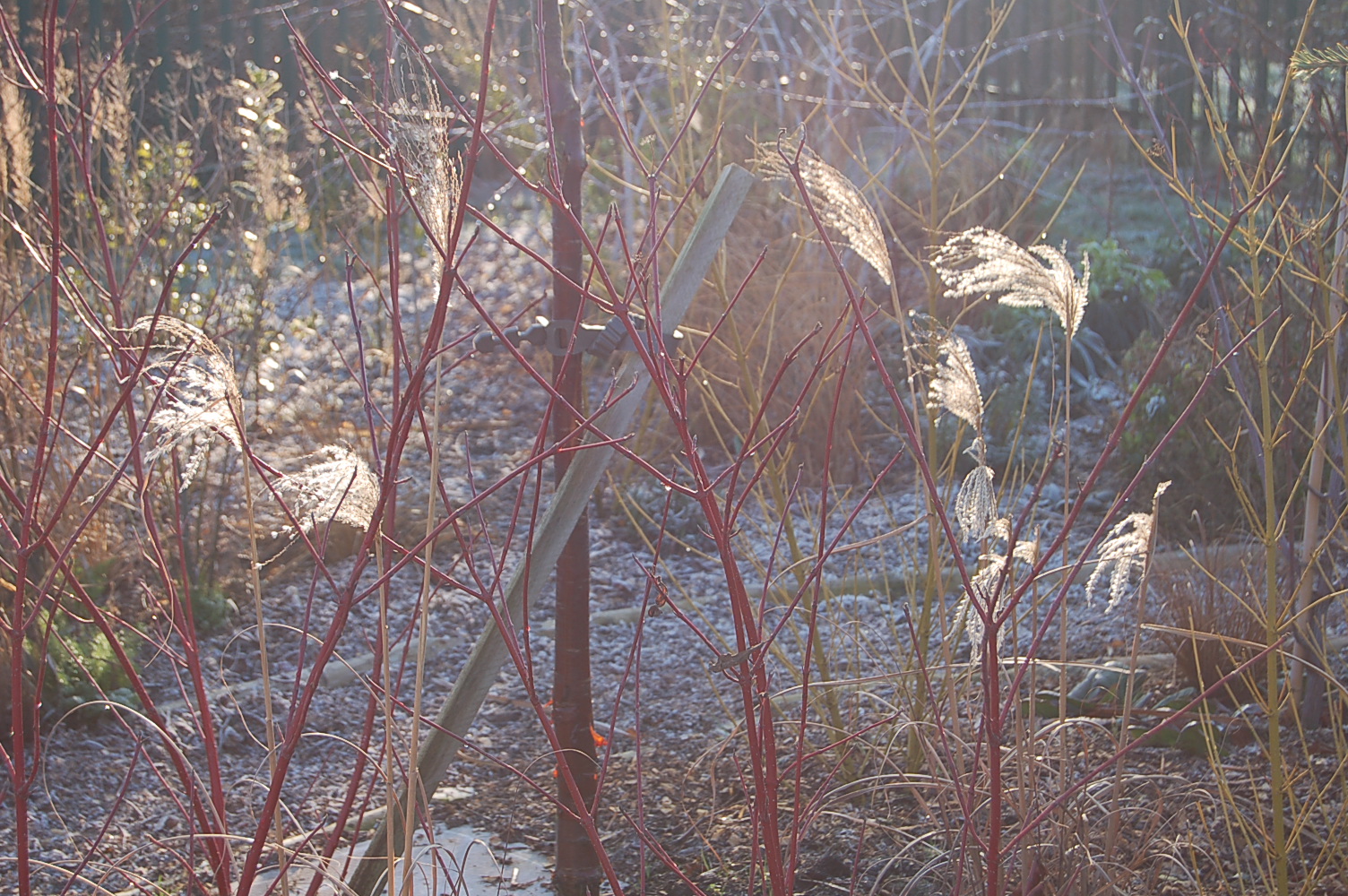
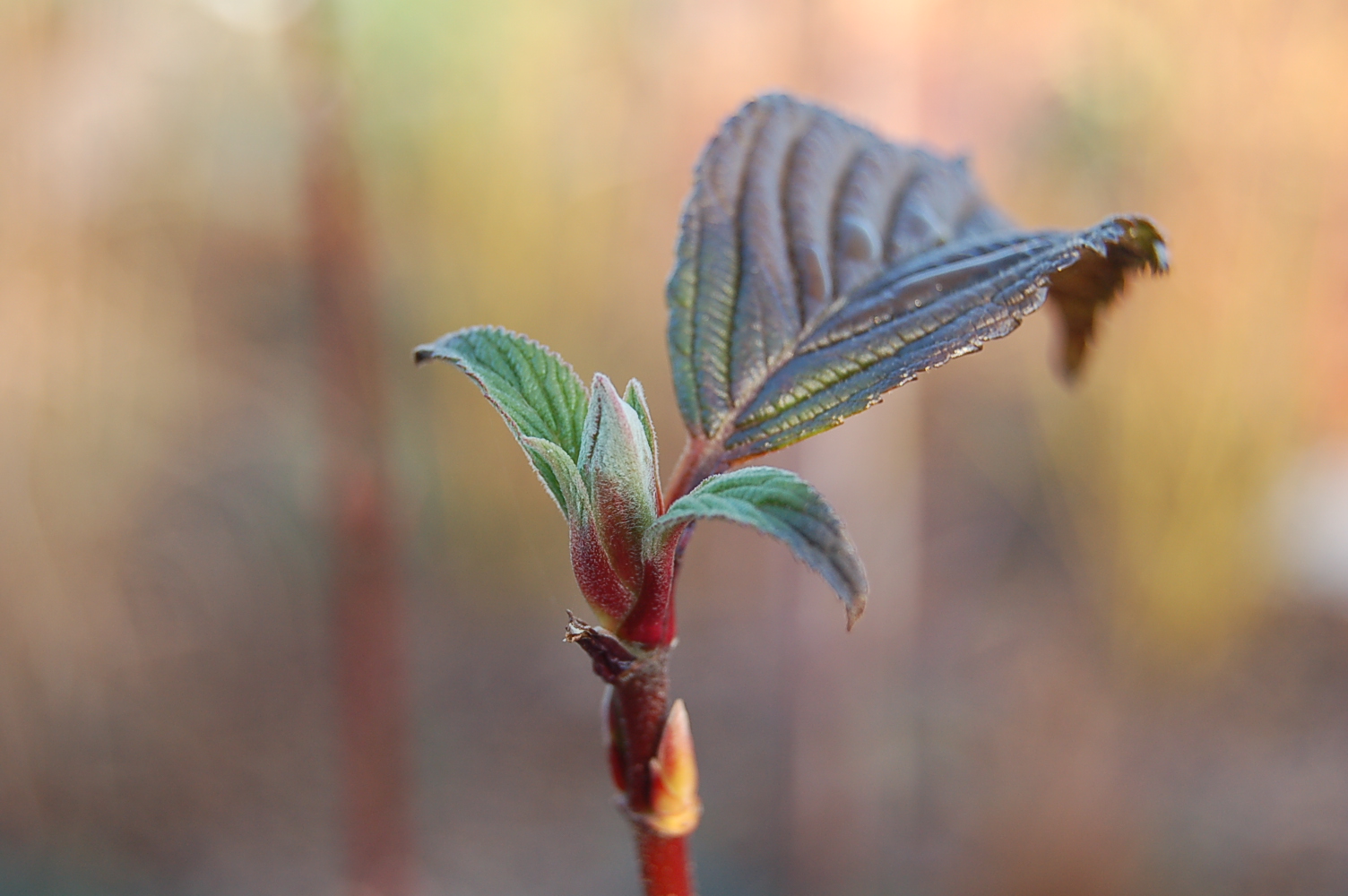
Winter sunlight through Miscanthus and Cornus.Stripes of fence shadows fall across a variegated holly.Blood red dogwood stems.Peeling bark like brittle toffee.Green flowered hellebore with striped shadows.Premature bud burst on Viburnum.Striped snake bark maple.
With so much to see after such a short time, we can but wonder at what our Winter Garden will bring us in the future. It was great fun creating it and judging from comments from plot holders it is already bringing much joy!
My blog reporting on “A January Wander around the Allotments” was all about the cold, as my wander then was on a bright, sunny but cold day with the thermometer registering minus five. Today my wander was a real treat, with temperatures of plus seven, it felt so mild. The sky however was grey and produced the occasional bout of drizzle. The bird life definitely appreciated the improvement, with so many to see and hear.
My walk over to our plot was halted by the whoosh of wings and the sight of a Kestrel in full hunting mode, its grey and rufus back curling low through the plots in search of its favourite prey, Field Voles. In a matter of a few minutes it had covered half the site, stopping occasionally to peer from a post or shed roof. The birdsong didn’t diminish with its presence but later when a Sparrow Hawk appeared, in threatening mode over the plots, silence reigned.
As I went to open up the shed I noticed how the recent freezing weather had shattered the little orange glazed dish I keep shells in on our coffee table, exposing the white china below its glaze.
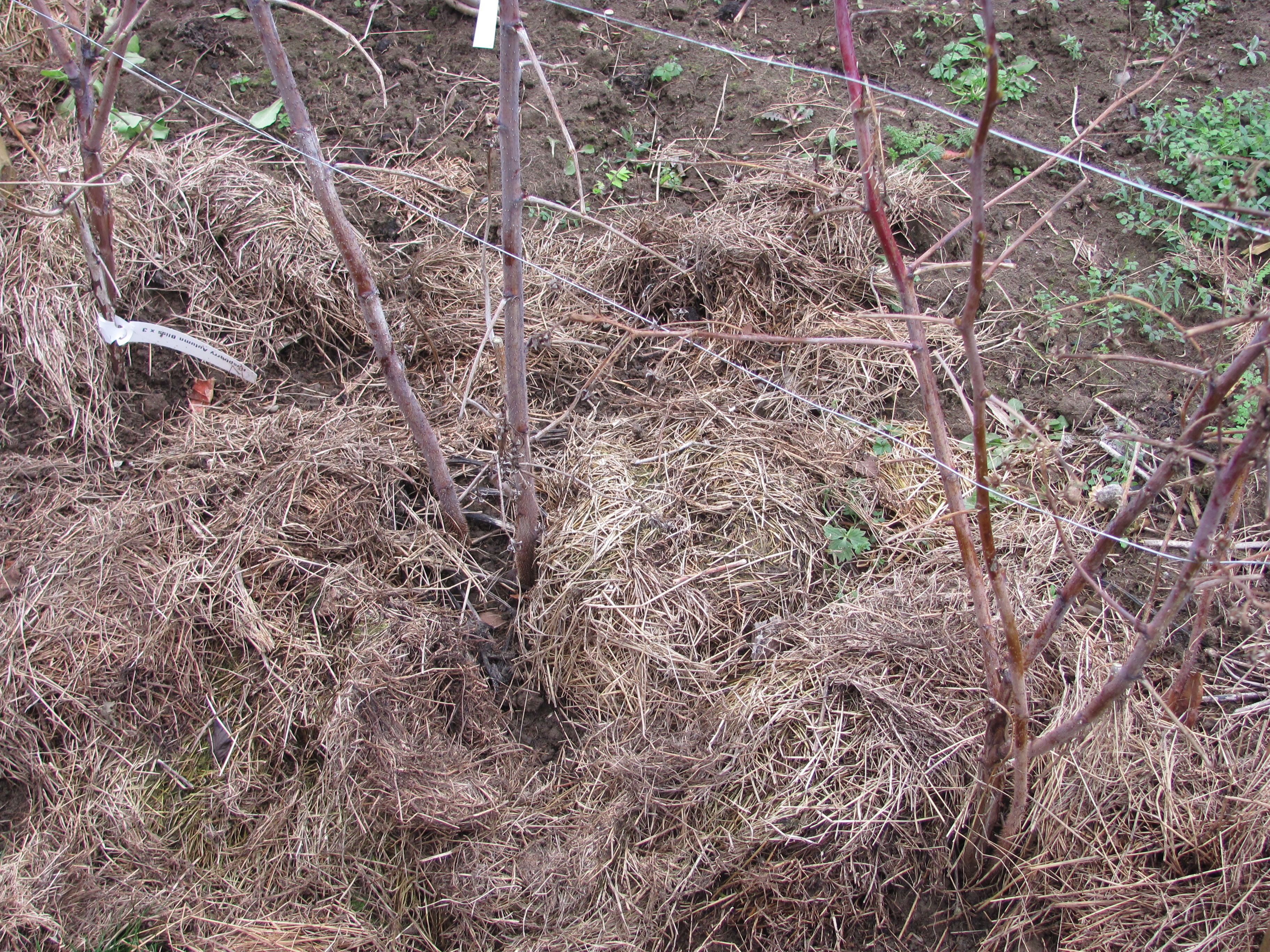
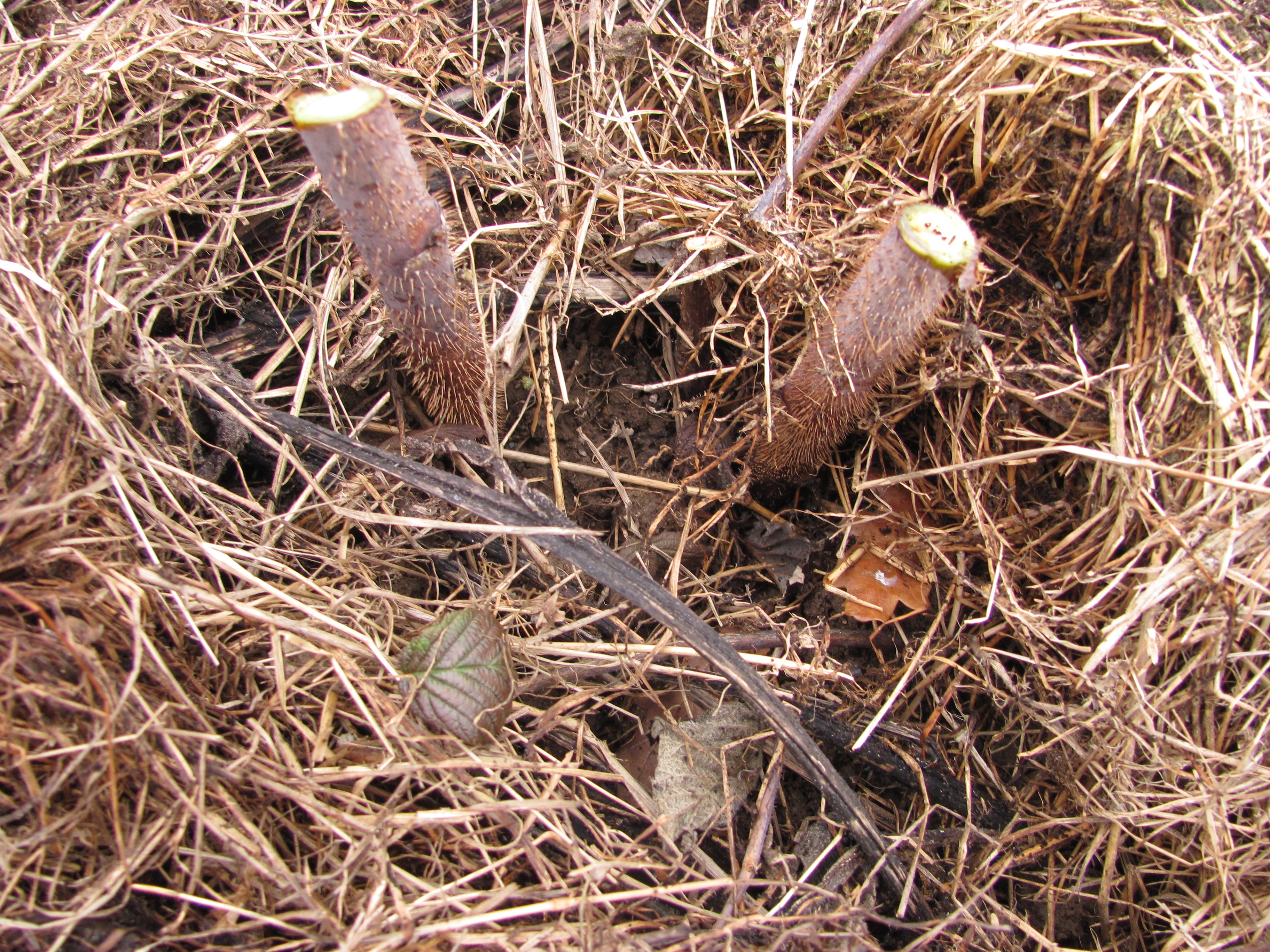
The feeders on our plot needed topping up before I set to work. My first task was to prune the Autumn fruiting raspberries, so pulled back their hay mulch and cut each stem down to just a few inches above the ground. Then their warm mulch blanket was replaced ready for the next cold spell.
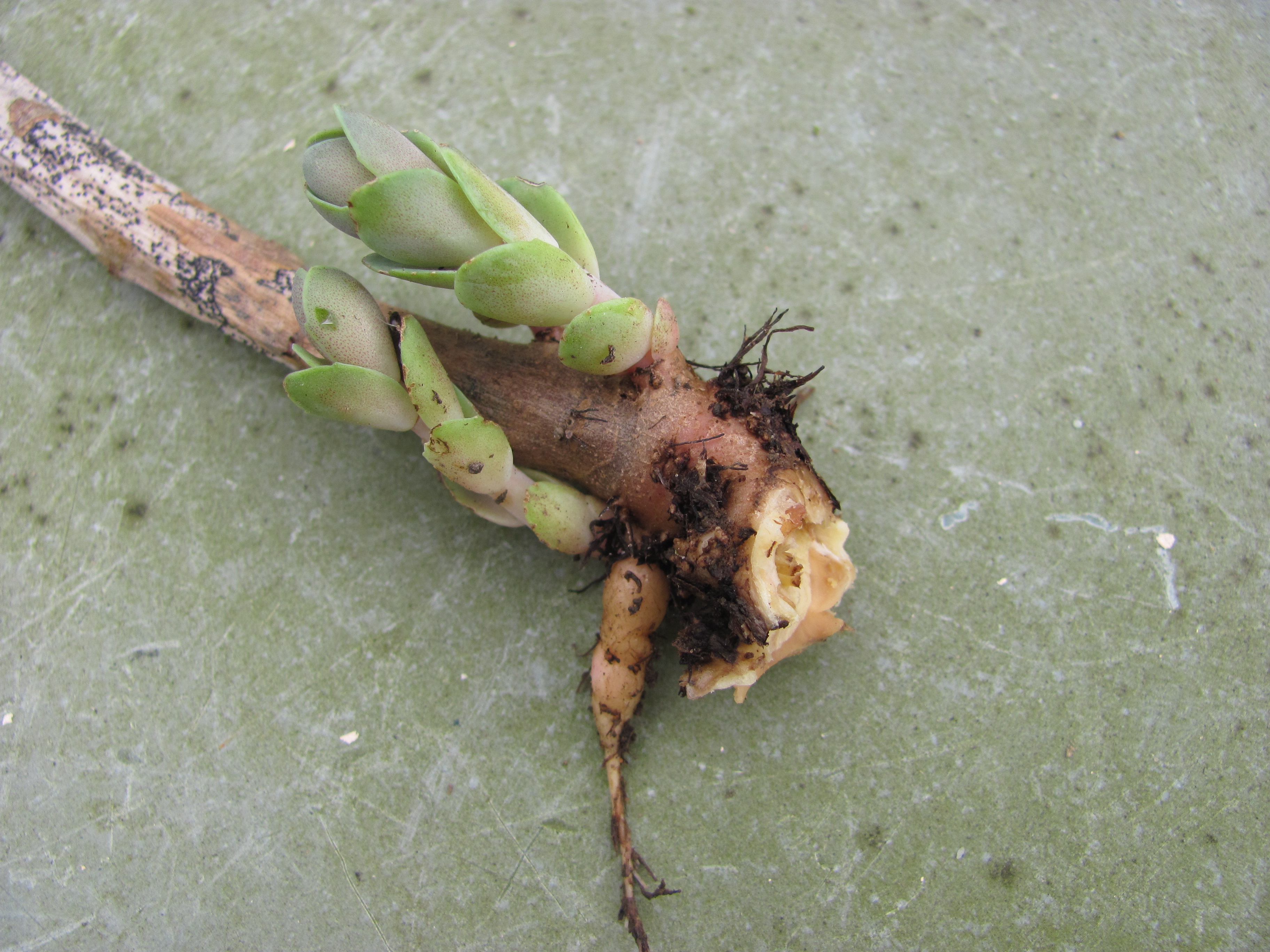
After tidying the edge of the plot where Calendulas had died down messily, I cut down perennials in the “Bug Border” alongside our central path, Sedum spectabile “Autumn Joy”, Linaria and several different Marjoram, all grown for the butterflies and hoverflies. As I pruned down the Sedum a few “slips” came away which I popped into my trug to be potted up at home.
A coffee break was called for to rest an aching back. A chance to do some bird spotting and listening out for their calls and songs. It was noticeable how some had moved on from calls to songs with the changing light of February. The Great Tit was giving a good performance repeatedly calling out “Teacher Teacher” just as it says in the books, but I often think it sounds more like the squeak of a tyre foot pump in need of lubrication. Its smaller cousin the Blue Tit sang gently from all around the site.
The peace was shattered as soon as the Rooks from the rookery on the northern boundary lifted as one and poured overhead, a cacophony of “cawing” and “rarking”. They are busy now restructuring last year’s nests. When one returned to the tree tops with twig in beak all its neighbours objected vocally craning their necks threatening and warning others to keep their distance. They live together in huge nesting groups but argue all the time! Their little corvid cousins, the Jackdaw, are quieter and more social. They pass overhead without any argument.
Signs of things to come! New growth is appearing at the base of perennials and the Globe Artichoke plants. Disappointingly the green manures have grown very little but just manage to cover the bare soil.
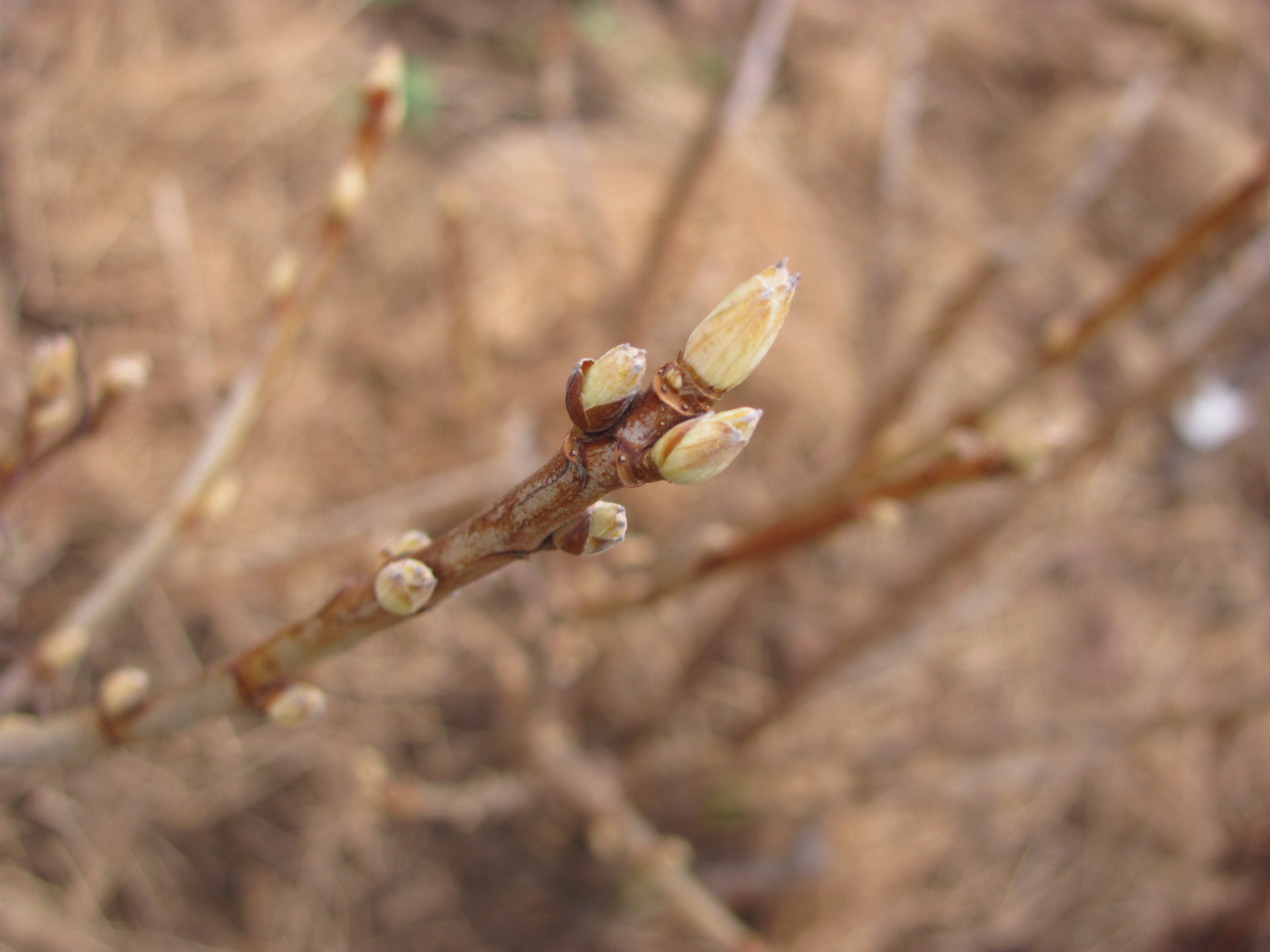
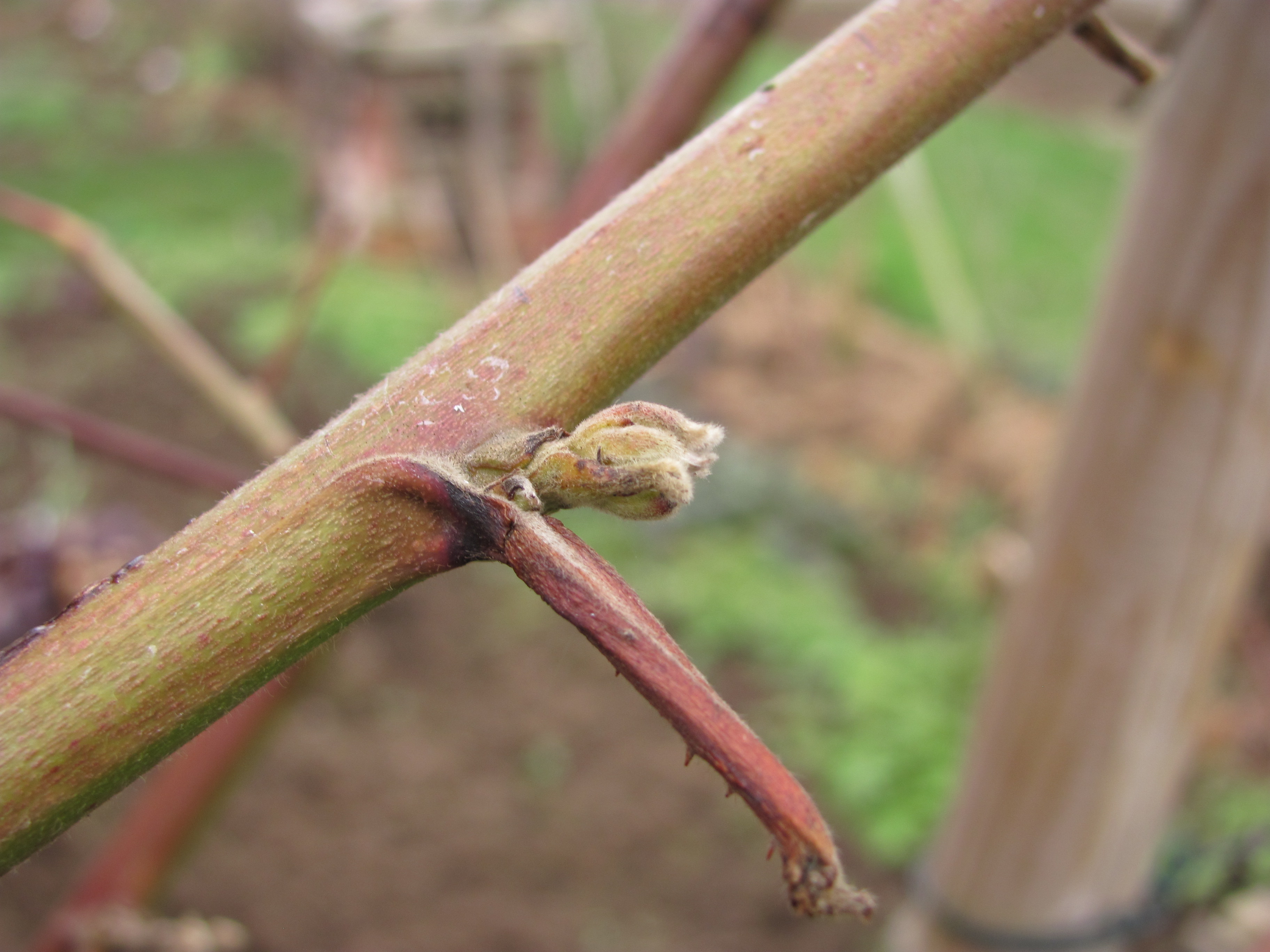
Buds are fattening on the Black Currants and the Blackberries. Promises of autumn bounty.
So once the work on our Plot 37 was completed I wandered off around the site, with wheelbarrow loaded – secateurs for pruning the roses in the Summer Garden, camera to take shots, surgical gloves and step-ladder to clear out nest boxes. As I walked along the established hedgerows flocks of chattering finches moved away, keeping close top the hedge and to each other – Goldfinches, Linnets and Greenfinches. A surprise sighting was a flock of about 15 Yellow Hammers, the first time they have been seen here. Unfortunately one of the loudest noises was the dry screech of my wheelbarrow’s wheel! A quick detour to the shed for a squirt of penetrating oil cured it.
Where the hedge has been left uncut for several years (where the council flailing machines can’t reach) the bushes are tall and busy with finches and tits. A Song Thrush was throwing leaves and under-hedge debris out onto the path searching for its lunch. The calls of Nuthatches and Great Spotted Woodpeckers echoed around the allotments all the time I was on site, but one call was unexpected. It stopped me in my tracks. I had never heard the piping call of a Bullfinch up here before. It wasn’t hard to find – a male with its pink, almost cerise breast glowing from a tall Hawthorn.
Nestbox cleaning can be a painful business if the nests have been colonised by nest fleas, hence the surgical gloves. Luckily none in residence today! Four of the five tit boxes had been used last year. The open-fronted Robin boxes were ignored by our population of redbreasts.
This photo shows how the Great Tits who nested here used their tails for added balance when feeding their young through the hole. The wood stain has been worn away.
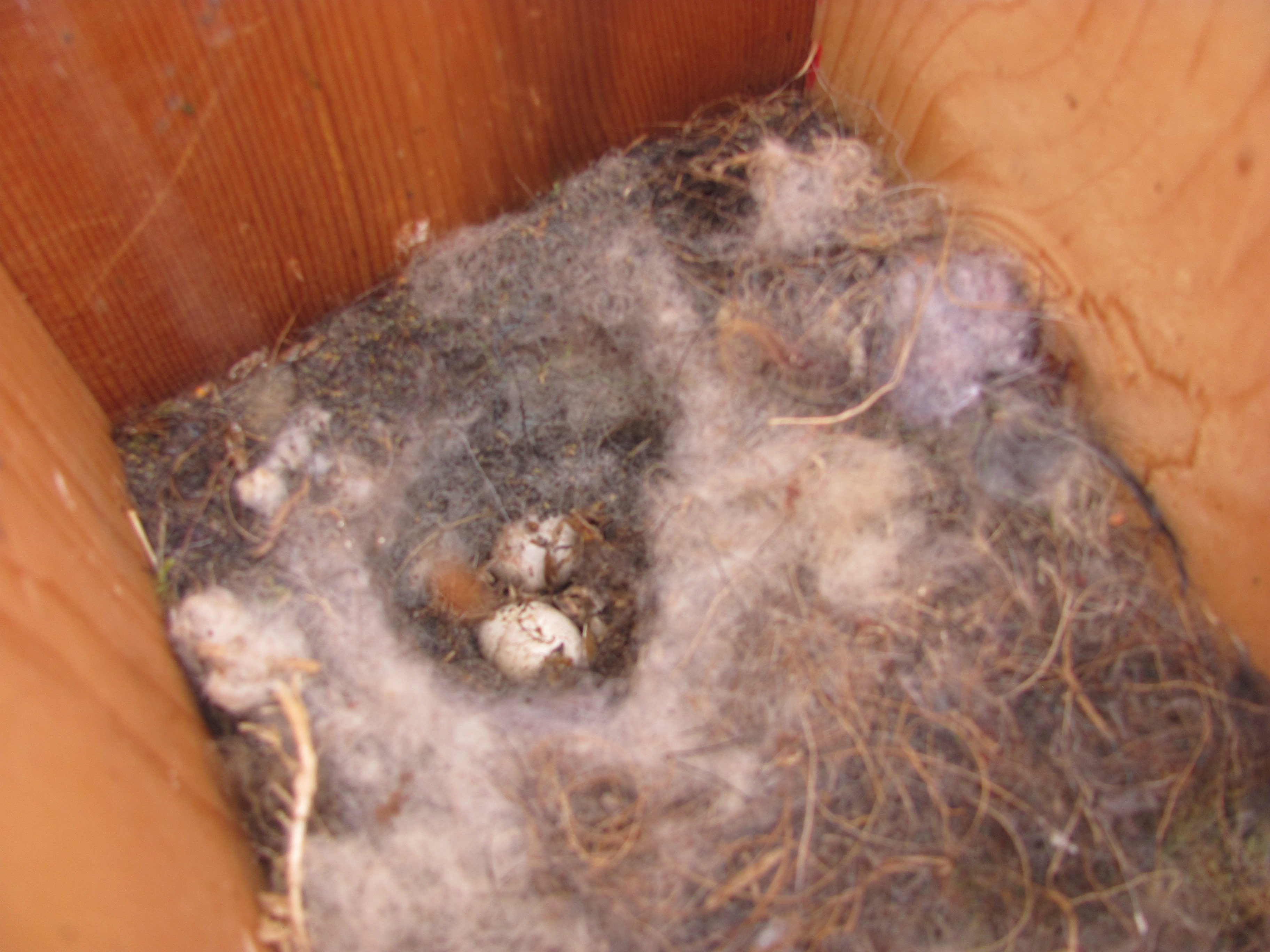
The box in the photo below was used three times in 2011, but the third attempt was thwarted by cold wet weather in the early autumn, so the clutch of eggs remains. When I emptied out the nesting materials I could see the three layers of nesting material. When I had emptied all the boxes the old nests were put in the compost heap.
In the meadow areas seedlings cover the ground, so our plan for self seeding meadows seems to be working out. In one meadow area a lone cornflower continues to throw up an odd bloom of the most beautiful blue.
'The most important and informative publication on wildlife of our times' - The Independent. This blog is a member of The UK & Ireland Natural History Bloggers group: www.uknhb.blogspot.com



























































 greenbenchramblings